AI search optimization services help brands get cited inside ChatGPT, Perplexity, and Google AI Overviews — not just ranked on page one. AI Overviews now appear on roughly 48% of tracked Google searches, up sharply year over year, so traditional SEO alone no longer guarantees visibility.
This guide explains what AI search optimization services actually include, how generative engine optimization (GEO) differs from classic SEO, platform-specific tactics, how to measure ROI, and the red flags that separate credible providers from hype.
AI search optimization services (GEO/AEO) help brands get cited inside ChatGPT, Perplexity, and Google AI Overviews instead of just ranking on page one. With AI Overviews now appearing on roughly 48% of tracked Google searches, structuring content for citation — not just rank position — has become essential for visibility in 2026.
What Are AI Search Optimization Services?
AI search optimization services are specialized marketing services that structure, optimize, and monitor a brand’s content so it gets cited, recommended, or summarized inside AI-generated answers — including Google AI Overviews, ChatGPT, Perplexity, and Gemini — instead of simply ranking among traditional blue links. They’re also commonly called generative engine optimization (GEO) or answer engine optimization (AEO).
Traditional SEO agencies compete for rank position. AI search optimization services compete to become the cited source inside an AI-generated summary — a related but genuinely different goal that calls for different tactics and different success metrics.
For background on how conventional ranking signals still feed into this process, see our guide on what SEO is and how it works. Google frames generative AI search as an extension of SEO rather than a full replacement, but the content patterns that earn citations — self-contained answers, cited statistics, and named authorship — differ enough from classic ranking factors that most agencies now treat GEO and AEO as a distinct discipline layered on top of an existing SEO foundation, not a swap for it.
Why Does AI Search Optimization Matter Right Now?
AI search optimization matters now because AI-generated answers increasingly replace the click. AI Overviews appear on roughly 48% of tracked Google search queries as of March 2026, and 89% of B2B buyers say they’ve used generative AI somewhere in their purchase research before ever reaching a vendor’s website.
This shift changes what “visibility” actually means in practice. A brand can rank well on page one and still lose the customer if a competitor is the one cited inside the AI answer sitting above those results. Our deeper breakdown of AI Overview optimization strategies covers the technical mechanics.
Compounding the urgency: AI-referred visitors convert roughly 4.4x higher than standard organic traffic, because they arrive already pre-qualified by a system that has effectively compared their options on their behalf before the click ever happens. Brands ignoring this shift aren’t just losing a few clicks — they’re losing the pre-purchase moment where buyer trust now gets decided.
How Is GEO Different from Traditional SEO and AEO?
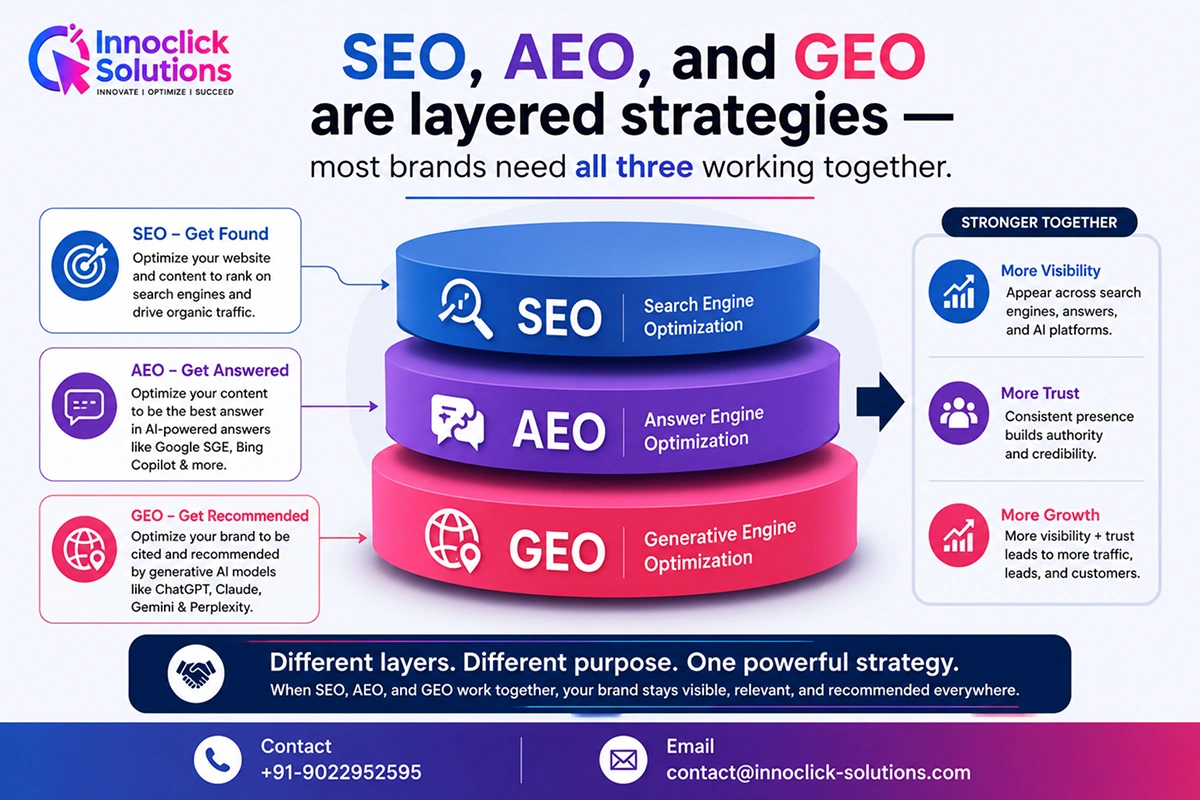
GEO, AEO, and SEO are layered disciplines, not interchangeable terms. SEO ranks pages in organic search results. AEO (answer engine optimization) structures content to win featured snippets and direct-answer boxes. GEO (generative engine optimization) focuses specifically on earning citations inside AI-synthesized responses from tools like ChatGPT and Perplexity. Most brands need all three working together, not one instead of the others.
| Strategy | Goal | Primary Platforms |
|---|---|---|
| SEO | Rank in organic search results | Google, Bing |
| AEO | Win direct-answer boxes | Featured snippets, voice search |
| GEO | Get cited inside AI-generated answers | ChatGPT, Perplexity, Gemini, AI Overviews |
A strong SEO foundation still matters here: a meaningful share of AI Overview citations also rank among a page’s existing top organic results, showing real overlap between classic rankings and AI-generated citations. GEO and AEO build on that existing foundation rather than replacing it outright, which is why a solid grasp of SEO versus SEM still matters before layering AI-specific tactics on top.
What Do AI Search Optimization Services Actually Include?
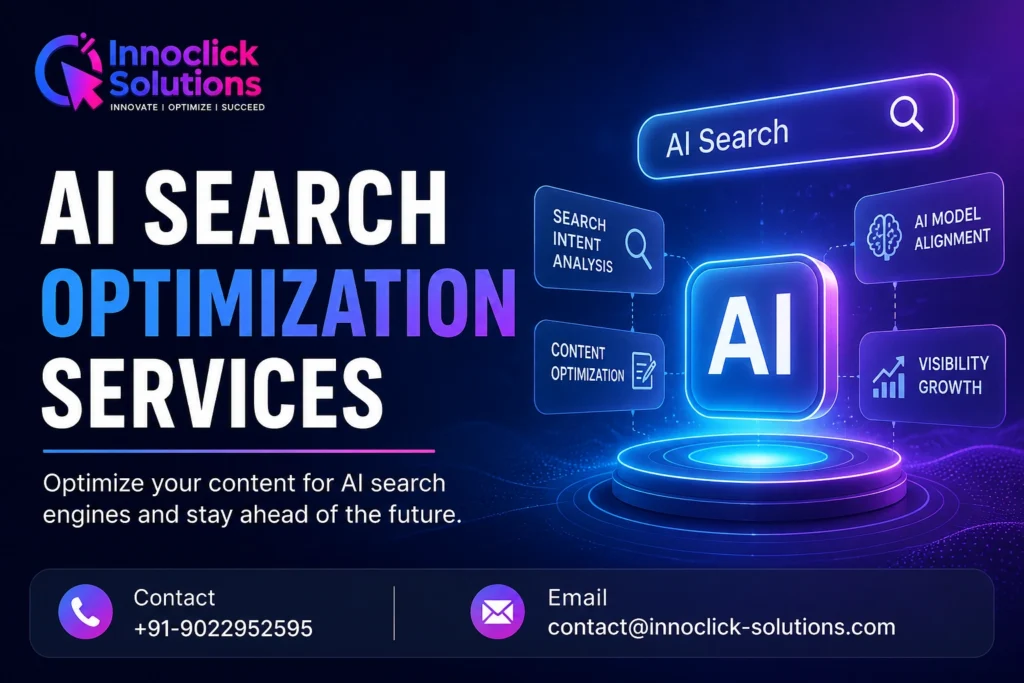
A typical AI search optimization retainer includes four components: content restructuring for citability (direct answers, cited statistics, named sources), technical access work (confirming AI crawlers can read the site), brand mention and entity building across third-party sites, and ongoing AI visibility tracking and reporting.
Content work means rewriting key pages so each section opens with a 40–60 word self-contained answer — the same compact format AI systems extract for their own summaries. Technical work confirms robots.txt allows GPTBot, ChatGPT-User, PerplexityBot, ClaudeBot, and Google-Extended, since most AI crawlers do not render JavaScript and will skip pages that depend on it.
Brand-building work pursues genuine mentions on Wikipedia, Reddit, G2, and relevant industry publications, since AI systems consistently cite third-party sources more than a brand’s own domain.
Reporting closes the loop by tracking citation rate, sentiment, and AI referral traffic in GA4 — a different scorecard than the one used to track traditional paid versus organic SEO performance.
How Should You Optimize for Different AI Platforms?
Each AI platform pulls from a different mix of sources, so tactics shift by platform. Google AI Overviews lean heavily on existing top-ranking pages. ChatGPT — responsible for the large majority of AI referral traffic — favors Wikipedia and Reddit. Perplexity leans on community discussion. Gemini draws primarily on Google’s own index and Knowledge Graph.
For Google AI Overviews, strong traditional rankings still matter most; passage-level structure and content freshness do the rest. For ChatGPT, presence in Wikipedia entries and Reddit threads carries more weight than your own domain’s authority alone.
For Perplexity, genuine, non-promotional participation in relevant subreddits and forums tends to outperform polished brand content. For Gemini and Copilot, technical SEO fundamentals and fast indexing through Bing’s IndexNow protocol remain foundational.
Multi-platform tracking matters because citation volume can vary enormously between engines for the same brand and query.
How Do You Measure ROI from AI Search Optimization?
ROI is measured through AI mention rate, citation sentiment, and AI referral traffic — not rankings alone. Start by manually testing 10–20 target queries across ChatGPT, Perplexity, and Google, logging whether your brand is cited and who else appears, then revisit that same query set monthly to track movement.
Connect citation tracking to business outcomes by isolating AI referral sessions in GA4 (chatgpt.com, perplexity.ai, gemini.google.com) and comparing their conversion rate against standard organic traffic; expect a meaningfully higher rate given how pre-qualified these visitors tend to arrive.
Realistic timelines: initial movement in branded AI Overview appearances within roughly six weeks; broader visibility across ChatGPT and Perplexity over three to six months; compounding authority effects after six to twelve months of consistent, fact-checked publishing.
Most brands skip this step — fewer than one in seven currently track AI search performance in any structured way, leaving a measurement gap competitors can quietly exploit.
Should You DIY AI Search Optimization or Hire an Agency?
DIY works when you already have in-house SEO expertise and content bandwidth; hiring makes more sense when you’re invisible in AI answers despite ranking well, or you compete in a crowded B2B, healthcare, or e-commerce niche. The deciding factors are internal expertise, available time, and competitive urgency.
In-house teams with strong existing SEO skills can often absorb GEO work themselves by restructuring high-value pages and tightening technical access for AI crawlers. Agencies earn their fee when a brand needs platform-specific strategy, ongoing multi-tool tracking, and digital PR for third-party brand mentions — work that’s genuinely hard to sustain alongside a full marketing calendar.
Before signing with any provider, work through our 10-factor checklist for choosing an SEO agency; most of the same transparency and reporting standards apply directly to GEO retainers.
What Red Flags Should You Watch for When Hiring an AI Search Optimization Provider?
Walk away from any provider promising “guaranteed AI rankings.” AI responses are non-deterministic by design, so guarantees of this kind simply aren’t credible. Other red flags: pitching an llms.txt file as a primary strategy, vague or evasive measurement methodology, and case studies built only on traditional traffic metrics rather than AI-specific ones.
A credible provider can explain exactly how they measure AI mention rate and citation sentiment, demonstrates platform-specific tactics instead of one generic playbook copied across every client, and treats brand mentions and digital PR as equally important to on-page content work. If a provider can’t answer “how do you actually know it’s working?” in plain language during the first conversation, that’s the clearest signal to keep looking elsewhere.
Conclusion
AI search is not a future trend — it’s already reshaping how buyers discover brands. AI search optimization services bridge the gap between where traditional SEO stops and where AI citations begin, helping brands build trust with buyers before a single website visit ever happens.
FAQ’s:
1. What is AI search optimization?
AI search optimization (also called GEO — Generative Engine Optimization) is the practice of structuring your content so platforms like ChatGPT, Google AI Overviews, and Perplexity cite or surface your site. It goes beyond traditional SEO by focusing on citability, entity signals, and how AI crawlers read your pages.
2. How to choose AI search optimization providers for e-commerce?
Look for providers who understand structured data, product schema, and passage-level content optimization. E-commerce sites need AI crawlers to reach product pages cleanly — so server-side rendering support and technical SEO capability matter as much as content strategy.
3. How do AI algorithms impact search rankings?
AI algorithms now decide whether your content gets cited inside an AI-generated answer, not just ranked on a results page. Google AI Overviews cover over 50% of queries. If your content isn’t structured for extraction — clear answers, specific data, short paragraphs — it gets skipped entirely.
4. What are the benefits of using AI for SEO strategies?
AI speeds up keyword clustering, content briefs, and competitive gap analysis — work that used to take days now takes hours. More importantly, AI-driven SEO lets you optimize for how answers are generated, not just how pages rank. That’s the difference between traffic and citations.
5. What will be the cost of AI search optimization packages?
Freelance GEO consultants typically charge $500–$2,500 per month for ongoing work. Agency packages run $1,500–$8,000 monthly depending on scope. One-time audits with recommendations start around $300–$1,000. SaaS tools that partially automate the process run $50–$400 per month.

Shivraaj Dhaygude is a Pune-based SEO Specialist with 7+ years of experience optimizing websites for Google search and AI-powered platforms like ChatGPT and Perplexity. As founder of InnoClick Solutions, he has worked with 60+ businesses across healthcare, real estate, and local services — helping them rank higher, generate more leads, and reduce dependence on paid ads. His SEO writing is based on real audit findings and client results.