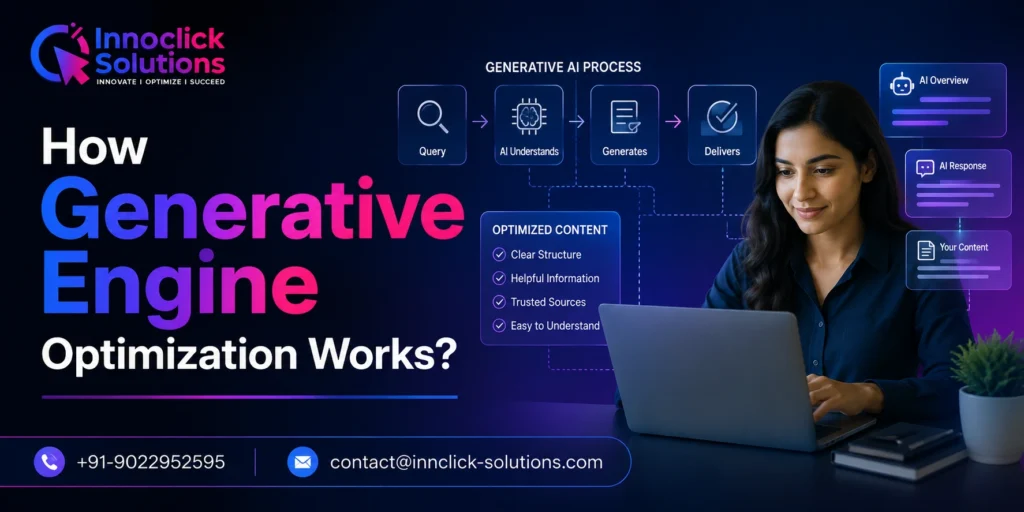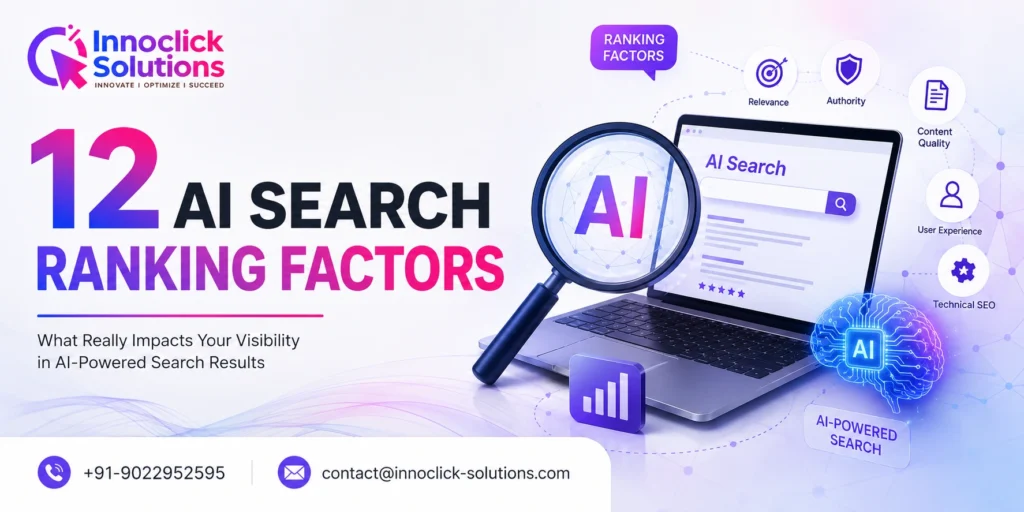

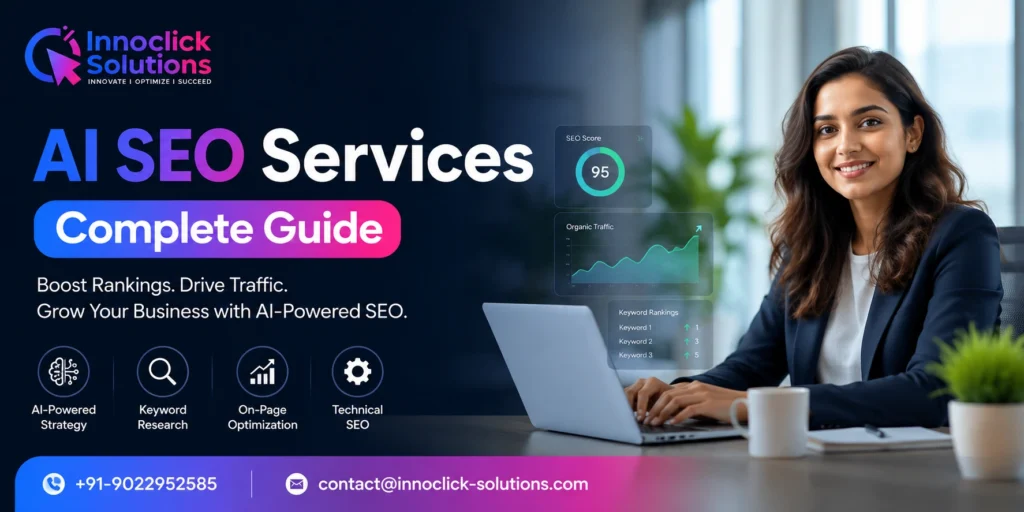

AI SEO services help your content get cited by AI tools like ChatGPT, Perplexity, and Google AI Overviews — not just ranked on Google. They focus on structuring pages so AI can extract direct answers, building authority through data and citations, and ensuring AI bots can actually crawl your site.
AI SEO services combine AI-powered SEO tools with optimization for AI search platforms like Google AI Overviews, ChatGPT, and Perplexity — a discipline called GEO (Generative Engine Optimization). Businesses that implement a structured AI SEO strategy covering intent mapping, content architecture, technical access, and AI visibility monitoring will earn citations in AI-generated answers and compound their search authority over time.
AI SEO services have redefined how businesses earn search visibility. Google AI Overviews now appear on approximately 48–50% of all US Google searches, and organic click-through rates drop by up to 58% when one does. Traditional SEO alone is no longer enough. This guide is a practitioner’s planning reference — by the end, you’ll know exactly what AI SEO services include, how to build a 7-step strategy, how to evaluate providers, and what to measure to prove it’s working.
Key Takeaways
- AI SEO services combine AI-powered tools (keyword automation, content generation) with optimization for AI search engines (GEO/AEO) — two distinct capabilities most buyers don’t realize are bundled.
- A working strategy requires intent mapping, content architecture, on-page extractability, technical readiness, and AI visibility monitoring working in parallel.
- 68% of AI citations come from third-party sources — earned media outweighs brand-owned pages for AI visibility.
- Success is measured through both traditional rankings AND AI citation rates — these are separate leaderboards with only 17–38% overlap.
- Businesses that invest in AI SEO now hold a compounding first-mover advantage as citation authority, like domain authority, builds over time.
What Are AI SEO Services?
AI SEO services refer to the combination of AI-powered optimization tools and strategies specifically designed to improve visibility across AI-driven search surfaces — including Google AI Overviews, ChatGPT, Perplexity, and Bing Copilot. Most providers bundle two distinct disciplines: using AI to perform SEO faster, and optimizing content so AI systems cite you as a source.
Understanding this distinction matters because the two require completely different tactics. The first is about efficiency — automating keyword research, content briefs, and technical audits with tools like Semrush or Ahrefs. The second is about earning citations in AI-generated answers — a discipline known as Generative Engine Optimization (GEO) and Answer Engine Optimization (AEO).
Most buyers don’t realize there’s a difference until they hire a provider and realize their “AI SEO” contract covers tools but not AI search visibility strategy. Knowing the distinction upfront protects your budget and your brief.
What’s Typically Included in AI SEO Services
- Keyword research automation — NLP-powered clustering, intent classification, and volume forecasting
- AI content strategy — Pillar and cluster mapping aligned to AI citation probability
- Technical SEO auditing — Core Web Vitals, crawlability, indexation health
- GEO/AEO optimization — On-page extractability, self-contained answer blocks, FAQ schema
- Schema markup implementation — Article, FAQPage, HowTo, and Organization structured data
- AI visibility monitoring — Citation tracking across ChatGPT, Perplexity, and AI Overviews
- Reporting — Both traditional ranking KPIs and AI citation rate metrics
How AI SEO Works?
AI SEO starts with data collection — crawling your site, pulling keyword and competitor data, and identifying gaps. AI then analyzes patterns across that data to prioritize what to fix first. From there, it assists with content creation, technical fixes, and monitoring — continuously learning from ranking changes to adjust the strategy.
Most people understand that AI SEO involves “using AI for SEO,” but the actual mechanics are less clear. Here’s how it works in practice, from start to ongoing optimization.
Step 1: Site crawl and data collection. AI-powered crawlers scan every page of your site — checking for broken links, crawl errors, duplicate content, missing metadata, slow-loading elements, and rendering issues. Tools like Screaming Frog or Sitebulb generate structured data about every URL. AI then flags which issues matter most for rankings, rather than leaving you with a list of 300 problems in no particular order.
Step 2: Keyword and competitor analysis. AI tools cluster keywords by search intent, volume, and difficulty — grouping related queries so you build topical authority rather than chasing individual terms. Competitor analysis maps which pages are ranking, what content structures they use, and where their backlink profiles are strong versus yours.
Step 3: Content gap identification. The AI compares your existing content against competitor coverage and target keyword clusters to surface what’s missing. This produces a prioritized list: high-volume topics you have no content for, existing pages targeting the wrong intent, and pages that cannibalize each other.
Step 4: AI-assisted content creation. AI tools generate content briefs with recommended word counts, headings, semantic keywords, and questions to answer. Some agencies use AI to draft first versions that human editors refine. For GEO optimization, the AI structures content into clearly citable blocks (134–167 words works best for AI Overview selection).
Step 5: Technical fixes. Based on the crawl data, technical SEO work begins: fixing broken pages, improving site speed, adding structured data (schema markup), optimizing image alt text, correcting robots.txt to allow AI crawlers like GPTBot and ClaudeBot, and — increasingly — adding llms.txt to help AI systems understand site structure.
Step 6: Monitoring and adjustment. AI monitoring tools track ranking changes, traffic shifts, and Core Web Vitals over time. When a Google core update drops, the AI identifies which pages lost visibility and what pattern they share — helping the strategy adjust faster than waiting for a monthly report.
The whole thing is iterative. Real AI SEO isn’t a one-time fix; it’s a feedback loop between data, changes, and results that improves over time.
Why Is Traditional SEO No Longer Enough for AI Search?
Traditional SEO is no longer sufficient because AI search platforms don’t just rank pages — they extract passages and generate answers, often without sending users to any website at all. AI Overviews appear on approximately 48–50% of US Google searches, and 58.5% of all searches already end without a single click.
The most important strategic shift: ranking ≠ being cited. Research shows that only 17–38% of AI-cited pages also rank in Google’s traditional top-10 organic results. This means a well-structured page on a mid-authority site can appear in an AI-generated answer while a higher-ranking competitor gets nothing.
Traditional SEO vs. AI SEO — What’s Different
| Dimension | Traditional SEO | AI SEO (GEO/AEO) |
|---|---|---|
| Primary Goal | Rank on SERP | Get cited in AI-generated answers |
| Key Signal | Backlinks + on-page | Brand mentions + passage citability |
| Content Unit | Full page | Self-contained passages (40–167 words) |
| Platforms | Google (primarily) | Google AIO, ChatGPT, Perplexity, Copilot |
| Success Metric | Rankings + organic traffic | AI citation rate + share of AI voice |
| Technical Focus | Crawlability, Core Web Vitals | AI crawler access, schema markup, llms.txt |
The correct framing: AI SEO amplifies traditional SEO — it doesn’t replace it. Since 92% of Google AI Overview citations come from pages that already rank in the top 10, a strong SEO foundation remains essential.
Why Businesses Need AI SEO Services?
Search is changing faster than most businesses can keep up with manually. AI Overviews, ChatGPT web search, and Perplexity now answer queries directly — before users even reach your site. Businesses need AI SEO services because traditional SEO tactics alone don’t address these new visibility channels or the scale of modern content demands.
Most business owners still think about SEO the way it worked five years ago: rank on page one, get clicks. That model still works, but it’s no longer the complete picture.
The traffic landscape shifted. Google’s AI Overviews appear on more than half of all queries. When that happens, users often get their answer without clicking anything. The click-through rate on standard blue links drops sharply. If your content isn’t in the AI Overview, you’re invisible for those queries — even if you rank #2 organically.
ChatGPT and Perplexity are now real referral sources. SparkToro reported 527% growth in AI-referred sessions from January to May 2025. That’s not a rounding error. Businesses that optimize for these platforms early are building visibility their competitors don’t have yet.
Content volume expectations increased. Google’s quality standards have risen, competitors are publishing more, and user expectations for depth and accuracy are higher. An in-house team writing three blog posts a month isn’t going to compete in most verticals without AI-assisted production.
Technical SEO is more complex. Core Web Vitals, JavaScript rendering, structured data, hreflang, IndexNow, llms.txt — the technical checklist grew significantly in the last two years. AI SEO tools catch issues faster and at greater depth than manual audits.
Competition isn’t slowing down. While you’re reading this, someone in your industry is using AI to produce more content, audit their site more thoroughly, and capture AI search visibility you haven’t thought about yet.
None of this means you need AI SEO immediately regardless of business size. A local plumber with 50 pages doesn’t have the same urgency as a national e-commerce brand with 50,000. But for any business where organic search drives meaningful revenue, the cost of falling behind is now measurable in real time.
Which AI SEO Services Does Your Business Actually Need?
It depends on your site’s biggest gap. If you’re losing traffic, start with a technical audit. If you’re not appearing in AI Overviews, you need GEO optimization. If competitors outrank you on content, you need AI-assisted content strategy. Most businesses need a combination, but the right starting point varies by situation.
“AI SEO services” covers a lot of ground, and buying the wrong thing wastes time and money. Here’s how to figure out what your business actually needs.
Start with diagnosis, not services. Before buying anything, understand where your traffic is coming from, where it’s dropping, and what your competitors are doing differently. A quick audit — even a free one from tools like Ahrefs Site Audit, Semrush, or Screaming Frog — tells you more than any sales pitch.
Technical AI SEO is the foundation. If your site has crawl issues, indexation problems, slow Core Web Vitals, or JavaScript-heavy rendering that blocks AI crawlers, nothing else works well. Fix the technical layer first. This is particularly important if your content is rendered client-side — AI crawlers don’t execute JavaScript, so they may not see your pages at all.
GEO optimization (Generative Engine Optimization) is for businesses that want visibility in AI Overviews, ChatGPT, and Perplexity. This means structuring content into clear 134–167 word self-contained answer blocks, using question-based headings, adding specific statistics with sources, and allowing AI crawlers in your robots.txt. If you’re in a competitive informational niche, this matters now.
AI-assisted content strategy makes sense if you’re trying to scale content production, improve topical authority, or compete on long-tail keywords. AI tools can generate content briefs, cluster keywords by intent, and score content against top-ranking competitors — faster than doing it manually.
Local AI SEO is for businesses serving specific geographic markets. This includes Google Business Profile optimization, local schema markup, citation consistency, and map pack ranking — increasingly important as AI search surfaces local results differently than traditional SERP.
What most small-to-medium businesses actually need:
A technical audit first. Then content gap analysis. Then GEO optimization if AI-generated search results appear for their target queries. Skip the expensive enterprise tools until the fundamentals are solid.
What are the benefits of AI SEO Services?
AI SEO services speed up keyword research, content auditing, and rank tracking — tasks that used to take days now take hours. They surface patterns humans miss in large datasets, scale content operations without scaling headcount, and adapt faster to algorithm changes. The real benefit is doing more with less guesswork.
Traditional SEO has always been data-heavy work. You’re juggling keyword volumes, competitor gaps, backlink profiles, crawl errors, and content performance — across hundreds or thousands of pages. AI tools don’t replace the thinking behind SEO, but they handle the data crunching faster and more consistently than any human team can.
Here’s where AI actually changes things in practice:
Scale without proportional cost. A three-person team using AI SEO tools can audit and optimize a 10,000-page site in a fraction of the time it would take a 10-person team working manually. Programmatic content, automated internal linking, and bulk meta description generation are genuinely faster with AI.
Pattern detection at depth. AI catches things humans skim past — thin content clusters, cannibalization across subcategories, pages that rank for the wrong intent. These aren’t obvious in a spreadsheet but become clear when an AI model maps the full picture.
Faster response to algorithm updates. Google’s core updates shift ranking signals without warning. AI monitoring tools detect traffic drops correlated with update dates and flag which page types or content patterns appear affected — often within 24–48 hours instead of weeks.
Better content targeting. Modern AI SEO tools analyze top-ranking pages for a query and identify what’s actually driving rankings: structure, word count, semantic coverage, entity mentions. That removes a lot of the guesswork from content briefs.
GEO readiness. AI Overviews now appear on 50%+ of queries, and ChatGPT web search is growing fast. AI SEO services increasingly cover visibility in these channels — not just traditional Google rankings. That’s a benefit traditional SEO agencies often can’t offer yet.
The catch: AI SEO tools still need a human to set strategy, evaluate output, and catch hallucinated recommendations. They amplify good SEO judgment; they don’t replace it.
Who Needs AI SEO Services?
Any business where organic search drives traffic or leads. That includes e-commerce brands, SaaS companies, local service businesses, publishers, and B2B companies. The urgency scales with competition — a highly competitive niche needs AI SEO now; a low-competition local market can afford to move slower.
The honest answer is: most businesses that care about organic search will benefit from some form of AI SEO. But the urgency, scope, and type of service varies significantly by business model.
E-commerce. If you sell products online, you’re competing on thousands of category pages, product descriptions, and comparison queries. AI SEO helps with programmatic content at scale, product schema, and SERP feature capture. AI Overviews now show product comparisons and recommendations directly in search — being cited there is a real traffic driver.
SaaS and B2B. These businesses live and die on informational and commercial-intent content. Blog posts, comparison pages, use-case pages — all of it feeds the top of the funnel. AI SEO accelerates keyword research, content production, and topical authority building. ChatGPT web search is increasingly where B2B buyers research tools, so GEO matters here.
Local service businesses. Plumbers, dentists, lawyers, contractors — local businesses need AI SEO too, though the scope is smaller. The priority is Google Business Profile optimization, local citation consistency, and appearing in AI-generated local results. A surprisingly large percentage of local queries now trigger AI Overviews with local intent.
Publishers and content sites. If your business model depends on ad revenue or affiliate income from organic traffic, you’ve probably already felt the impact of AI Overviews reducing click-through rates. AI SEO for publishers means restructuring content for citability — getting featured in AI Overviews rather than losing traffic to them.
Who can wait? Early-stage startups with no content foundation yet, businesses in genuinely low-competition niches, and companies where organic search isn’t a meaningful revenue channel. If you’re just starting out, basic on-page SEO fundamentals matter more than sophisticated AI tooling.
The common thread: if organic search is part of your growth model, AI SEO isn’t a nice-to-have much longer. The gap between businesses using it well and those not using it at all is growing month over month.
AI SEO Pricing
AI SEO services range from $500/month for basic tool access to $10,000+/month for full-service agency retainers. Pricing depends on site size, scope (technical, content, local, or GEO), and whether you’re buying software or paying for human-led strategy backed by AI tools. Most businesses land between $1,500–$5,000/month.
Pricing for AI SEO varies more than almost any other digital marketing service, because “AI SEO” gets used to mean three quite different things: pure software subscriptions, AI-assisted agency retainers, and everything in between.
Software-only tier ($50–$500/month)
Tools like Surfer SEO, Semrush AI features, NeuronWriter, or RankIQ fall here. You’re getting AI-assisted content scoring, keyword clustering, and SERP analysis. You still do the work — the AI helps you work faster and smarter. Good for in-house SEOs who already know what they’re doing.
Hybrid retainer ($1,500–$5,000/month)
An agency uses AI tools to deliver more — more content, more audits, more pages optimized per month — but human strategists own the direction. This is the most common model for small-to-mid businesses. You’re paying for the human judgment, and the AI is what makes the volume possible.
Full-service AI SEO agency ($5,000–$15,000+/month)
Enterprise sites, competitive verticals, or businesses needing full GEO optimization alongside traditional SEO typically land here. These retainers usually include technical audits, content production, AI Overview optimization, and regular strategy calls.
Project-based pricing ($2,000–$10,000)
One-time audits, site migrations, or AI SEO strategy documents fall here. Useful if you want a clear picture of what to fix before committing to an ongoing retainer.
What actually drives the price:
- Number of pages on the site
- Target market competitiveness
- Local vs. national vs. international targeting
- Whether GEO/AI Overview optimization is included
- Content production volume
One thing worth noting: some agencies charge premium prices just for adding “AI” to their service names without meaningfully changing how they work. Ask any prospective agency what specific tools they use, what AI actually does in their process, and how they measure results.
What Are the Most Common AI SEO Mistakes to Avoid?
- Treating AI SEO as entirely separate from traditional SEO — GEO amplifies SEO; it doesn’t replace it
- Blocking AI bots in robots.txt — If GPTBot or PerplexityBot are blocked, those platforms cannot cite you
- Gating all content behind forms — AI engines can’t access gated content; your most authoritative work must be open
- Ignoring third-party presence — 68% of AI citations come from earned media, not your own domain [3]
- No freshness signals — Undated content loses to dated content because AI systems weight recency heavily
- Keyword stuffing — This actively reduces AI visibility; the Princeton GEO research found it has negligible or negative effects on AI rankings [4]
- Hiding pricing or details behind “contact us” walls — AI agents evaluating your product on behalf of buyers cannot parse what they cannot read
- No AI visibility monitoring — You can’t improve what you don’t measure; at minimum, run a manual citation audit monthly
How to Choose the Right AI SEO Agency?
Look for agencies that show their process, not just their results. Ask what specific AI tools they use, how they measure success beyond traffic, and what they’ve done for businesses like yours. Avoid agencies that can’t explain what “AI” actually does in their workflow or promise rankings within a set timeline.
The AI SEO agency space is noisy. A lot of agencies added “AI-powered” to their websites in 2024 without changing much about how they work. Separating serious agencies from marketing-dressed-up-as-AI takes a few specific questions.
Start with the process conversation. A good AI SEO agency should be able to walk you through exactly what happens in month one, month three, and month six. What gets audited first? Who writes the content strategy? How do they handle technical SEO? If the answer is vague (“we use AI to optimize your site”), that’s a red flag.
Ask about specific tools. Legitimate AI SEO agencies use a stack: Semrush or Ahrefs for keyword data, Surfer or Clearscope for content optimization, Screaming Frog or Sitebulb for technical audits, and increasingly tools for GEO analysis and AI crawler monitoring. If they can’t name their tools or refuse to, keep looking.
Check for GEO competency. Ask whether they optimize for AI Overviews, ChatGPT, and Perplexity — not just traditional Google rankings. Most agencies that are genuinely current on AI SEO will have a clear answer here. Those still treating SEO as purely a Google game are behind the curve.
Scrutinize case studies. Request case studies from businesses in your industry or with similar site structures. Traffic increases are good; revenue or lead increases tied to organic search are better. Ask what happened after algorithm updates — how did they respond, and how quickly?
Watch the promises. No legitimate agency promises a specific ranking within a specific timeframe. Google’s algorithm has too many variables. Agencies that guarantee “page one in 90 days” are either selling something, or they’re planning to use tactics that backfire.
Pricing as a signal. The cheapest option almost never delivers meaningful results. But the most expensive doesn’t either — without the right fit. Mid-range agencies ($2,500–$6,000/month for SMBs) with a transparent process and verifiable results are usually the better bet than marquee names charging 3x as much.
The right agency feels like a team extension, not a vendor. If the first sales call is about closing the deal rather than understanding your business, that tells you something.
How Do You Build Keyword Intent and AI Search Alignment?
Effective AI SEO starts by mapping search intent to the AI platforms that serve each intent type. Informational queries trigger Google AI Overviews at the highest rates — Pew Research found AI summaries appeared in 60% of queries beginning with “who,” “what,” “when,” or “why”. Commercial investigation queries are dominated by ChatGPT and Perplexity, where users explicitly ask for recommendations and comparisons.
Practical Alignment Template
Test your top 15–20 target queries across Google, ChatGPT, and Perplexity. For each query, record: Does an AI answer appear? Who is cited? What page of theirs is being cited? This baseline audit reveals where competitors hold AI citation positions and where you have an uncontested opportunity.
Map keywords to intent types and assign the AI platforms most likely to surface answers for each. Your keyword strategy should include platform-specific targets, not just search-volume targets.
How Does Content Architecture Drive AI Citation Probability?
Content architecture for AI SEO is built on a pillar-and-cluster model. AI engines favor sites that demonstrate topical authority across a complete subject — not single optimized pages. A well-structured hub-and-spoke system, where a pillar page covers a broad topic and cluster pages go deeper on subtopics, signals comprehensive authority to both traditional search algorithms and AI citation systems.
For your AI SEO services cluster, the pillar is this guide. Cluster pages should include: what is GEO, how GEO works, GEO vs SEO, AI search ranking factors, and platform-specific optimization guides.
Content Formats That Get Cited Most by AI
- Comparison articles — ~33% of AI citation share
- Definitive guides — ~15% citation share
- Original data / research — ~12% citation share
- How-to guides — ~8% citation share
Prioritize comparison articles and definitive guides first. These are the formats AI engines consistently reach for when generating answers to commercial and informational queries.
How Do You Write Content That AI Engines Can Extract?
AI-extractable content follows a single core principle: AI systems extract passages, not pages. Every key claim must work as a standalone statement — fully meaningful without the surrounding sentences. This is the fundamental reframe from traditional content writing.
The optimal structure for every H2 section: open with a direct, declarative 40–60 word answer. Then expand with 150–250 words of context, examples, and data. This mirrors the architecture AI systems use when generating responses — they pull the cleanest, most self-contained answer block available.
The AI Content Checklist (Before Publishing)
| Check | Why It Matters |
|---|---|
| Direct definition in first paragraph | Triggers definition-extraction by AI engines |
| Self-contained answer blocks (40–167 words) | Extractable without surrounding context |
| Statistics with named sources | Increases AI citability by up to 40% [4] |
| Question-based H2/H3 headings | Matches how people phrase queries to AI |
| Comparison tables for “X vs Y” queries | ~33% of AI citation share [4] |
| FAQ section | Direct extraction source for AI answers |
| Schema markup (FAQ, HowTo, Article) | 30–40% higher AI visibility with schema |
| Author attribution with credentials | E-E-A-T signal required for AI trust |
| Visible “last updated” date | AI systems weight content freshness heavily |
What Technical SEO Readiness Does AI Search Require?
Technical AI SEO involves three non-negotiable actions: allowing AI crawlers in your robots.txt, implementing schema markup across priority pages, and ensuring content is server-side rendered so AI bots can read it.
The major AI crawlers you must allow are: GPTBot and OAI-SearchBot (OpenAI/ChatGPT), PerplexityBot, ClaudeBot (Anthropic), and Google-Extended (Gemini/AI Overviews). Blocking any of these in robots.txt prevents that platform from citing you — a silent visibility kill. For a comprehensive breakdown of how each platform selects sources, see our guide on AI search ranking factors.
Schema Types That Boost AI Visibility
| Schema Type | Use Case | AI Impact |
|---|---|---|
| Article / BlogPosting | All long-form content | Author, date, topic identification |
| FAQPage | Q&A sections | Direct Q&A extraction |
| HowTo | Step-by-step guides | Step extraction for process queries |
| Organization | Brand entity | Entity recognition and trust |
Pages with three or more schema types show a 13% higher AI citation probability. Implement Article schema on this post as a minimum, and FAQPage schema on every FAQ block.
How Do You Monitor AI Search Visibility and Measure Results?
AI visibility monitoring tracks whether your brand appears in AI-generated answers — a metric that doesn’t show up in Google Search Console, Google Analytics, or any traditional SEO dashboard. This is the most overlooked capability in most AI SEO engagements.
The core metrics to track monthly: AI Overview presence for your target queries, brand citation rate across ChatGPT and Perplexity, share of AI voice vs. competitors, and referral traffic from AI sources in GA4 (filter by perplexity.ai, chat.openai.com, gemini.google.com).
AI Visibility Monitoring Tools
| Tool | Best For | Cost |
|---|---|---|
| Otterly AI | Share of AI voice tracking | Paid |
| Peec AI | Multi-platform citation monitoring | Paid |
| LLMrefs | SEO keyword → AI visibility mapping | Paid |
| Manual monthly audit | Top 20 queries across 3 platforms | Free |
For teams not ready to invest in paid tools, run a manual audit monthly: pick your top 20 queries, run each through ChatGPT, Perplexity, and Google, document who gets cited and from which page, and track changes month-over-month in a spreadsheet.
Conclusion
AI SEO services represent the next mandatory layer of search strategy for any business that depends on organic visibility. Google AI Overviews now reach 2 billion monthly users globally, and AI-referred traffic grew 600% in a single year. The businesses building AI citation authority today will be the ones AI systems recommend by default in 2027 and beyond. Start with a manual AI citation audit of your top 20 queries, fix your robots.txt, and apply the content architecture and on-page extractability framework from this guide.
Ready to build your AI search visibility? Explore our AI SEO and GEO services or contact the Innoclick Solutions team for a free AI visibility audit.
FAQ’s:
Q1. What are AI SEO services?
AI SEO services combine AI-powered SEO tools (keyword automation, content generation) with optimization strategies for AI search platforms like Google AI Overviews, ChatGPT, and Perplexity — a discipline called Generative Engine Optimization (GEO). Most providers bundle both capabilities; buyers should confirm which is included.
Q2. How do AI SEO services differ from traditional SEO?
Traditional SEO optimizes for page-level rankings in search results. AI SEO services optimize for passage-level citation in AI-generated answers. Key differences: AI SEO requires self-contained answer blocks, question-based headings, AI crawler access in robots.txt, and separate citation-rate monitoring that doesn’t appear in standard SEO dashboards.
Q3. How long does it take to see results from AI SEO services?
Most businesses see measurable AI citation improvements within 60–90 days of implementing on-page extractability changes, schema markup, and robots.txt fixes. Brand citation authority (from third-party mentions) builds over 3–6 months. AI visibility monitoring tools make before/after comparison straightforward.
Q4. What is the most important ranking factor for AI search?
Fact density is the highest-impact optimization signal for AI search. Research from Princeton (KDD 2024) found that including authoritative citations, statistics, and quotations can boost AI visibility for lower-ranked sites by up to 40%. Structural clarity (question-based headings, direct answer blocks) is the second most impactful factor.
Q5. Should small businesses invest in AI SEO services?
Yes. AI search partially levels the playing field because AI engines evaluate passage-level quality, not just domain authority. A well-structured, directly answerable content block on a regional or smaller site can be cited over a shallow answer on a high-authority national domain — making AI SEO services viable and high-ROI for SMBs.


Shivraaj Dhaygude is a Pune-based SEO Specialist with over 6+ years of hands-on experience helping local businesses dominate Google Search and AI-powered results. He specializes in Local Pack optimization, Google AI Overview visibility, and Generative Engine Optimization (GEO) — an emerging discipline focused on appearing inside AI-generated search answers.
Shivraaj has personally led SEO campaigns for 50+ SMBs across Pune and Maharashtra, consistently delivering top-3 local pack rankings and measurable increases in organic leads. His approach combines technical SEO foundations with AI search readiness strategies, giving clients a competitive edge as search evolves.
He writes about local SEO, GEO, and AI search trends based on real client data and ongoing experimentation — not theory.