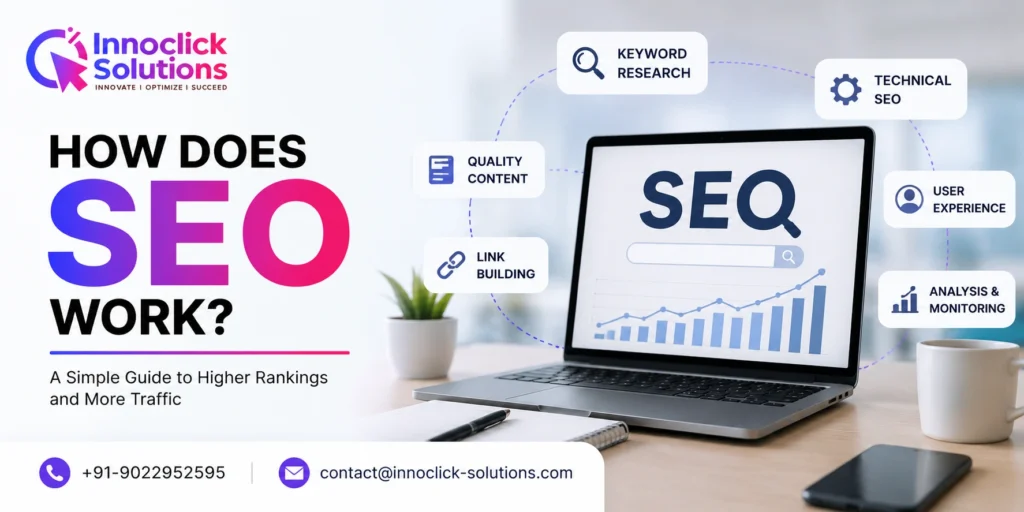
SEO works by guiding search engines through three stages — crawling, indexing, and ranking — to surface your website for relevant searches. Google’s crawlers discover your pages via links, store them in its index, then score them against hundreds of signals including content relevance, backlinks, technical health, and user experience to decide which pages rank. Every day, Google processes roughly 8.5 billion searches, yet 75% of users never scroll past page one — making it critical for any website to understand and apply SEO fundamentals before a competitor does.
Search Engine Optimization (SEO) is the practice of improving a website’s visibility in unpaid search engine results by aligning its content, structure, and authority with what search algorithms reward. It spans three core disciplines — technical (how search engines crawl and index your site), on-page (how well your content matches user intent), and off-page (how other sites and signals vouch for your authority). Done well, SEO turns search engines into a compounding traffic channel that grows over time without paying for every click.
SEO works by helping search engines crawl, index, and rank your website for relevant searches. Google evaluates your content quality, keywords, backlinks, technical health, and user experience to decide your ranking. By optimizing these elements, your site earns higher visibility in organic search results — without paying for ads.
Understanding how SEO works is the first real step toward getting your website to show up on Google — and it’s simpler than most people think. Every day, Google processes roughly 8.5 billion searches, yet the top three organic results capture the overwhelming majority of clicks. If your website isn’t on page one, most of your potential customers will never find you.
In this guide, you’ll get a clear, practical breakdown of how search engines actually work, which ranking signals carry the most weight in 2026, and what steps to take first — whether you’re a complete beginner or exploring whether to bring in a professional SEO service provider to accelerate the process.
Quick Summary
- SEO improves organic (unpaid) visibility in search results — unlike paid ads, its effects compound over time.
- Search engines rank pages through three stages: crawling, indexing, and ranking.
- Google evaluates content relevance, backlinks, technical health, and user experience together.
- There are three core types of SEO: on-page, off-page, and technical.
- New sites typically take 6–12 months; established sites can rank new pages in 3–6 months.
- AI Overviews are reshaping how people search — structure your content to be extractable, not just rankable.
- Working with an experienced SEO expert can shortcut the learning curve for local businesses.
Key Facts:
- Google processes an estimated 8.5 billion searches every day
- 75% of users never scroll past page 1 of Google results
- The #1 organic result captures an average CTR of roughly 22–27.6%, depending on the study
- Pages with more high-quality backlinks consistently outrank thinner-linked pages of similar content quality
- Sites meeting Core Web Vitals benchmarks are significantly more likely to rank in top positions
- 46% of all Google searches carry local intent
- New websites typically need 6–12 months to build ranking authority; established sites can rank new content in 3–6 months
- AI Overviews now appear on a meaningful and growing share of informational searches, making structured, citable content more important than ever
What Is SEO?
SEO is the process of improving a website’s visibility in search engine results to attract more organic, non-paid traffic. It involves optimizing content, keywords, technical elements, and backlinks so search engines can easily understand, index, and rank your pages for relevant searches.
Why Is SEO Important?
SEO puts your website in front of people who are already searching for what you offer. Without it, you’re invisible on Google — no matter how good your product is. Organic search drives over 53% of all website traffic, making it the single largest channel most businesses have.
Think about your own behavior. When you need something, you Google it. So does everyone else. About 8.5 billion searches happen on Google every single day, and the top three results get roughly 54% of all clicks. Position 10 gets around 2.5%. If you’re not on page one, you’re basically not there.
What makes SEO different from just “having a website” is intent. People arrive through search already wanting something — information, a product, a service. That’s a fundamentally warmer audience than someone who saw a banner ad while scrolling.
There’s also the compounding effect. A well-ranked page keeps pulling traffic for months or years without you paying per click. That’s very different from ads, where traffic stops the moment your budget runs out.
For AI search, the stakes are climbing fast. Google’s AI Overviews now reach 1.5 billion users monthly across 200+ countries, and over 50% of queries trigger one. If your content isn’t structured to be cited by AI answers, you’re losing visibility in a channel that didn’t exist three years ago.
How Does SEO Work & Why Is It Important?
Search engines crawl your site, index its content, and rank pages based on relevance and authority. SEO is the practice of making those signals stronger — better content, cleaner code, more credible links — so Google ranks you higher for searches that matter to your business.
Google’s process has three stages, and understanding them changes how you think about SEO.
Crawling is Google sending bots (called Googlebot) to discover pages. They follow links across the web. If a page has no links pointing to it, it may never get crawled. If your robots.txt accidentally blocks the crawler, you disappear entirely — a surprisingly common mistake.
Indexing is Google storing and analyzing what it found. Not everything gets indexed. Thin pages, duplicate content, slow-loading pages — Google may decide they’re not worth keeping. If a page isn’t indexed, it can’t rank.
Ranking is where the real complexity lives. Google runs on hundreds of signals to decide which indexed page best answers a given query. The major ones: content relevance (does your page actually answer the question?), backlinks (do credible sites link to yours?), technical quality (does the page load fast and work on mobile?), and E-E-A-T — Experience, Expertise, Authoritativeness, Trustworthiness.
For AI search, there’s a fourth consideration now. AI Overviews don’t just rank pages — they extract passages and synthesize answers. Your content needs to be structured so specific paragraphs are self-contained and citable. Optimal passage length for AI citation sits around 134-167 words.
How Is SEO Different from Paid Search?
SEO earns traffic through rankings; paid search buys it through ads. SEO takes months to show results but produces traffic that persists after you stop spending. Paid search delivers immediate visibility but disappears the moment your budget runs out.
Both show up on the same Google results page. That’s where the similarity ends.
Speed. Paid search (Google Ads, also called PPC or SEM) goes live today. You set a budget, write an ad, and traffic starts flowing. SEO is a 3-12 month project depending on your domain’s age and authority.
Cost structure – With paid search you pay per click (CPC). Average CPCs vary wildly — competitive industries like insurance or legal can run $50-100 per click. With SEO, you pay for labor (content, technical work, link outreach) but the clicks themselves are free. The economics flip over time: SEO gets cheaper per visitor as rankings hold; paid traffic stays at market rate forever.
Visibility type – Ads appear at the top of results and are labeled “Sponsored.” A meaningful percentage of users skip them on purpose. Organic results feel more neutral — there’s a trust differential.
Control – Paid search lets you target very specific queries, geographies, times of day, and audience segments. You can turn it off instantly. SEO gives you much less precise control over when and for what you appear, but more durable results.
Best practice – They work better together than apart. Paid search covers competitive keywords while you’re building organic authority. SEO reduces long-term dependence on ad spend. Many mature businesses use paid search for bottom-funnel keywords and SEO for everything upstream.
For AI search, this distinction is evolving again. There’s no “paid placement” in AI Overviews (yet). Everything in those answers is earned — through content quality, authority, and citability. That levels the playing field in some ways and raises the stakes of SEO.
Why SEO Matters for a Business?
SEO reduces customer acquisition costs over time. Unlike ads that stop the moment you stop paying, organic rankings keep generating leads. For most businesses, organic search is the highest-converting, lowest-cost channel at scale — which is why companies invest in it heavily.
Here’s the financial reality most businesses eventually discover: paid search is renting traffic, SEO is owning it.
When you run Google Ads, every click costs money. Stop paying and traffic drops to zero immediately. SEO works differently. A page that earns a top ranking through good content and backlinks keeps pulling visitors for months — sometimes years — without incremental cost. The ROI compounds in a way that paid channels can’t match.
There’s also a trust angle. Studies consistently show that users trust organic results more than ads. A significant portion of searchers deliberately skip paid listings and scroll to organic results. Being there signals credibility.
For local businesses, the calculus is even sharper. When someone searches “plumber near me” or “best dentist in [city],” they’re ready to buy. Appearing in those results — especially in Google’s local map pack — can drive a substantial chunk of revenue. And appearing in AI Overviews for those same queries is becoming just as valuable.
Small businesses without SEO budgets often find themselves stuck: they can’t afford to run ads forever, and they have no organic foundation to fall back on. Companies that invest in SEO early build an asset. The others are always paying to rent someone else’s audience.
Why Does SEO Matter for Any Website?
SEO matters because it drives free, high-intent traffic, builds credibility, and delivers a better long-term return than paid ads. Sites that rank well are seen by users as more trustworthy, which increases both clicks and conversions.
- Higher visibility — appear in front of people actively searching for what you sell
- More traffic — attract visitors without paying per click
- Better ROI — SEO compounds over months and years; ad spend stops the moment you stop paying
- Brand trust — ranking higher is itself a credibility signal to users
- Local reach — for businesses in specific areas, SEO puts you in Google Maps and Local Pack results
How Do Search Engines Work? The 3-Step Process
Search engines discover content by crawling links, store it through indexing, then rank it using hundreds of signals when someone searches. The whole process from crawl to ranking decision happens in milliseconds — but the preparation behind it takes constant, ongoing work on your site.
There are three stages, and a problem at any one of them breaks everything downstream.
Stage 1 — Crawling
Googlebot is essentially a browser that follows links. It starts from known URLs, follows every internal and external link it finds, and maps the web constantly. Your crawl budget matters: large sites with thousands of pages need to ensure Googlebot isn’t wasting time on low-value pages (thin content, duplicate URLs, paginated archives). Robots.txt controls what the crawler can access. Accidentally blocking key pages is more common than you’d think.
Stage 2 — Indexing
After crawling, Google processes each page: extracts content, understands structure, identifies entities and relationships, evaluates quality signals. Pages that don’t make the cut — thin content, duplicate pages, very slow loads — may be crawled but not indexed. A page that isn’t indexed can’t rank, full stop. You can check indexation via Google Search Console’s URL Inspection tool or the site: search operator.
Stage 3 — Ranking
When someone searches, Google retrieves relevant indexed pages and runs a ranking algorithm across hundreds of signals. Major factors include semantic relevance (does the content match query intent, not just keywords?), E-E-A-T signals (is this content from a credible source?), backlink authority (what does the web’s link graph say about this page’s importance?), Core Web Vitals (does the page load fast and feel stable?), and freshness (for time-sensitive queries, when was this content last updated?).
For AI-generated answers (Google AI Overviews, Bing Copilot), there’s now a fourth layer: passage extraction. The system doesn’t just pick which page is best — it pulls specific paragraphs that directly answer the query. Content needs to be chunked into self-contained answer blocks to win here.
What Ranking Factors Does Google Actually Look At?
Google weighs hundreds of signals, but they cluster into five practical categories: relevance, authority, technical health, user experience, and trust. Getting the fundamentals right in each category matters more than chasing any single “hack.”
| Ranking Factor | What It Measures | Difficulty to Control |
|---|---|---|
| Content relevance & keywords | How well your content matches search intent | Easy |
| Backlinks & domain authority | How many credible sites vouch for you | Hard |
| Technical health (speed, mobile, Core Web Vitals) | How well your site performs technically | Medium |
| User experience signals (CTR, dwell time) | Whether users are satisfied after clicking | Medium |
| E-E-A-T | Whether Google trusts your expertise and authority | Hard |
Content Relevance and Keyword Signals
Google matches your content against what the searcher is actually trying to accomplish, not just the literal words typed. Content that directly answers the query — with the right keywords used naturally — has the best chance of ranking.
Backlinks and Domain Authority
Backlinks act as votes of confidence: the more credible sites that link to yours, the more Google trusts your content. According to Moz’s link-building research, pages with more high-quality backlinks consistently outrank pages with fewer links, even at similar content quality.
Technical Health (Site Speed, Mobile-Friendliness, Core Web Vitals)
Google uses mobile-first indexing, meaning it primarily evaluates your site’s mobile version. Sites that meet Core Web Vitals benchmarks — covering loading speed, interactivity, and visual stability — are significantly more likely to rank for competitive keywords.
User Experience Signals (CTR, Dwell Time, Pogo-Sticking)
When users click a result and immediately return to Google (“pogo-sticking”), it signals the page didn’t satisfy their intent. Google interprets sustained engagement — longer time on page, fewer immediate back-clicks — as evidence the page delivered real value.
E-E-A-T: Why Does Google Trust Some Sites More Than Others?
E-E-A-T stands for Experience, Expertise, Authoritativeness, and Trustworthiness — the framework Google’s quality raters use to judge content creators. Sites that show real author credentials, cite credible sources, and demonstrate first-hand experience earn more trust than anonymous or thin content.
What Are the 3 Types of SEO — and What Does Each One Do?
The three main types are on-page SEO (content and keywords), off-page SEO (backlinks and authority signals), and technical SEO (site structure, speed, and crawlability). Most SEO problems trace back to one of these three areas — often technical issues that quietly undermine everything else.
On-page SEO covers everything you directly control on a page. Title tags, meta descriptions, headings, content quality, keyword use, internal linking. The goal is to make each page clearly relevant to a specific query while being genuinely useful to the person reading it.
Google’s E-E-A-T guidelines matter here: Experience, Expertise, Authoritativeness, Trustworthiness. Pages that demonstrate real knowledge by people with real credentials rank better than generic content.
Off-page SEO is everything that happens outside your website. Backlinks are the biggest signal — links from authoritative sites act as votes of confidence. A link from the BBC or a major university carries far more weight than one from a random directory. But it’s not just links.
Brand mentions, reviews, social signals, and presence on platforms like Wikipedia, Reddit, and YouTube all feed into how authoritative Google considers you to be. For AI search specifically, brand mentions now correlate 3x more strongly with AI citation than backlinks do.
Technical SEO is the foundation everything else rests on. Fast load times, mobile responsiveness, proper crawlability, correct use of canonical tags, structured data (schema markup), XML sitemaps, a clean robots.txt. You can have brilliant content and a great backlink profile, but if Google can’t crawl and index your site properly, none of it matters.
Technical SEO also now includes AI accessibility — whether AI crawlers like GPTBot and ClaudeBot can reach your content, and whether your pages render server-side (AI crawlers don’t execute JavaScript).
What are the benefits of SEO?
SEO builds lasting organic traffic, reduces paid ad dependency, increases brand credibility, and produces compounding returns over time. The biggest practical benefit: people find you while already searching for what you sell — so they convert at higher rates than almost any other channel.
The benefits are real, but they come with a timeline attached. SEO is not fast. Most campaigns take 3-6 months to show meaningful results. Anyone promising overnight rankings is selling something else. That said, when it works, it works in ways that paid traffic can’t match.
Traffic that doesn’t stop when your card gets charged – Organic rankings have staying power. A well-optimized page on a strong domain can hold position for years.
Higher conversion rates – Search intent is purchase intent. Someone searching “buy running shoes size 10” is further down the buying journey than someone who just saw your Instagram ad.
Compounding authority – The more quality content you publish, the more internal links you can build, the more topical authority you accumulate. A site that publishes consistently for two years has a structural advantage over one that just started — even with similar backlink counts.
Visibility in AI answers – Google’s AI Overviews, ChatGPT search, and Perplexity are increasingly the first thing people see before they click anything. If your content gets cited in those answers, you’re visible even when users don’t click through. Brand recall and trust build anyway.
Reduced cost per acquisition over time – The monthly cost of SEO (content, technical maintenance, link building) typically falls while traffic grows. Ads have a flat or rising CPC. The crossover point where SEO becomes cheaper per customer than paid ads usually happens around month 12-18.
How to Measure SEO Success?
Track organic traffic growth, keyword rankings, click-through rate, conversion rate from organic, and backlink acquisition. Rankings alone mean nothing — what matters is whether SEO traffic is growing, converting, and contributing to revenue.
The biggest mistake in measuring SEO: treating rankings as the end goal.
Ranking #1 for a keyword nobody searches is worthless. And ranking #3 for a high-intent keyword that converts at 5% is worth a lot. Rankings are an input, not an outcome.
Here’s what actually matters:
Organic traffic (sessions and users) – This is your baseline health check. Use Google Search Console — it’s free and shows you exactly which queries are sending traffic, which pages they land on, and how click-through rate is trending. Google Analytics 4 shows what happens after they arrive.
Click-through rate (CTR) – A page ranking in position 2 with a 12% CTR is outperforming a page in position 1 with a 7% CTR. A weak title tag or meta description might be the problem.
Conversions from organic – In GA4, set up goal completions or purchase events segmented by
organic traffic. This tells you if SEO traffic is actually doing anything commercially useful.
Keyword position tracking – Tools like Ahrefs, Semrush, or Google Search Console show position changes over time. Watch for sudden drops — they often signal a Google algorithm update hit your site.
Backlink growth – Track referring domain count (not raw backlink count, which can be inflated). Slow, steady growth from relevant sites is healthy. A sudden spike from low-quality sites is a red flag.
Core Web Vitals – Google uses INP (Interaction to Next Paint), LCP (Largest Contentful Paint), and CLS (Cumulative Layout Shift) as ranking signals. Google Search Console’s Core Web Vitals report shows which pages are failing field data thresholds.
How Long Does SEO Take to Work?
SEO is a compounding, medium-to-long-term investment, not an instant switch. New websites typically need 6–12 months to build enough authority to rank competitively, while established sites with existing authority can often rank new content in 3–6 months.
Realistic Timelines for New vs. Established Sites
A brand-new domain has no backlink history and no trust signals, so early months go toward technical setup, content foundation, and initial link building. An established site with existing authority can publish a new page and see it rank within weeks to a few months, because Google already trusts the domain.
Why Is SEO a Long-Term Investment (Not a Switch)?
Unlike paid ads, SEO gains don’t disappear the day you stop spending — rankings built on genuine authority and quality content tend to hold and compound. That’s why most businesses treat SEO as an ongoing program rather than a one-time project.
What Are the Common SEO Mistakes to Avoid?
The most damaging SEO mistakes are blocking crawlers, publishing thin content, ignoring technical issues, and targeting keywords without checking search intent. Most sites have at least one critical technical error silently killing organic visibility — and most don’t know it.
Most SEO mistakes aren’t obvious. They’re quiet. The site looks fine, pages load, everything seems normal — but Google can’t properly crawl, index, or rank the content. Here are the ones that hurt most:
Blocking your own site – A misconfigured robots.txt or a “noindex” meta tag left over from development can wipe out organic traffic overnight. Always verify using Google Search Console’s Coverage report.
Publishing content that doesn’t match search intent – You might rank briefly for a keyword, then drop because users bounce immediately. If someone searches “best CRM software,” they want a comparison — not a product page for your CRM. Format mismatch between what
people expect and what you deliver tanks engagement signals.
Ignoring Core Web Vitals – Since 2021, Google uses real-world page experience data as a ranking factor. A site that loads slowly, shifts layout while loading, or responds sluggishly to interaction gets penalized. INP (Interaction to Next Paint) is the current metric to watch — it replaced FID.
Thin or duplicate content – Pages with very little original content or that substantially duplicate other pages on your site confuse Google about which version to rank. Canonical tags fix some of this, but the real fix is writing content that actually adds value.
Targeting keywords with no search volume – Keyword research matters. A technically perfect page for a query nobody searches is wasted effort.
No internal linking – Internal links distribute authority across your site and help Google understand your content hierarchy. Sites that treat every page as an island leave a lot of ranking potential unused.
Skipping structured data – Schema markup helps Google (and AI crawlers) understand what your content is about — a recipe, a product, a review, an FAQ. Sites without schema miss out on rich results and have lower AI citability scores.
Blocking AI crawlers – With AI Overviews growing fast, blocking GPTBot, ClaudeBot, or PerplexityBot from your robots.txt cuts your visibility in AI-generated answers. Most sites block these accidentally, often inheriting a blanket “block all bots” directive.
The fastest way to find what’s wrong: run a crawl of your own site with a tool like Screaming Frog, check Google Search Console’s Coverage and Core Web Vitals reports, and read your robots.txt carefully. Most sites find something fixable within the first hour.
How Are AI Overviews and AI Search Changing SEO in 2026?
AI-generated answers now appear for a large and growing share of informational searches, sometimes satisfying the searcher’s question without a click to any websitef. This shift — often called GEO (Generative Engine Optimization) — means content also has to be structured for extraction by AI systems, not just ranked by traditional algorithms.
What Do Google’s AI Overviews Mean for Organic Traffic?
Even a #1 ranking can now generate fewer clicks if an AI Overview answers the query directly above it. Businesses that rely purely on ranking position — without adapting content structure — risk losing visibility even while “winning” the traditional SEO game.
How Do You Optimize for Both Traditional Results and AI Summaries?
Write clear, self-contained answer blocks near the top of each section, back claims with cited statistics, and use descriptive headings that match how people phrase questions. Content structured this way tends to perform well in both classic rankings and AI-generated summaries.
How Do You Start Doing SEO? Your First 5 Steps
You don’t need to master every ranking factor before you begin — you need one clear starting sequence. Here’s the practical path most beginners should follow:
- Find keywords your audience is searching for – Start with terms your customers actually type, not internal jargon.
- Optimize your on-page elements – Fix title tags, meta descriptions, headings, and internal links.
- Publish helpful, high-quality content – Answer real questions better than what’s currently ranking.
- Build backlinks from reputable sources – Earn links through genuinely useful content, partnerships, and outreach — avoid shortcuts like link farms.
- Monitor your progress with Google Search Console – Track what’s ranking, what’s clicked, and where technical issues appear.
If steps 1–5 feel like a lot to manage alongside running a business, many SMBs choose to hire an experienced SEO service provider in PCMC rather than DIY-ing the entire process — particularly for the technical and link-building steps, which tend to have the steepest learning curve.
Conclusion
SEO works through a repeatable cycle: crawling → indexing → ranking, with Google consistently rewarding relevant, technically sound, trustworthy pages. It’s a long game, but one worth starting today — the businesses ranking well a year from now are the ones building their foundation right now.
FAQ’s:
Q1. What is SEO in simple terms?
SEO (Search Engine Optimization) is the process of improving a website so search engines like Google rank it higher in organic, unpaid results. It combines content optimization, technical fixes, and authority building through links. The goal: when someone searches a relevant term, your site appears near the top instead of a competitor’s.
Q2. How long does SEO take to show results?
Most websites see measurable SEO results within 3–6 months, with significant traffic and ranking gains typically appearing between 6–12 months. Timeline depends on site age, competition level, and content/link-building consistency. New websites or highly competitive industries (legal, finance) often take longer — sometimes 12+ months — before rankings translate into real organic traffic.
Q3. What’s the difference between SEO and paid ads?
SEO earns organic (unpaid) traffic by improving rankings in natural search results — slower to build, but it keeps generating traffic without ongoing spend. Paid ads (PPC) buy placement at the top of search results instantly, but traffic stops the moment you stop paying. Most effective strategies use both: ads for immediate visibility, SEO for compounding long-term growth.
Q4. What are the 3 main types of SEO?
The three main types are on-page SEO (optimizing content, keywords, and HTML elements on individual pages), technical SEO (site speed, crawlability, indexing, and structure), and off-page SEO (backlinks, brand mentions, and external authority signals). All three work together — strong content alone can’t rank without a technically sound, authoritative site behind it.
Q5. Do I need an SEO agency, or can I do it myself?
It depends on your time, skill level, and competition. DIY SEO works for small, local, or low-competition niches with basic content and technical fixes. Competitive industries, larger sites, or businesses needing faster, scalable growth usually benefit from an agency’s expertise, tools, and bandwidth. A hybrid approach — learning basics in-house, outsourcing technical work — often works best.
Q6. What is schema markup in SEO?
Schema markup is structured data code added to a webpage’s HTML that helps search engines understand the content’s context and meaning. It uses a standardized vocabulary from Schema.org to label elements like products, reviews, FAQs, events, and articles. When search engines read schema markup, they can display rich results — such as star ratings, prices, or FAQ dropdowns — directly in the search results page. Schema markup does not directly boost rankings, but it improves how your content appears in SERPs, increasing click-through rates and making your pages eligible for AI Overviews and featured snippets.
Q7. What is topical authority?
Topical authority is a website’s perceived expertise and depth of coverage on a specific subject area. Search engines like Google assess topical authority by evaluating how comprehensively a site covers all relevant subtopics, questions, and angles within a niche. A site with high topical authority on a subject is more likely to rank for competitive queries in that space — even with fewer backlinks — because it signals trustworthiness and expertise. Topical authority is built by creating a cluster of interlinked, high-quality content that covers a topic from multiple angles rather than targeting isolated keywords.
Q8. How do I check if my site is indexed?
To check if your site is indexed by Google, use the site: search operator in Google — type site:yourdomain.com in the search bar and review the results. For a more accurate and detailed report, use Google Search Console: navigate to the Indexing > Pages report to see which URLs are indexed, which are excluded, and the reasons why. You can also use the URL Inspection Tool in Search Console to check the index status of any individual page and request indexing if it hasn’t been crawled yet.

Shivraaj Dhaygude is a Pune-based SEO Specialist with over 6+ years of hands-on experience helping local businesses dominate Google Search and AI-powered results. He specializes in Local Pack optimization, Google AI Overview visibility, and Generative Engine Optimization (GEO) — an emerging discipline focused on appearing inside AI-generated search answers.
Shivraaj has personally led SEO campaigns for 50+ SMBs across Pune and Maharashtra, consistently delivering top-3 local pack rankings and measurable increases in organic leads. His approach combines technical SEO foundations with AI search readiness strategies, giving clients a competitive edge as search evolves.
He writes about local SEO, GEO, and AI search trends based on real client data and ongoing experimentation — not theory.