Over 30% of Google searches now surface an AI Overview before a single organic result — and yet SEO still drives more than half of all website traffic on the internet. So if you’re a business owner or marketing manager staring at a limited budget and asking yourself “should I invest in SEO or GEO right now?“ — you’re asking exactly the right question.
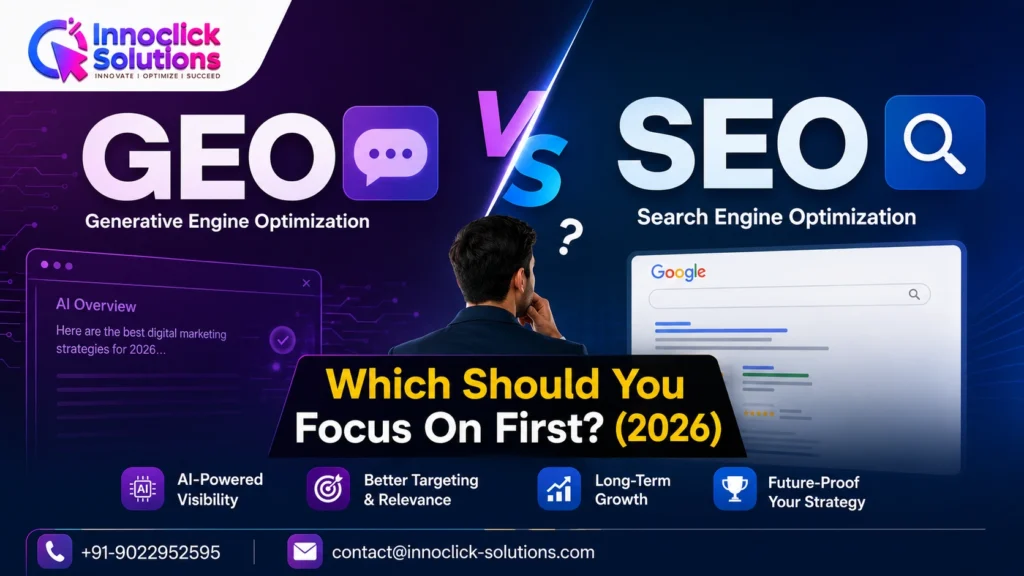
This guide breaks down the real difference between GEO (Generative Engine Optimization) and SEO (Search Engine Optimization), gives you a clear decision framework based on your business type, and shows you exactly how to sequence both strategies for maximum ROI. Whether you’re working with an affordable AI SEO agency in Pune or building your strategy in-house, by the end of this post you’ll know precisely where to start.
GEO (Generative Engine Optimization) and SEO (Search Engine Optimization) are complementary strategies, not competitors. For most businesses, SEO should come first as it builds the authoritative content foundation that AI engines like ChatGPT, Perplexity, and Google AI Overviews need to cite your content. Once that foundation exists, layering GEO tactics multiplies your visibility across both traditional and AI-powered search.
Quick Summary
- SEO optimizes content to rank in traditional search engines like Google; GEO optimizes content to be cited by AI engines like ChatGPT, Perplexity, and Google AI Overviews.
- GEO without a strong SEO foundation is fragile — AI engines prefer citing authoritative, well-linked content.
- For most businesses, the winning move is SEO first (months 1–3), GEO second (months 2–4), running them in parallel as soon as the foundation is set.
- Local, e-commerce, and transactional searches are still dominated by traditional Google results — SEO is non-negotiable for these.
- Content structured with clear definitions, numbered lists, and short paragraphs performs best in both traditional SERPs and AI-generated answers.
What Is SEO, and Does It Still Work in 2026?
SEO is the process of making your website rank on Google through relevant content, backlinks, and technical fixes. It still works in 2026, but not the same way. AI Overviews now answer many queries directly, cutting organic clicks. SEO is still worth doing — it just needs to be paired with GEO.
Despite constant “SEO is dead” headlines, the data tells a different story. Google processes over 8.5 billion searches per day, and the overwhelming majority of local, transactional, and product-intent searches still return traditional organic results — not AI Overviews.
Where SEO has evolved is in how it rewards content. Google’s Helpful Content system and E-E-A-T (Experience, Expertise, Authoritativeness, Trustworthiness) signals now heavily favor content written by genuine subject-matter experts. Thin, recycled content gets filtered out faster than ever.
For local businesses, e-commerce brands, and service providers — including those looking for the best AI SEO service provider in Pune — traditional SEO remains the bedrock strategy. It builds durable visibility that compounds over time.
What Is GEO, and How Is It Different from SEO?
GEO (Generative Engine Optimization) means optimizing content so AI tools like ChatGPT, Perplexity, and Google’s AI Overviews cite you in their answers. SEO targets search engine rankings. GEO targets AI-generated responses. SEO drives clicks; GEO drives mentions. Both matter now, but they need different content strategies.
The core difference is the destination. SEO puts you on page 1 of Google. GEO puts your content inside the AI-generated answer that appears above page 1.
Here’s how the two strategies compare across five dimensions:
| Dimension | SEO | GEO |
|---|---|---|
| Goal | Rank in SERPs | Be cited in AI answers |
| Timeline | 4–12 months | 2–8 weeks |
| Primary Signal | Backlinks + keywords | Authority + content structure |
| Measurement | Rankings, organic traffic | AI citation tracking, brand mentions |
| Volatility | Lower (more stable) | Higher (AI updates frequently) |
The critical insight most marketers miss: AI engines don’t crawl the internet independently. They draw from a corpus of high-authority, well-structured content — which is exactly what a strong SEO strategy produces. GEO without SEO is like building a roof without walls.
AI search traffic from Perplexity and ChatGPT Search grew by over 200% year-over-year in 2024, making GEO an increasingly important channel — but not a replacement for SEO’s durable traffic foundation.
Which One Should You Focus On First?
The answer depends on three factors: your website’s current authority, your primary audience’s search behavior, and your business type. Here’s a practical decision matrix:
Start with SEO First if you:
- Have a website younger than 2 years with low domain authority (DA < 30)
- Operate a local service business (restaurant, clinic, agency, retail)
- Sell products where buyers use transactional search queries (“buy,” “near me,” “price”)
- Have zero existing content — you need crawlable pages before AI can cite them
- Have a tight budget and need compounding, long-term ROI
Start with GEO First if you:
- Already have a high-authority site (DA 50+) with solid existing content
- Target informational or research-heavy audiences (B2B, SaaS, consulting)
- Your competitors already dominate traditional SERPs and you need an alternative channel
- You publish thought-leadership content that AI engines are likely to summarize
- You need brand visibility without waiting 6+ months for organic rankings
Decision Matrix by Business Type
| Business Type | Priority | Reason |
|---|---|---|
| Local service (salon, clinic, agency) | SEO First | Local pack + maps = traditional results |
| E-commerce brand | SEO First | Product searches = non-AI results |
| SaaS / Software | Both simultaneously | Informational intent suits GEO; commercial suits SEO |
| B2B Consultancy | GEO First (if high DA) | AI engines cite expert analysis frequently |
| New startup / blog | SEO First | Needs domain authority before GEO works |
| Established media / publisher | GEO First | Content volume + authority = high AI citability |
If you’re a Pune-based business — whether you’re a growing startup or an established SME — partnering with an affordable AI SEO agency in Pune like InnoClick Solutions gives you the expertise to execute both tracks without guesswork.
How Do SEO and GEO Actually Work Together?
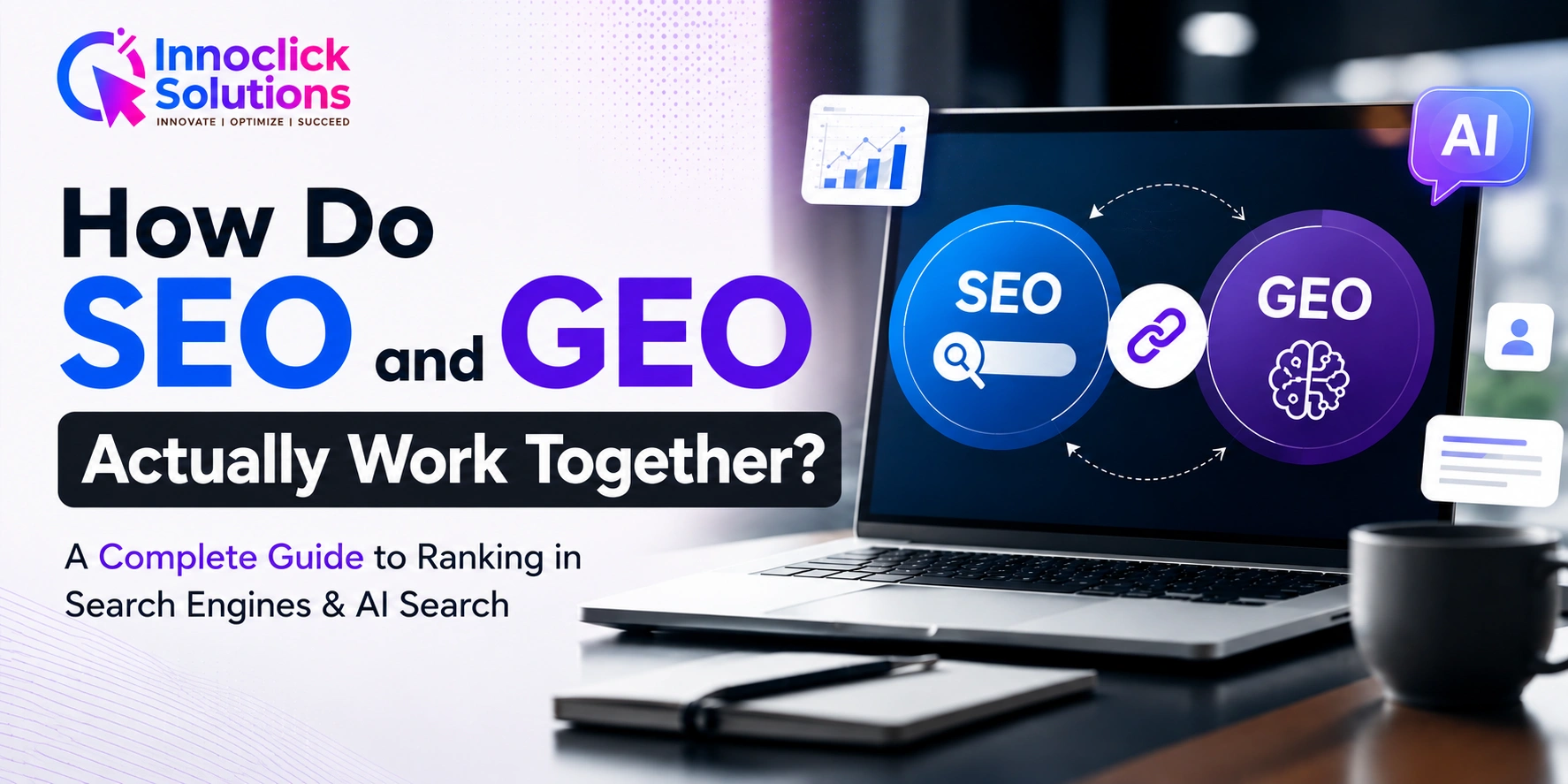
SEO gets you ranked on Google. GEO gets you cited by AI. They reinforce each other because AI models often pull from high-ranking, authoritative pages. Strong SEO builds the credibility GEO needs. Write clear, specific, well-structured content and you feed both systems at once.
Content types that win in both channels simultaneously:
- Comprehensive how-to guides (ranked by Google for keywords; cited by AI for definitions)
- Data-backed original research (earns backlinks for SEO; earns AI citations for authority)
- FAQ sections with direct answers (targets PAA boxes in Google; signals AI-ready structure)
- Comparison pages (captures consideration-stage searches; gets cited in “X vs Y” AI queries)
The structural principles that help both are identical: short paragraphs, clear H2 question headings, direct 50-word answers at the top of each section, and factual claims with specific numbers. Write one piece of content that does this well, and it works across Google, ChatGPT, Perplexity, and Google AI Overviews simultaneously.
What Is the Real Timeline for GEO vs SEO Results?
SEO typically takes 3–6 months to show ranking improvements. GEO moves faster — structured, citable content can get picked up by AI tools within weeks of publishing. Neither is instant. But if you’re starting today, GEO often shows measurable AI visibility results before your SEO fully kicks in. SEO typically delivers measurable results in 3–6 months for new content and 1–3 months for optimized existing content; GEO citations can appear within 2–4 weeks but are more volatile.
Here’s a realistic 12-month horizon for a typical SMB:
Months 1–3 (SEO Foundation):
- Technical audit and fixes (site speed, crawlability, schema)
- Publish 4–6 cornerstone content pieces targeting primary keywords
- Begin internal linking and basic backlink outreach
Months 2–4 (GEO Layer — runs parallel to SEO):
- Restructure existing content for AI citability (add definition boxes, numbered answers)
- Add
llms.txtfile to guide AI crawlers - Optimize schema markup (Article, FAQPage, HowTo)
- Monitor AI citation tools (Perplexity brand mentions, AI Overview tracking)
Months 5–12 (Compound Growth):
- SEO rankings stabilize and traffic compounds
- GEO citations increase as domain authority grows from SEO activity
- Both channels reinforce each other — a true search visibility flywheel
The average time-to-first-page-1 ranking through SEO is 4–6 months for competitive keywords. GEO visibility can appear in weeks — but without the authority SEO builds, those citations won’t stick.
Your 90-Day GEO + SEO Quick-Start Plan
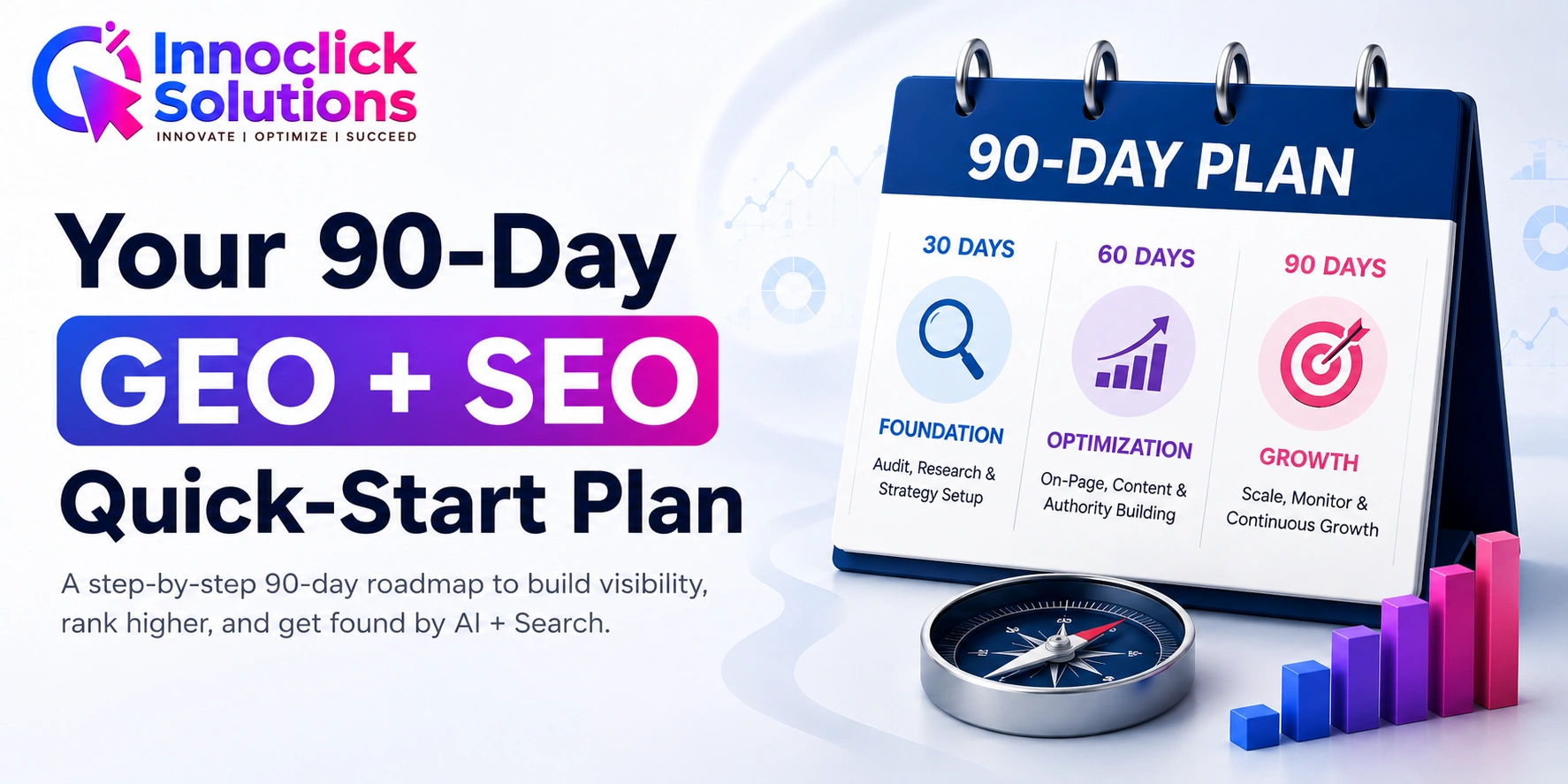
A phased 90-day plan lets you build SEO foundations in the first month while layering GEO optimizations from week 3 onward — no burnout, no budget waste.
Days 1–30: Build the SEO Foundation
- Run a full technical SEO audit (fix crawl errors, page speed, mobile usability)
- Identify 5–10 primary keywords matched to your audience’s search intent
- Publish 2–3 long-form cornerstone content pieces (1,500+ words each)
- Set up Google Search Console and GA4 for baseline measurement
Days 31–60: Optimize for AI Citability (GEO Layer)
- Add a direct-answer “definition block” to every existing blog post
- Structure all H2s as questions with 50-word direct answers beneath them
- Add FAQPage schema to high-traffic posts
- Create or update your
llms.txtfile to guide AI crawlers - Monitor Perplexity, ChatGPT Search, and Google AI Overviews for brand citations
Days 61–90: Measure, Iterate, Expand
- Identify which content is getting AI citations and double down on that format
- Build 3–5 internal links connecting your cornerstone content pieces
- Begin outreach for 2–4 quality backlinks (guest posts, resource pages)
- Publish your first comparison page (“X vs Y”) targeting both search and AI queries
- Review: Are keywords moving? Are AI citations appearing? Adjust publishing cadence accordingly
Conclusion
The GEO vs SEO debate has a clear answer for most businesses: start with SEO, then layer GEO on top. SEO builds the authoritative, well-structured content foundation that AI engines rely on for citations. GEO amplifies that foundation into AI-powered search channels that grow in importance every quarter.
The businesses winning in 2025 aren’t choosing between the two — they’re running them as a unified strategy. Whether you’re a Pune-based startup or an established brand, the right move is to build your SEO core now and optimize for AI citability simultaneously.
Ready to build a strategy that dominates both Google and AI search? Explore InnoClick Solutions’ AI SEO services — the best AI SEO service provider in Pune for growing businesses that can’t afford to wait.
Call to Action
Innoclick Solutions is Pune’s leading affordable AI SEO agency helping businesses rank in Google and get cited by AI engines like ChatGPT and Perplexity. Whether you’re starting from scratch or ready to layer GEO onto an existing SEO foundation, our team handles the full strategy. Book a free AI SEO audit today →
FAQ’s:
Q.1 How GEO Differs from Traditional SEO?
SEO targets search engine ranking algorithms — keywords, backlinks, technical structure. GEO targets AI systems that synthesize answers — ChatGPT, Perplexity, Google AI Overviews. Instead of ranking a page, you’re getting cited inside a generated response. Brand mentions now outperform backlinks 3x as an AI visibility signal.
Q.2 GEO vs SEO: Which One Actually Brings in Customers?
Both do, but differently. SEO drives clicks to your page. GEO drives brand mentions inside AI-generated answers — often without a click at all. Right now, SEO still converts better. But AI-referred traffic grew 527% in early 2025. Smart businesses aren’t choosing one — they’re running both.
Q.3 Will GEO Replace Google Search Results?
Not replace — reshape. Google AI Overviews already appear on 50%+ of queries and reach 1.5 billion users monthly. But 92% of AI Overview citations still come from top-10 ranked pages. So classic SEO still matters. GEO is a layer on top, not a replacement underneath.
Q.4 How Generative Engine Optimization Actually Works?
AI systems pull from content that’s easy to quote: specific facts, clear definitions, self-contained 134–167 word passages. GEO means structuring your content so AI can lift a clean answer from it. Question-based headings, direct answers in the first 40 words, and original data all help.
Q.5 Can You Rank in AI Search Without Traditional SEO?
Partially. ChatGPT heavily cites Wikipedia (47.9%) and Reddit (11.3%) — neither requires classic SEO. But Google AI Overviews pull almost exclusively from top-10 ranked pages. So for Google’s AI, traditional SEO is still the entry ticket. For other platforms, entity presence and community mentions matter more.

Shivraaj Dhaygude is a Pune-based SEO Specialist with over 6+ years of hands-on experience helping local businesses dominate Google Search and AI-powered results. He specializes in Local Pack optimization, Google AI Overview visibility, and Generative Engine Optimization (GEO) — an emerging discipline focused on appearing inside AI-generated search answers.
Shivraaj has personally led SEO campaigns for 50+ SMBs across Pune and Maharashtra, consistently delivering top-3 local pack rankings and measurable increases in organic leads. His approach combines technical SEO foundations with AI search readiness strategies, giving clients a competitive edge as search evolves.
He writes about local SEO, GEO, and AI search trends based on real client data and ongoing experimentation — not theory.