
Healthcare SEO and traditional SEO share the same technical foundations — keywords, backlinks, page speed — but the rules of the game are quite different once you cross into medical territory. Google treats health-related content with a level of scrutiny it simply doesn’t apply to a fashion blog or a software review site.
If you run a clinic, hospital, or any healthcare business, treating your SEO strategy like a standard digital marketing playbook is a mistake. This post breaks down where healthcare SEO diverges from traditional SEO, why it matters in 2026, and what you actually need to do differently.
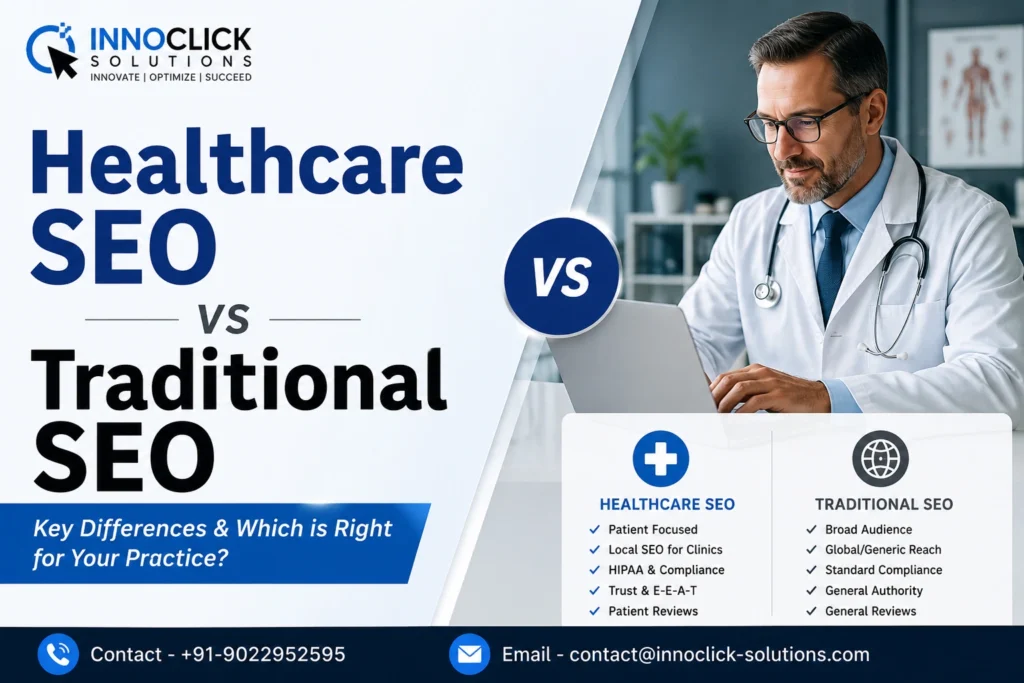
Healthcare SEO vs Traditional SEO: Quick Comparison
| Factor | Healthcare SEO | Traditional SEO |
|---|---|---|
| Content Standards | Medically accurate, expert-reviewed, clinically verified | Quality content preferred, but no professional review required |
| YMYL Classification | Always applies — health decisions carry real-world risk | Rarely applies (e-commerce, SaaS, travel, etc.) |
| E-E-A-T Requirements | Mandatory — licensed author credentials must be visible | Beneficial but not essential for ranking |
| Author Requirements | Must be a credentialed medical professional or reviewed by one | Any qualified writer or in-house team member |
| Local SEO Importance | Critical — patients search by location and specialty | Important but less concentrated on trust signals |
| Content Topics | Symptoms, treatments, patient FAQs, clinical procedures | Product reviews, how-tos, comparisons, opinion content |
| AI-Generated Content | Usable only with mandatory medical review before publishing | Usable with quality checks; no expert review required |
| Competition | Dominated by Mayo Clinic, WebMD, NHS, government health sites | Varies widely by niche; often beatable with good strategy |
| Timeline for Results | 4–12 months (longer due to YMYL scrutiny) | 3–6 months for most competitive niches |
| Review Signals | Patient reviews — heavily influence local pack rankings | Customer reviews help but aren’t make-or-break |
| Legal/Compliance Risks | High — incorrect content can harm patients and invite liability | Low — factual errors are embarrassing, not dangerous |
| Link Building | Requires citations from medical journals, health directories, gov sites | Guest posts, niche directories, PR, industry blogs |
What Is Healthcare SEO, and How Is It Different From Regular SEO?
Healthcare SEO is the practice of optimizing websites for hospitals, clinics, doctors, and other medical providers to rank in search engines and attract patients. Unlike traditional SEO — which can succeed with promotional content, user-generated reviews, or opinion-driven articles — healthcare SEO requires medically accurate, verifiable, and professionally reviewed content.
The core difference comes down to consequence. If a running shoe recommendation is wrong, someone buys uncomfortable shoes. If medical advice is wrong, someone could make a decision that harms their health. Google’s algorithms account for this. Healthcare sites are flagged as YMYL (Your Money or Your Life), a classification that raises the bar for trust signals, author credentials, and factual accuracy.
Traditional SEO can get away with thin content, anonymous authors, and aggressive promotional language. Healthcare SEO cannot. Google’s Quality Rater Guidelines explicitly require that medical content demonstrate real-world expertise — ideally authored or reviewed by licensed professionals.
In practice, this means healthcare businesses need content strategies built around patient concerns, clinical accuracy, and local visibility. A generic blog about “wellness tips” written by a content mill won’t cut it anymore, especially with AI Overviews pulling cited excerpts from only the most authoritative sources.
Read a related blog – Learn how SEO for hospitals works in 2026?
What Are YMYL Guidelines and Why Do They Matter for Medical Websites?
YMYL (Your Money or Your Life) is Google’s classification for content that could significantly affect a user’s health, financial stability, or safety. Healthcare websites automatically fall into this category. Google applies stricter quality evaluation to these pages because inaccurate information carries real-world risk.
For a healthcare website, YMYL classification means:
- Content accuracy is scrutinized more heavily by Google’s quality evaluators.
- Author credentials and professional affiliations directly influence ranking signals.
- Pages with no expert review or citation are unlikely to rank competitively against established medical publishers.
Most traditional SEO industries — e-commerce, travel, SaaS, real estate — operate outside YMYL. A blog post about “best CRM tools” doesn’t require a certified expert. A page about “symptoms of type 2 diabetes” absolutely does.
The practical implication: healthcare businesses cannot delegate content entirely to generalist writers. Medical content needs a qualified reviewer — a licensed physician, pharmacist, or credentialed health professional — attached to every page. That reviewer’s name, credentials, and profile need to be visible. Anonymous authorship is a silent ranking penalty in healthcare SEO.
Why Does E-E-A-T Matter More for Healthcare SEO Than for Traditional SEO?
E-E-A-T — Experience, Expertise, Authoritativeness, and Trustworthiness — is Google’s framework for evaluating content quality. For healthcare websites, it’s the single most important ranking factor after technical health. Traditional SEO benefits from E-E-A-T, but can survive without it. Healthcare SEO cannot.
Here’s what each element requires specifically in medical contexts:
- Experience: Real-world clinical experience. A page about knee replacement surgery written by an orthopedic surgeon carries far more weight than one written by a generalist blogger.
- Expertise: Documented qualifications. Author bios should include medical degrees, licenses, and specializations.
- Authoritativeness: External recognition. Being cited by medical journals, health institutions, or government health sites signals authority.
- Trustworthiness: Technical and editorial transparency. HTTPS, clear privacy policies, and accurate disclosures matter more in healthcare than in almost any other vertical.
For context: a SaaS blog can rank #1 with a confident, well-structured article written by any capable writer. A page claiming to describe “early signs of stroke” without a medical author attached will struggle to compete with Mayo Clinic, WebMD, or NHS — regardless of keyword optimization.
If you’re running a clinic’s blog, the fastest way to build E-E-A-T is to publish content with named, credentialed authors and link those authors to their medical profiles or LinkedIn pages.
How Does Local SEO Work Differently for Clinics and Hospitals?
Local SEO is significantly more important for healthcare businesses than for most traditional industries. A patient looking for a cardiologist, physiotherapist, or IVF clinic almost always searches with location intent — “near me,” “in [city],” or “[specialty] [neighborhood].” Getting this wrong means losing patients to competitors, even if your clinical quality is better.
The core components of local SEO for healthcare include:
- Google Business Profile (GBP): Complete and verified profiles with accurate hours, services, photos, and responses to reviews.
- NAP consistency: Name, Address, and Phone number must match exactly across your website, GBP, and every directory listing.
- Local citations: Listings on Practo, Justdial, Sulekha (in India), and healthcare-specific directories improve local authority.
- Patient reviews: Volume and recency of Google reviews directly influence local pack rankings. A clinic with 200 recent reviews outranks one with 20 old ones.
- Location-specific pages: Multi-location practices need a dedicated, unique page for each branch — not one page listing all locations.
Traditional businesses need local SEO too, but the stakes aren’t as concentrated. A restaurant or a retail shop draws walk-in traffic. A clinic draws patients who’ve often already made a significant trust decision before they even call. That trust starts with search visibility.
“Near me” healthcare searches grew over 500% in five years according to Google Trends data [4]. That’s not a niche signal — it’s the dominant patient acquisition channel for most local healthcare providers.
What Are the Biggest Differences in Content Strategy Between Healthcare and Traditional SEO?
Content strategy for healthcare SEO is built around patient questions and clinical accuracy, not product features or conversion funnels. The audience is different. The intent is different. The risks are different.
Traditional SEO content typically looks like:
- Product comparisons (“Best CRM Software in 2026”)
- Opinion-led roundups (“Top 10 Running Shoes”)
- Promotional service pages (“Our SaaS Platform”)
Healthcare SEO content needs to be:
- Symptom-and-condition focused (“What Causes Unexplained Weight Loss?”)
- Treatment-explaining and evidence-based (“How Is IVF Different from IUI?”)
- FAQ-driven around patient anxieties (“Is Laparoscopic Surgery Safe?”)
- Medically reviewed and dated for accuracy
One major pitfall: AI-generated content without medical review. A generic AI writing tool will produce fluent, plausible-sounding health content — but plausible isn’t the same as accurate. For healthcare, publishing inaccurate content isn’t just an SEO problem. It’s a liability and an ethical one.
Content that ranks in healthcare also needs to be optimized for AI Overviews, since Google now surfaces AI-generated summaries for a huge proportion of health-related queries. That means structured, self-contained answer blocks — not walls of promotional text — positioned prominently in each article [6].
Can Healthcare Websites Use AI-Generated Content for SEO?
Healthcare websites can use AI-assisted content, but not AI-generated content published without medical review. Google’s guidance is clear that the source of content matters less than its quality and accuracy — but for YMYL topics, quality and accuracy require human expertise.
The practical rule: AI can draft, structure, and assist. A qualified medical professional must review, verify, and approve anything that makes clinical claims.
AI tools are genuinely useful for:
- Drafting initial content structure and questions
- Generating meta descriptions and heading variations
- Repurposing existing approved content for social media
- Building FAQ sections from reviewed clinical material
What they shouldn’t do alone: write condition pages, describe symptoms, recommend treatments, or make any claims that a patient might act on. The review step isn’t optional — it’s what separates publishable healthcare content from content that damages both rankings and patient trust.
How Long Does Healthcare SEO Take to Show Results?
Healthcare SEO typically takes 4–12 months to show meaningful ranking improvements, which is longer than most traditional SEO timelines. The reasons are structural: competitive medical keywords are dominated by large health publishers (WebMD, NHS, Mayo Clinic), and Google applies extra evaluation time to YMYL content before trusting new or updated pages.
For local healthcare SEO — getting a clinic to appear in Google’s local pack for “physiotherapist [city]” — results can come faster, often within 6–12 weeks, especially if Google Business Profile optimization, review acquisition, and citation building are addressed simultaneously.
The honest expectation: healthcare SEO is a long-term investment. Practices that start seeing strong organic results in year two are often the ones that started building E-E-A-T signals, consistent content output, and local authority in year one.
What Healthcare SEO Mistakes Should Clinics Avoid?
The most common healthcare SEO mistakes are:
- Publishing thin medical content — short, unreviewed pages that don’t answer patient questions fully.
- Ignoring local SEO — not claiming or optimizing Google Business Profile, or having NAP inconsistencies across directories.
- No doctor author profiles — publishing content without attaching credentialed authors visibly undermines E-E-A-T.
- Using AI content without review — fast to publish, risky to rank, potentially harmful to patients.
- Slow website performance — healthcare patients are often on mobile, often under stress. Pages that load slowly lose them before they book.
Each of these mistakes is fixable. Most clinics that struggle with SEO aren’t doing anything egregiously wrong — they’re just treating their website like a brochure rather than a patient acquisition channel.
What I Learned Working on Healthcare SEO vs Traditional SEO?
When I started doing SEO for a diagnostic center in Pune, I made the classic mistake — I used the same playbook that had worked for e-commerce and local service clients. Good content, targeted keywords, a few citations. Six months in, barely any movement.
The problem wasn’t technical. The site was fast and mobile-friendly. The problem was trust. No doctor names on content. An “About” page that read like a brochure. A Google Business Profile with 11 unanswered reviews from 2021.
Once I added credentialed medical reviewers to each page, built proper author bios, and started a review acquisition strategy — local pack movement showed up within 8 weeks.
The mindset shift that changed everything: in traditional SEO, I’m helping a business get found. In healthcare SEO, I’m helping a patient find the right doctor when they’re anxious or in pain.
Healthcare content also takes longer to publish — a single condition page can need 3–4 weeks of medical review. That’s not a bottleneck. That’s the standard.
Conclusion
The gap between healthcare SEO and traditional SEO comes down to trust and consequence. Standard SEO techniques — keyword research, backlinks, technical audits, quality content — apply to both. But healthcare adds layers that most industries never deal with: YMYL compliance, E-E-A-T requirements, medically reviewed content, and the specific local intent of patients who need to find the right provider nearby.
If you’re running a clinic, hospital, or any healthcare practice, a generic SEO approach will only get you so far. Building patient trust through search starts with the right strategy — one built for your industry, not borrowed from an e-commerce playbook.
Ready to build an SEO strategy that actually works for your healthcare practice? Contact the team at Innoclick Solutions for a healthcare SEO consultation — or explore our digital marketing services for healthcare businesses.

Shivraaj Dhaygude is a Pune-based SEO Specialist with over 6+ years of hands-on experience helping local businesses dominate Google Search and AI-powered results. He specializes in Local Pack optimization, Google AI Overview visibility, and Generative Engine Optimization (GEO) — an emerging discipline focused on appearing inside AI-generated search answers.
Shivraaj has personally led SEO campaigns for 50+ SMBs across Pune and Maharashtra, consistently delivering top-3 local pack rankings and measurable increases in organic leads. His approach combines technical SEO foundations with AI search readiness strategies, giving clients a competitive edge as search evolves.
He writes about local SEO, GEO, and AI search trends based on real client data and ongoing experimentation — not theory.