
Healthcare in India is more competitive than it’s ever been. Patients in Pune, Hyderabad, Bengaluru, and even Tier-2 cities now pull out their phones before they ever step into a clinic. They read reviews. They compare doctors. They check if the website even loads on mobile. And if your hospital doesn’t show up — or shows up poorly — they move on to the one that does.
This isn’t a future problem. It’s happening right now, in your city, possibly to your hospital.
This guide breaks down the real reasons hospitals lose patients (both online and offline), and what it actually takes to fix them — not in theory, but in practice.
How Patients Actually Search for Hospitals Today
Before we get into what hospitals are doing wrong, it helps to understand what patients are doing right.
Patients Start on Google, Not Word of Mouth
The first thing most patients do when they need a doctor is type something into Google. “Best orthopedic hospital in Nagpur.” “24-hour emergency hospital near me.” “Cardiologist in Baner Pune.” These aren’t rare searches — millions of them happen every day across India.
According to Google, over 70% of health-related journeys now start online. That stat matters because it means your hospital’s first impression isn’t your reception desk — it’s your Google listing.
Google Maps Decides Before Patients Visit
The Google Maps “local pack” — that cluster of three results you see at the top of a local search — gets the majority of clicks. Patients use it to check ratings, read reviews, look at photos, and find directions.
If your hospital isn’t in the top three results for your local area, a huge portion of potential patients never even know you exist.
Patients Compare, Then Decide
People don’t just find one hospital and book. They open three or four tabs, compare reviews, check doctor profiles, look at whether appointment booking is easy, and go with whoever seems most trustworthy. Your website, your Google rating, and your response to reviews all factor into a decision that takes maybe four minutes.
That’s the reality. Now here’s where hospitals in India consistently get it wrong.
The Major Reasons Indian Hospitals Lose Patients Online
Poor Google Visibility
What “not ranking on Google” actually costs you: If a patient searches “best gynecologist in Thane” and you don’t appear on page one, you might as well not exist for that search. And it’s not just about having a website — it’s about the website doing the right things, which is exactly where healthcare SEO services become critical.
Most hospital websites in India have weak or no SEO. Pages lack the specific local keywords patients use. Service pages don’t exist for every speciality. Content structure is confusing to Google’s crawlers.
The fix isn’t complicated. It requires creating dedicated pages for every department and condition you treat, using location-specific keywords naturally throughout those pages, and building content that actually answers patient questions.
Google Business Profile is often left half-done. This is the single easiest win most hospitals are leaving on the table. Your Google Business Profile (the card that appears when someone searches your hospital name or a local health query) needs complete information: accurate hours including emergency hours, all relevant medical categories selected, recent photos of your facility, and active responses to reviews.
Hospitals with incomplete or inconsistent profiles rank lower and convert fewer visitors into patients. It takes a few hours to fix and the impact is immediate.
The Maps Pack is the battleground most hospitals ignore. Walk-in patients especially rely on map rankings. If you’re not in the top three for “hospital near me” in your locality, you’re losing walk-ins to whoever is — regardless of how good your care actually is.
Know what is the difference between healthcare SEO and traditional SEO?
Negative or Unmanaged Online Reputation
Bad reviews don’t just hurt feelings — they cost appointments. A hospital with a 3.2-star rating on Google loses patients to a nearby hospital with 4.5 stars, even if the clinical quality is identical. Patients can’t evaluate your surgeons’ skills from their phone. They judge by what they can see: your rating, the number of reviews, and how you responded to criticism.
Most hospitals have no review strategy at all. They don’t ask satisfied patients to leave reviews. They don’t respond to negative feedback. They don’t monitor what people are saying. The result: a handful of unhappy patients (who are highly motivated to write reviews) set the narrative for everyone else.
Responding to negative reviews matters more than most hospitals realize. A thoughtful, non-defensive response to a bad review doesn’t just reassure the reviewer — it reassures every future patient reading that exchange. “We’re sorry about your experience and would like to understand what happened. Please contact our patient care team at…” is not complicated. But barely any hospitals do it consistently.
Your own website might be undermining trust. Missing doctor credentials. No patient testimonials. Broken links. No information about accreditations or certifications. A website that looks like it was built in 2009 and hasn’t been touched since. These things signal to patients that if you don’t care about your website, you might not care about details in general.
Poor Website Experience
Speed and mobile usability are now clinical-grade requirements. Over 80% of healthcare searches in India happen on mobile. If your website takes more than three seconds to load on a 4G connection, a significant chunk of visitors leave before seeing anything. Google’s Core Web Vitals data confirms that slow websites rank lower — and convert worse.
Most hospital websites fail basic mobile tests: text too small to read, buttons too close together to tap, forms that break on certain browsers. These aren’t minor inconveniences. They’re patient-losing failures.
Appointment booking is where hospitals bleed patients daily. Think about what a patient has to do on most Indian hospital websites to book an appointment: find the right department page (if it exists), look for a phone number, call during business hours, wait on hold, answer questions, finally get a slot. Or they just call somewhere else.
The hospitals winning new patients have WhatsApp booking links visible within ten seconds of landing on their home page. They have online booking forms that take under two minutes. They have callback request buttons. Every additional step in the booking process loses people.
Wrong or outdated information is an underrated problem. Doctors who left two years ago still listed on the website. Phone numbers that ring to nothing. Timings that don’t match actual hours. These create real problems — patients who show up to a clinic that’s closed, or who try to book with a doctor who’s no longer there. And once that happens, they don’t come back.
Weak Patient Communication Systems
Slow response is patient loss. Someone submits an inquiry form at 9 PM. If no one calls them until the next afternoon, they’ve already booked with someone else. The hospitals that are growing fastest in India right now treat digital inquiries with the same urgency as phone calls.
No WhatsApp channel in 2025 is a real gap. India has over 500 million WhatsApp users. Patients want to ask questions, confirm appointments, and get directions over WhatsApp. They don’t want to fill out a form and wait. If your hospital doesn’t have a WhatsApp business number actively monitored, you’re creating unnecessary friction.
Language matters more than most digital teams acknowledge. A hospital in Nagpur that communicates only in English is harder to trust for a patient more comfortable in Marathi or Hindi. A simple multilingual website — or even multilingual WhatsApp support — can meaningfully change patient acquisition in regional markets.
No Real Digital Marketing Strategy
Depending only on offline referrals is a shrinking strategy. Referrals from other doctors and word-of-mouth still matter. But referral networks are finite. Digital reach is not. Hospitals that have invested in SEO and content over the last three years are compounding that investment — every blog post ranking on Google is a 24/7 patient acquisition machine.
Your competitors are not standing still. Chain hospitals like Manipal, Fortis, and Apollo have had digital marketing teams for years. But so do smaller specialty hospitals that have figured out local SEO. If you search “best fertility clinic in Hyderabad” and your competitors show up while you don’t, that’s not a market problem — it’s a visibility problem.
Educational content builds trust before patients ever contact you. A hospital that publishes clear explanations of common procedures, honest answers to FAQ about costs, and accessible health information gets treated differently by both Google and patients. Google sees it as an authoritative medical resource. Patients see it as a hospital that knows what it’s talking about.
Operational Reasons Hospitals Lose Patients
Online presence gets most of the attention, but operational problems drive plenty of patient loss too.
Long waiting times are the most-cited frustration in Indian hospital reviews. A patient who waits three hours for a fifteen-minute consultation won’t come back, and they’ll say so on Google. The solution isn’t always more staff — it’s better scheduling, realistic appointment windows, and communicating wait times honestly.
Front desk experience sets the tone for everything. The person at your front desk is the first human touchpoint after your Google listing. If they’re dismissive, slow, or confused, that’s what patients remember. Many Indian hospitals underinvest in training front desk staff, treating it as an entry-level admin role rather than a patient retention function.
Pricing opacity is a trust problem. “What will this cost?” is one of the most common questions patients have and one of the hardest to answer at most Indian hospitals. Patients who feel they can’t get a straight answer on pricing feel anxious throughout their visit. Transparency — even approximate ranges — builds trust more than people expect.
Post-treatment engagement is almost entirely absent. A patient who had a knee replacement at your hospital three years ago has friends who might need the same. But if no one from your hospital has ever followed up, sent a health tip, or asked how the recovery went, that patient has no particular reason to recommend you. Simple follow-up calls, discharge summary WhatsApp messages, and periodic health check reminders maintain relationships that drive referrals.
How Indian Hospitals Can Actually Fix These Problems?
Optimize Your Google Business Profile First
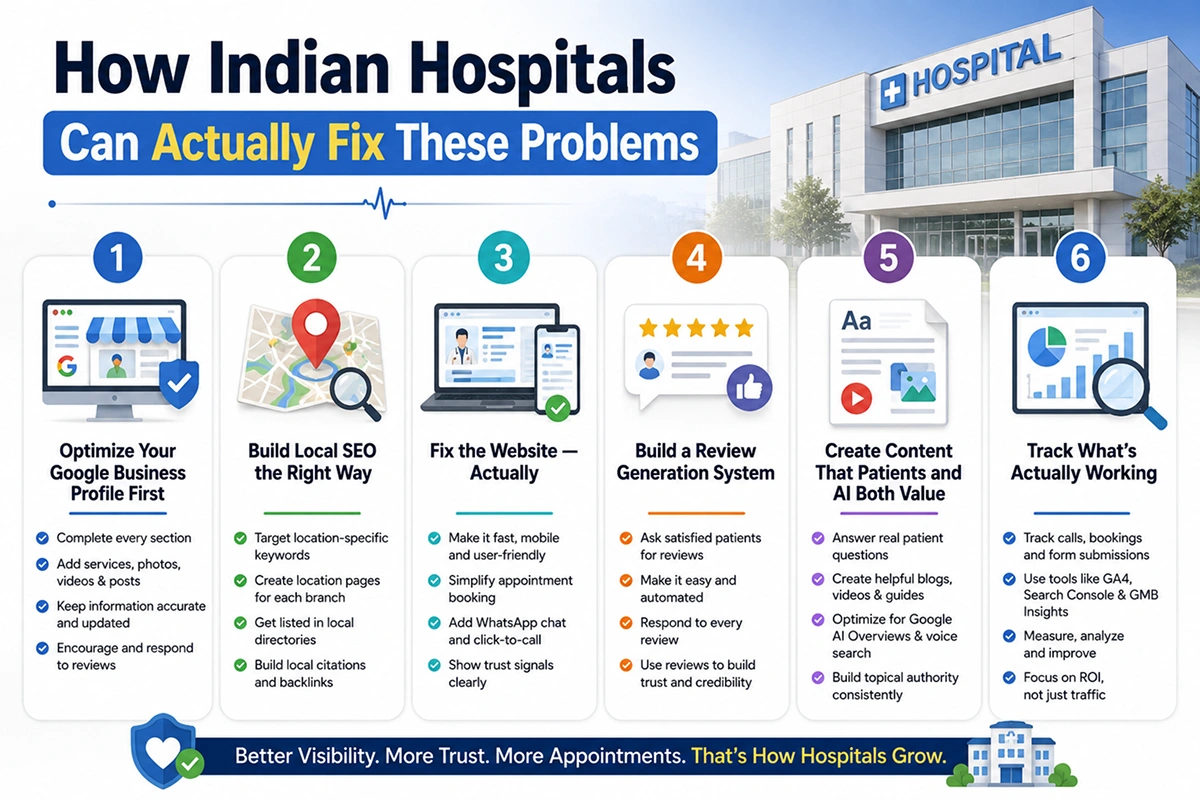
This is free, relatively fast, and the ROI is immediate. Go through your GBP and check: Are all your service categories correct? Are hours accurate? Have you added photos of your facility in the last six months? Are you responding to reviews? This alone can move a hospital up in local rankings within weeks.
Build Local SEO the Right Way
Target the queries patients actually use, not medical jargon. Patients search “knee replacement surgery Pune” not “orthopedic arthroplasty center Pune.” Create dedicated pages for each speciality and each major procedure. Include the city or neighbourhood name naturally. Add a clear description of what patients can expect.
Location-specific pages matter for hospitals with multiple branches. Each location needs its own page with its own Google Business Profile. A generic “Contact Us” page for a hospital with three locations in different cities is leaving local SEO value on the table.
Fix the Website — Actually
Not just redesign it aesthetically. Run it through Google’s PageSpeed Insights and fix what’s broken. Test it on a mid-range Android phone on 4G and see how it feels. Find your appointment booking flow and time how long it takes to complete. If it’s more than two minutes, shorten it.
Add WhatsApp click-to-chat. Add doctor credentials with photos. Add a clear, prominent phone number on every page. Add patient testimonials (with permission). These aren’t nice-to-haves anymore.
Build a Review Generation System
After every discharged patient or completed outpatient visit, send a WhatsApp message thanking them and — if their experience was positive — asking if they’d be willing to share a review on Google. Make the link easy to access. Do this consistently. Over six months it transforms your rating profile.
When negative reviews come in, respond within 24 hours. Keep it professional. Offer to take the conversation offline. Never argue in public.
Create Content That Patients and AI Both Value
Google AI Overviews now appear for a huge share of health queries. To get cited in these, your content needs to answer specific questions directly and concisely. A blog post titled “What to Expect Before Knee Replacement Surgery” that gives a clear, structured answer in the first two paragraphs is more likely to appear in AI Overviews than a dense, jargon-heavy clinical page.
Write for patients first. Use proper heading structure (H2s and H3s that match actual search queries). Add an FAQ section to every major service page. Include your author’s medical credentials. These choices directly affect both traditional rankings and AI visibility.
Track What’s Actually Working
You can’t manage what you don’t measure. At minimum, your hospital should be checking Google Search Console monthly (which queries bring people to your site), Google Analytics (how many visitors book appointments), and your GBP insights (how many people called or clicked directions from your Maps listing).
Healthcare Marketing Trends Indian Hospitals Need to Watch
AI-powered search is changing how patients find hospitals. When someone asks ChatGPT “which hospital is best for diabetes management in Coimbatore,” the AI pulls from web sources. Hospitals whose websites have structured, authoritative content about their diabetes programmes are more likely to be cited. This is AI SEO — and it’s not a future trend, it’s happening now.
Voice search queries are different from typed searches. “Hey Google, find me a 24-hour hospital near me” is more conversational than what people type. Content optimized for voice tends to be more natural in phrasing, uses question-and-answer structures, and targets featured snippet positions.
Video is the highest-trust content format. A two-minute video of your orthopedic surgeon explaining what a knee replacement recovery looks like does more for patient trust than five pages of text. YouTube is the second largest search engine. Most Indian hospitals have no YouTube presence worth mentioning.
Hyperlocal SEO is the opportunity smaller hospitals are best positioned to exploit. A 50-bed specialty hospital in a specific neighbourhood can dominate local search for that area. National chains have to spread their SEO investment thin. A focused local strategy can out-compete them in a defined geography.
A Real Example: How Local SEO Changed Appointment Volume
A mid-sized multi-speciality hospital in Pune (keeping specifics confidential) was getting most of its patients through doctor referrals and a small amount of offline advertising. Their website hadn’t been updated in four years. Their Google Business Profile was incomplete. Their Google rating was 3.6 based on 40 reviews.
Over eight months, they made these changes:
- Completed and optimized their GBP with accurate categories, updated photos, and correct hours
- Created 12 new service pages targeting specific local keywords like “laparoscopy surgery Kothrud” and “paediatric hospital Baner”
- Added WhatsApp click-to-chat to their homepage
- Implemented a post-visit review request via WhatsApp
- Published 8 patient-focused blog posts answering common questions about their most popular procedures
- Fixed mobile speed issues that had been causing a 65% mobile bounce rate
Results after eight months: Google rating moved from 3.6 to 4.4 (now based on 280 reviews). Organic website traffic increased by 180%. Online appointment bookings went from near-zero to 40+ per month. Their Google Maps listing now appears in the top three for 15 key local health queries.
None of this required a massive budget. It required consistency.
Frequently Asked Questions
Q.1 Why do hospitals lose patients online?
The most common reasons are poor Google visibility, an incomplete or unoptimized Google Business Profile, negative reviews that go unmanaged, websites that are slow or hard to use on mobile, and no easy way for patients to book appointments or ask questions digitally. Patients compare hospitals online before deciding — any one of these problems can tip the decision in a competitor’s favour.
Q.2 How important is SEO for hospitals in India?
Very. Over 70% of health journeys in India now begin with an online search. A hospital that doesn’t rank for relevant local search terms is invisible to a large portion of potential patients. SEO for hospitals isn’t a luxury marketing expense — at this point, it’s basic infrastructure.
Q.3 What is local SEO for hospitals?
Local SEO for hospitals is the practice of optimizing your hospital’s online presence to appear in searches made by people in your area. This includes optimizing your Google Business Profile, building location-specific service pages, earning local reviews, and targeting keywords that include your city or neighbourhood. It’s what determines whether you show up when someone searches “best cardiologist in Baner” or “emergency hospital near me.”
Q.4 How can hospitals improve their Google rankings?
Start with your Google Business Profile — complete every field, add recent photos, select accurate medical categories, and respond to reviews. Then build dedicated service pages for each department and major procedure using keywords patients actually search. Publish content that answers patient questions. Fix any technical issues with your website’s speed and mobile performance.
Q.5 Why are Google reviews important for hospitals?
Reviews directly influence both your Google Maps ranking and patient trust. Hospitals with higher ratings and more reviews appear more prominently in local search results. Patients also read reviews before booking — a hospital with 4.5 stars and 300 reviews is nearly always chosen over one with 3.6 stars and 40 reviews, regardless of actual clinical quality. Your reviews are one of the few public signals of patient experience that prospective patients can actually see.
Q.6 How can hospitals increase online appointments?
Make booking frictionless. Add a WhatsApp click-to-chat button to your website homepage. Add an online appointment booking form that takes under two minutes. Include a prominent phone number on every page. Respond to all digital inquiries within two hours. The hospitals seeing strong online appointment growth have treated booking like a user experience problem — and solved it.
Q.7 What digital marketing works best for hospitals?
Local SEO delivers the highest sustained ROI for most Indian hospitals because it targets patients actively looking for exactly what you offer. Reputation management (review generation and response) compounds over time and has ongoing impact on both rankings and trust. Content marketing — particularly FAQ-style content and procedure explanations — builds authority and captures patients earlier in their decision process. For faster results, Google Search Ads targeting local health queries can supplement organic efforts while SEO builds.

Shivraaj Dhaygude is a Pune-based SEO Specialist with over 6+ years of hands-on experience helping local businesses dominate Google Search and AI-powered results. He specializes in Local Pack optimization, Google AI Overview visibility, and Generative Engine Optimization (GEO) — an emerging discipline focused on appearing inside AI-generated search answers.
Shivraaj has personally led SEO campaigns for 50+ SMBs across Pune and Maharashtra, consistently delivering top-3 local pack rankings and measurable increases in organic leads. His approach combines technical SEO foundations with AI search readiness strategies, giving clients a competitive edge as search evolves.
He writes about local SEO, GEO, and AI search trends based on real client data and ongoing experimentation — not theory.