Here’s a number that should stop you in your tracks: 75% of people never scroll past the first page of Google results (HubSpot, 2023). If your business isn’t visible there, you’re essentially invisible to most potential customers — regardless of how good your product or service actually is. You don’t need to be a tech wizard to change that. Understanding how Google rankings works — even at a foundational level — can completely transform how your business attracts customers online.
In this guide, we’ll break it all down in plain English. No jargon, no fluff — just what you actually need to know to start competing.
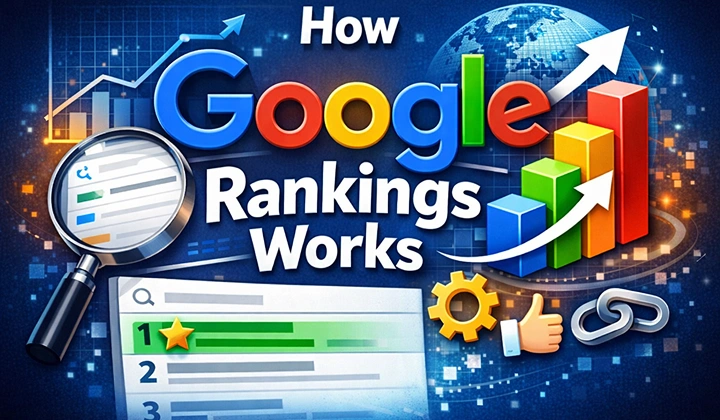
How Google rankings works: Google uses a complex algorithm — a set of rules — to evaluate and rank millions of web pages for every search query. It considers factors like relevance (does your page answer the search?), authority (do others trust your site?), and user experience (is your site fast and easy to use?) to decide which pages appear first. The goal is always to show the searcher the most helpful, credible result possible.
What Is Google’s Algorithm — And Why Should Business Owners Care?
Think of Google’s algorithm as a very smart librarian. Every time someone types a question into Google, this librarian sorts through billions of web pages in under a second and picks the ones most likely to help.
The algorithm uses over 200 ranking factors, but most fall into three buckets:
- Relevance — Does your page actually answer what the user is searching for?
- Authority — Is your website trusted and credible in your industry?
- Experience — Is your site fast, mobile-friendly, and easy to navigate?
According to Google’s Search Quality Evaluator Guidelines (2023), the search engine prioritises content that demonstrates Experience, Expertise, Authoritativeness, and Trustworthiness — known as E-E-A-T. This framework is essentially Google’s quality checklist for every website it evaluates.
How Does Google Decide What Ranks on Page One?
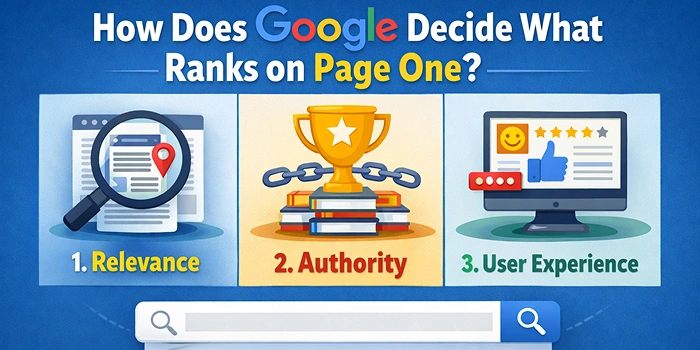
Let’s walk through the three pillars that determine whether you show up on page one — or page ten.
1. Relevance: Do You Match What People Are Searching For?
Google reads your web pages and tries to understand what they’re about. If someone searches ‘best digital marketing agency in Pune’ and your page uses similar language — naturally, in your content — Google is more likely to show it.
This is where keywords come in. Keywords are the words and phrases your potential customers actually type into Google. Knowing which ones to target — and how to use them naturally — is a core part of working with the best SEO services in Pune or doing it yourself.
2. Authority: Does Google Trust Your Website?
Trust is built through backlinks — when other reputable websites link to yours. Think of each link as a vote of confidence. The more credible the site linking to you, the more valuable that vote is.
According to Moz’s State of Link Building Report (2023), pages with a higher number of quality backlinks consistently outrank those with fewer links — even when their content is similar in quality.
3. User Experience: Is Your Website a Pleasure to Use?
Google now tracks signals like how long users stay on your page, whether they click back immediately, and how fast your site loads. A slow, cluttered website signals poor quality — and Google ranks it accordingly.
According to Google’s Core Web Vitals Report (2023), sites that meet Core Web Vitals benchmarks — covering speed, interactivity, and visual stability — are significantly more likely to rank in the top positions for competitive keywords.
What Are the Most Important Google Ranking Factors in 2026?
Not all 200+ ranking factors carry equal weight. Here are the ones that matter most for local businesses — especially if you’re considering working with the best SEO agency in Pune or handling SEO efforts yourself.
- High-quality, helpful content that genuinely answers real questions
- Mobile-friendliness (Google now indexes the mobile version of your site first)
- Page speed — particularly on mobile devices
- Secure website (HTTPS, not HTTP)
- Local SEO signals: Google Business Profile, local citations, and customer reviews
- Backlinks from credible, relevant websites in your industry
- Structured data (schema markup) that helps Google understand your content type
According to Semrush’s Ranking Factors Study (2023), direct website visits and pages-per-session are among the strongest correlating signals with high rankings — showing how much actual user behaviour now influences your position.
Why Is Local SEO Different From Regular SEO?
If you run a local business — a law firm in Pune, a restaurant in Koregaon Park, or a gym in Kothrud — you don’t need to compete with the whole world. You just need to show up when people nearby search for what you offer.
Local SEO focuses on appearing in the ‘local pack’ — the map results Google shows above the organic listings for searches with local intent like ‘plumber near me’ or ‘best local SEO expert in Pune.’
To rank locally, you need:
- A fully completed and regularly updated Google Business Profile
- Consistent NAP (Name, Address, Phone number) information across all online platforms
- Positive Google reviews — both quantity and recency matter
- Local content that mentions your city, neighbourhood, or service area
- Citations in Indian directories like Justdial, Sulekha, and IndiaMart
According to BrightLocal’s Local Consumer Review Survey (2023), 98% of consumers read online reviews for local businesses — and 87% use Google specifically. Your review profile directly impacts your local rankings.
A Real-World Scenario: What Happens When You Ignore SEO?
Imagine you run a chartered accountancy firm in Pune. You’ve got 15 years of experience, excellent client retention, and strong referrals. But when someone searches ‘CA firm in Pune’ on Google — you don’t appear anywhere in the first three pages.
Meanwhile, a smaller firm that started two years ago consistently shows up in positions 3 to 5. They’re not more experienced than you. They’ve simply invested in making sure Google knows they exist, where they’re located, and what they do.
This is exactly the kind of gap that the best SEO expert in Pune can help you close — not by gaming the system, but by ensuring your online presence genuinely reflects the quality of your offline business.
How Long Does It Take for Google Rankings to Improve?
One of the most common questions business owners ask — and the honest answer is: it depends. But here’s the data to set realistic expectations.
According to Ahrefs (2023), the average page that ranks in the top 10 results is over 2 years old — and only 22% of top-ranking pages were created within the past year. SEO is a long game.
That said, you don’t have to wait years to see any movement. Here’s a realistic benchmark:
| Timeline | What to Expect | Key Action |
| 1–3 Months | Google indexes your site; minor improvements | Fix technical SEO, set up GBP |
| 3–6 Months | Keyword rankings begin moving | Publish consistent quality content |
| 6–12 Months | Noticeable organic traffic growth | Build backlinks, earn reviews |
| 12+ Months | Sustained page-one rankings | Maintain and iterate strategy |
What Google Rankings Can’t Do — The Honest Trade-Offs
Let’s be transparent here, because trust matters more than hype.
SEO is not a magic switch. It won’t replace a broken product, fix poor customer service, or guarantee overnight success. It’s a long game — and if you stop investing in it, rankings can erode over time as competitors continue building.
Paid ads (Google Ads) can get you to page one faster, but the moment you stop paying, the visibility disappears entirely. Organic rankings, built through SEO, compound over time and continue delivering value long after the work is done.
Also worth noting: Google’s algorithm changes constantly. Strategies that worked two years ago may be less effective today — which is why partnering with a reputable best SEO agency in Pune that stays current with algorithm updates can make a significant difference to your long-term results.
Your Next Step: Turn Google Into Your Best Sales Tool
Now that you understand how Google rankings works, the question is: what are you going to do about it?
You don’t have to tackle this alone. Whether you’re just getting started or trying to recover lost rankings, the right SEO partner can make a measurable difference in how your business grows online.
This guide explains how Google rankings works in plain language, written for business owners, service professionals, and startup founders in Pune and beyond who want to grow online without deep technical knowledge.
We covered Google’s core algorithm pillars (relevance, authority, user experience), the key ranking factors that matter most in 2024, how local SEO differs from general SEO, realistic timelines for ranking improvements, and the honest trade-offs every business owner should understand before investing in SEO.
The article is backed by data from HubSpot, Moz, Ahrefs, BrightLocal, and Semrush — and includes expert insights from Rand Fishkin (SparkToro/Moz), Joy Hawkins (Sterling Sky), and Neil Patel (NP Digital).
FAQ’s on How Google Rankings Works:
Q1: How long does it take to rank on Google?
Most new pages take 6–12 months to rank on page one for competitive keywords. According to Ahrefs, only 22% of top-ranking pages were created within the past year. However, local searches and low-competition keywords can show results faster — sometimes within 3 months — especially with a well-optimised Google Business Profile and consistent local citations.
Q2: What is the most important factor in Google rankings?
There’s no single factor, but the most consistently powerful combination is: high-quality relevant content + strong backlinks + good user experience. Google’s own documentation emphasises E-E-A-T as the underlying quality framework. For local businesses specifically, Google Business Profile optimisation and customer reviews carry significant additional weight.
Q3: Can I rank on Google without paying for ads?
Absolutely. Organic SEO — improving your free, non-paid search rankings — is entirely separate from Google Ads. While ads get you to the top faster, organic rankings are more sustainable and cost-effective over time. Research consistently shows that most users trust and click organic results more than ads, making organic SEO more valuable for long-term brand credibility and lead generation.

Shivraaj is an experienced SEO Specialist with 6+ years of experience and passionate about helping businesses grow through strategic organic visibility. With strong expertise in AI Overview optimization, GEO targeting, and data-driven SEO strategies, he focuses on building results-oriented campaigns that enhance search performance and brand authority.
As a consultant and writer, Shivraaj is passionate about helping brands get more traffic, better engagement, and long-term success in today’s competitive digital world.