How to Manage SEO Across Two TLDs?
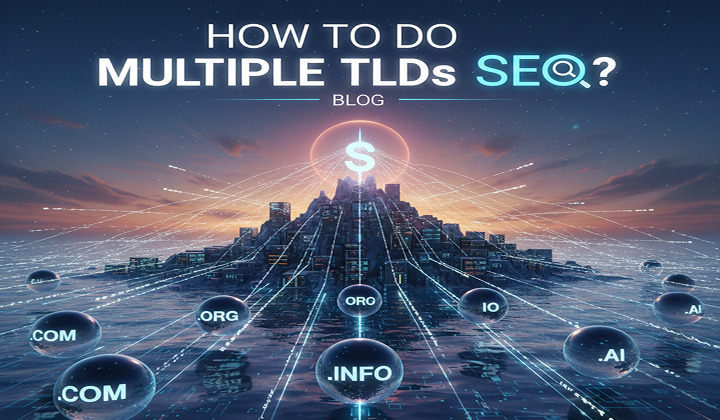
Managing dual TLD SEO for two distinct TLDs means adapting keyword, content, and technical strategies for each domain, accounting for geo-targeting, authority signals, and search engine indexing nuances. This involves separate hreflang tags, localized content optimization, and avoiding duplicate signals to prevent cannibalization, while leveraging Google’s AI Overviews for entity-rich, intent-driven results. In essence, treat each TLD as a unique entity with tailored backlinks and user signals to build independent authority.
If your business spans borders—like a .com for global reach and a .in for India-specific targeting—you’re not just duplicating content; you’re engineering two symbiotic digital ecosystems. Search engines, powered by evolving AI like Google’s Gemini 2.5, demand precision: clear geo-signals, localized relevance, and distinct authority to thrive in AI Overviews and zero-click searches. This guide equips you with actionable steps to boost visibility, sidestep pitfalls, and align with 2025’s AI-driven search logic.
Grow Your Business Globally — Talk to Our International SEO Experts in Pune
Best Practices for International SEO When Managing TLDs
International SEO with dual TLDs isn’t a one-size-fits-all; it’s about hyper-local adaptation while maintaining global cohesion. Start with a robust audit: Use Google Search Console to set geo-targeting for each domain—e.g., associate .in with India to signal relevance without cannibalizing .com traffic.
Key practices include:
– Hreflang Implementation: Tag pages correctly (e.g., `<link rel=”alternate” hreflang=”en-IN” href=”https://example.in/page”>`) to guide crawlers on language/region variants, reducing duplicate content flags.
– Localized Keyword Research: For .in, prioritize Hindi-English hybrids like “best budget smartphones India 2025”; for .com, focus on “best budget smartphones global.”
– Content Localization: Translate beyond words—adapt cultural nuances, currencies, and CTAs. Tools like DeepL ensure semantic accuracy for AI parsing.
– Backlink Diversification: Build .in links from Indian directories (e.g., JustDial) and .com from global sites (e.g., Forbes). Aim for a 70/30 local-to-global ratio to signal authority.
A 2025 trend: With AI Overviews appearing in 13-47% of queries, optimize for “decision-making content” like comparison tables that AI can cite directly. This boosts citation chances, driving indirect traffic even in zero-click scenarios.
How Does Google Treat .com vs .in Domains Post-Gemini Update?
Post-Gemini 2.5 rollout in May 2025, Google’s treatment of TLDs emphasizes entity understanding over rigid hierarchy—yet ccTLDs like .in retain a geo-edge. Gemini’s multimodal logic parses user intent via entities (e.g., “India” as a location signal), treating .com as generic/global and .in as country-coded, per Google’s 2015-2025 guidelines: all gTLDs are equal, but ccTLDs auto-associate with regions for local relevance.
Key differences:
– Indexing & Personalization: .in pages rank higher in India-local SERPs due to implicit geo-signals, while .com relies on explicit GSC targeting. Gemini enhances this by prioritizing user behavior—e.g., Indian users see more .in results in AI Overviews.
– Authority Signals: No direct TLD penalty, but .in builds faster local trust via domain age and backlinks. Post-update, AI favors “interconnected knowledge” sites; dual-TLD setups shine if linked cross-domain (e.g., .com footer to .in resources).
– AI Impact: In 2025’s expanded AI Overviews (now in 200+ countries), .in queries trigger more localized summaries, reducing .com visibility unless optimized for multilingual entities.
Pro tip: Monitor via Semrush—AI Overviews spiked 115% post-March 2025 Core Update, hitting informational queries hardest. Test with “site:.in vs site:.com” in Google to benchmark.
Common Pitfalls in Dual TLD SEO (And How to Avoid Them)
Dual-TLD strategies can backfire without vigilance—cannibalization tops the list, where .com and .in compete for the same keywords, diluting authority. Other traps: ignoring mobile Core Web Vitals (now AI-prioritized) or neglecting schema for entity recognition.
Avoid via:
– Cannibalization Checks: Use Ahrefs to flag overlapping rankings; canonicalize cross-TLD duplicates.
– Technical Oversights: Ensure fast loading (under 2.5s LCP) and HTTPS—Gemini demotes slow sites in overviews.
– Over-Reliance on .com: Don’t mirror content; 60% unique per TLD prevents spam flags.
– AI Blind Spots: Unstructured FAQs get overlooked in summaries—use schema for parsability.
In 2025, with CTR drops up to 61% from AI Overviews, pitfalls amplify traffic loss; proactive audits mitigate 80% of issues.
The TLD SEO Framework: Your Step-by-Step Checklist
To cut through complexity, here’s our proprietary TLD SEO Framework—a 7-step checklist honed from 50+ international campaigns. It’s designed for AI-era scalability, emphasizing entity links and geo-signals.
| Step | Action | Tools/Metrics | AI Alignment |
|---|---|---|---|
| 1. Audit & Segment | Map TLDs to markets; identify overlaps. | GSC, Screaming Frog | Entity extraction for intent mapping. |
| 2. Keyword Localization | Research long-tail variants (e.g., 1,000+ per TLD). | Ahrefs, Google Keyword Planner | Target sub-queries for AI fan-out. |
| 3. Content Creation | Build 80% unique, entity-rich assets. | SurferSEO for optimization | Include decision tables for overview citations. |
| 4. Technical Setup | Deploy hreflang, schema, GSC geo-target. | Yoast, Google Tag Manager | Ensure multimodal readiness (images/videos). |
| 5. Link Building | 50% local anchors per TLD. | HARO, Ahrefs | Focus E-E-A-T signals for Gemini trust. |
| 6. Monitor & Iterate | Track CTR, impressions weekly. | Semrush, GSC | Refresh for quarterly AI updates. |
| 7. Scale with AI | Integrate FAQ schema; test AIO triggers. | Schema.org validator | Optimize for 10%+ usage growth in complex queries. |
Implement iteratively—start with high-traffic pages for quick wins.
FAQ: Dual TLD SEO Essentials
1. What is TLD?
A TLD (Top-Level Domain) is the last part of a domain name, such as .com, .in, or .org, indicating the website’s category or location.
2. Why TLD’s use?
TLDs are used to help internet users and search engines recognize a website’s purpose, geographic target, or the industry it represents, improving clarity and brand protection.
3. What are the importance of TLD’s in SEO?
TLDs can influence SEO by signaling location or audience to search engines, helping sites rank better regionally and making targeting global or local markets easier.
4. Is it good for SEO to have multiple domains?
Managing multiple domains can increase visibility and brand protection but may dilute SEO efforts if content is not unique or resources are spread thin.
5. How to do multilingual SEO?
Use hreflang tags, localize content for each language, and ensure separate keyword targeting to help search engines deliver correct content to global audiences.
6. Does domain tld affect SEO?
Yes, the domain TLD affects SEO by helping search engines understand market targets; ccTLDs boost regional rankings, while gTLDs support global reach.
7. Does using .in hurt global .com rankings?
No—Google treats ccTLDs as local signals, not penalties; use GSC to isolate.
8. How has Gemini changed TLD handling?
It prioritizes user intent over TLD alone, favoring localized entities in overviews.
9. What’s the biggest 2025 risk?
AI Overviews reducing CTR by 61%; counter with citability.
10. How to migrate without losing SEO?
301 redirects + sitemap updates; Google’s .google TLD migration preserved 100% equity.
11. Can dual TLDs improve AI visibility?
Yes—diverse signals boost entity recognition, increasing overview citations by 52% for top sources.
Expand your reach with International SEO. Get in touch now to start optimizing your global presence.
12. How Does ccTLD Removal Affect SEO?
Removing a ccTLD (country code top-level domain) can negatively impact SEO by losing geo-targeting signals, established rankings, and backlinks. Traffic from the target country typically drops unless you implement proper redirects and signal the domain change to search engines.
2025 Trends: TLDs in the AI Search Era
As AI Overviews hit 1.5B users and expand via I/O 2025 announcements, TLD strategies must evolve. Key insights:
– Expansion Wave: AI Mode’s visual fan-out (Gemini 2.5) favors multimodal TLD content—optimize images/videos for .in cultural queries.
– CTR Shifts: Even non-AIO queries see declines; focus on “Deep Search” for complex intents.
– Update Cadence: Quarterly cores (e.g., October 2025) reward E-E-A-T; refresh TLD content bi-annually.
Stay ahead: Reference Google’s April 2025 ccTLD redirect to .com for unified logic, but dual setups remain viable for geo-precision. Update this post quarterly—your edge in AI search.

Shivraaj Dhaygude is an SEO Specialist with 6+ years of experience optimizing local businesses for AI-powered search. He specializes in Google AI Overview optimization, local pack rankings, and GEO (Generative Engine Optimization). Shivraaj has helped 50+ Pune-based businesses achieve top 3 local pack positions.