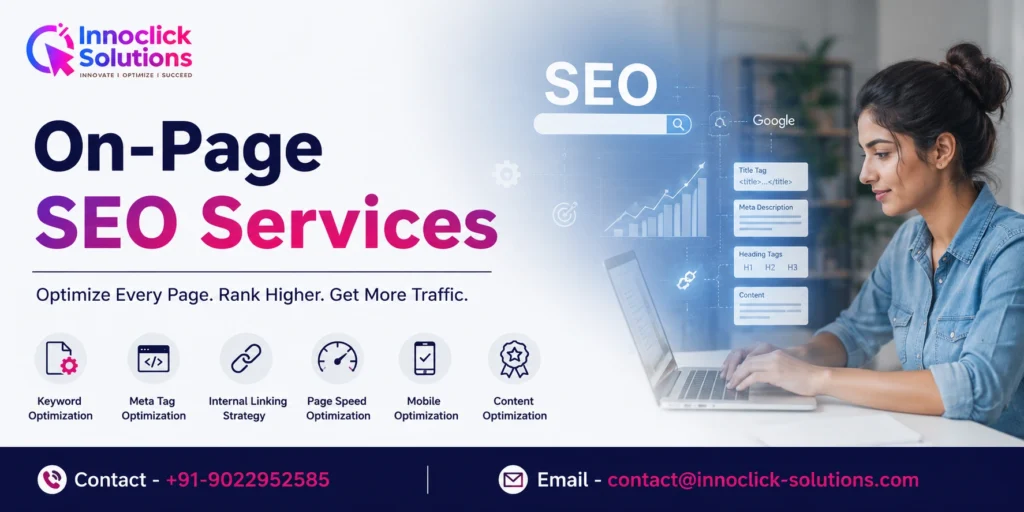
On-page SEO services optimize the content, HTML elements, and user-experience signals on individual web pages so search engines rank them higher and users click through. Done well, they deliver compounding ROI over 3–6 months — unlike paid ads, which stop the moment your budget does. For businesses in Pune and beyond, investing in the best SEO service providers in Pune is one of the highest-leverage growth decisions you can make.
On-page SEO services are one of the most powerful investments a website can make — yet most businesses barely scratch the surface. Consider this: the #1 result on Google earns 39.8% of all clicks, while the page sitting at position #10 earns just 1% [1]. The difference between those two positions is almost always on-page SEO. In this guide you will learn exactly what on-page SEO services include, how Google evaluates each element, which of the 12 key factors move the needle most, and how to choose a provider — including why many growing businesses are turning to affordable SEO services in Pune to compete at scale.
Key Takeaways
- On-page SEO directly controls how search engines understand and rank your content — you are fully in charge of every lever.
- It covers 12+ factors: title tags, content depth, page speed, internal links, schema markup, and more.
- Professional on-page SEO services deliver measurable ROI — typically visible within 3–6 months of implementation.
- Choosing the right provider means looking beyond checklists to strategy, communication, and transparent reporting.
- 96.55% of all web pages get zero organic traffic — optimising on-page elements is what separates visible sites from invisible ones [2].
What Are On-Page SEO Services?
On-page SEO services are professional optimisations applied directly to the content and HTML of your web pages to help search engines understand what each page is about and rank it for the right queries. They cover everything from title tags and meta descriptions to heading structure, keyword placement, internal linking, image alt text, schema markup, Core Web Vitals, and overall content quality — all within your own site.
On-Page SEO vs. Off-Page SEO vs. Technical SEO
Understanding where on-page SEO sits in the broader picture prevents wasted effort. The three pillars work together, but each has a distinct role:
| Factor | On-Page SEO | Off-Page SEO | Technical SEO |
| Focus | Content & HTML elements | Links & brand mentions | Site infrastructure |
| Who Controls It? | Site owner / agency | Partly external | Developer / agency |
| Examples | Title tags, meta, content | Backlinks, social signals | Crawlability, page speed, indexing |
| Impact Speed | 3–6 months | 6–12 months | Weeks–months |
On-page SEO is the foundation. Without it, off-page link building and technical fixes have far less impact. Think of it as building a strong argument for Google’s algorithm — you are telling the search engine exactly what your page is about, who it is for, and why it deserves to rank. For more context on how SEO compares with paid and social channels, see our guide on SEO vs other digital marketing strategies.
What Do On-Page SEO Services Typically Include?
A reputable provider of on-page SEO services will usually deliver:
- Title tag and meta description optimisation
- H1/H2/H3 heading hierarchy restructuring
- Primary and LSI keyword mapping and natural placement
- Content quality review and rewriting for E-E-A-T signals
- Internal linking strategy and implementation
- Image alt text, filename, and compression optimisation
- Schema markup (Article, FAQ, HowTo, Product, LocalBusiness)
- Page speed and Core Web Vitals improvements (LCP, INP, CLS)
- Mobile-first optimisation audit
- URL structure cleanup
How Does On-Page SEO Actually Work?
On-page SEO works by aligning your page’s content and HTML signals with what Google’s crawlers look for when deciding relevance and quality. Google crawls your URL, reads HTML elements (title, headings, body, schema), assesses content depth against search intent, measures user-experience signals like page speed, and then ranks the page in its index accordingly.
How Google Reads and Evaluates a Page
Google’s Googlebot crawls billions of URLs. When it reaches your page, it reads:
- The <title> tag and meta description (to understand the topic and measure CTR potential).
- The H1 and heading hierarchy (to map the content’s structure and subtopics).
- Body copy — including keyword placement, semantic richness, and reading depth.
- Structured data / schema markup (to serve rich results like FAQ boxes or star ratings).
- Technical signals — page speed, mobile responsiveness, Core Web Vitals scores.
After crawling, the page enters the index. Google’s ranking systems then weigh it against hundreds of signals before deciding its position on the SERP.
The Role of Search Intent
Matching content to search intent is the single biggest on-page lever in 2026. If a user searches ‘best on-page SEO services‘ they have commercial-investigation intent — they want comparison, benefits, and pricing. Publishing a purely definitional article will underperform regardless of how well the keywords are placed. Professional on-page SEO services analyse SERPs to understand the dominant intent and restructure content accordingly.
How On-Page SEO Aligns with Google’s Current Systems
Three Google systems matter most in 2026:
- Helpful Content System — rewards pages that demonstrate real expertise and satisfy the reader completely, without thin or AI-spun filler.
- E-E-A-T (Experience, Expertise, Authoritativeness, Trustworthiness) — on-page signals like author bios, citations, and original data reinforce trust.
- Core Web Vitals — LCP under 2.5 seconds, CLS under 0.1, and a responsive INP are now baseline expectations. Yet 45.4% of websites still fail at least one [3].
What Are the 12 Key On-Page SEO Factors?
The 12 key on-page SEO factors are: title tags, meta descriptions, H1 and heading hierarchy, URL structure, keyword optimisation, content quality and depth, internal linking, image optimisation, page speed and Core Web Vitals, mobile optimisation, schema markup, and user-experience signals. Together they determine whether Google can understand, index, and rank a page effectively.
- Title Tags — 60-character limit; front-load the primary keyword; Google rewrites them 76% of the time when they are weak [4].
- Meta Descriptions — Not a ranking factor, but a CTR driver. A compelling 155-char description can boost clicks by 5.8% from the same ranking position.
- H1 & Heading Hierarchy — One H1 per page (matching the primary keyword); H2s and H3s provide semantic structure for crawlers and readers alike.
- URL Structure — Short, descriptive, keyword-containing slugs. Avoid parameter-heavy URLs and unnecessary subfolders.
- Keyword Optimisation & Semantic Coverage — Primary keyword in the first 100 words, naturally placed; LSI and NLP variants throughout.
- Content Quality & Depth — Google’s Helpful Content system rewards thorough, expert content. Thin pages rarely reach page one.
- Internal Linking — Distributes page authority, guides Googlebot to deep pages, and reduces bounce rate by offering users relevant next steps.
- Image Optimisation — Descriptive alt text, compressed WebP files, and correct dimensions improve accessibility and image-search visibility.
- Page Speed & Core Web Vitals — 53% of mobile users abandon pages that load in more than 3 seconds [5]. LCP, INP, and CLS are direct ranking inputs.
- Mobile Optimisation — Google uses mobile-first indexing. 80% of top-ranking pages are mobile-optimised [6].
- Schema Markup — Structured data unlocks rich results (FAQ boxes, star ratings, HowTo steps) that dramatically increase SERP real estate and CTR.
- User-Experience Signals — Dwell time, engagement rate, and scroll depth all feed back into Google’s quality assessment.
What Are the Real Benefits of On-Page SEO Services?
The primary benefits of on-page SEO services are improved organic rankings, higher click-through rates, better user experience, more qualified traffic, and long-term ROI that far exceeds paid advertising on a cost-per-visitor basis. Unlike ads, an optimised page continues delivering traffic for years without ongoing spend.
According to industry data, the median SEO programme delivers approximately 748% ROI — $7.48 for every $1 invested. That compounds: a page optimised once keeps earning traffic, while Google Ads spend stops producing the moment the budget runs out. If you have been wondering why businesses should invest in SEO services, this statistic says it clearly. For a deeper look at the business case, read our post on why business should invest in SEO services?
Benefit Breakdown
- Improved Rankings & Visibility — Optimised pages consistently climb SERPs over 3–6 months as Google re-crawls and reassesses content.
- Higher CTR — Better titles and meta descriptions earn more clicks from the same ranking position. Moving from #2 to #1 yields 74.5% more clicks [8].
- Lower Bounce Rate — Fast, well-structured pages with clear intent alignment keep visitors reading.
- More Qualified Traffic — Intent-matched content attracts buyers in the decision phase, not just random browsers.
- Stronger Brand Authority — Ranking in the top 3 signals credibility to users who subconsciously trust high-ranking results.
How Does On-Page SEO Differ Across Business Types?
On-page SEO strategy varies significantly by business model. E-commerce sites prioritise product schema and category-page optimisation; local businesses need geo-targeted keywords and LocalBusiness schema; SaaS and B2B companies focus on feature-comparison pages and lead-gen CTAs; service businesses combine location+service keyword pairs with strong trust signals.
E-Commerce Websites
Product pages need unique, benefit-focused copy (not manufacturer descriptions), Product schema with pricing and availability, and compressed high-res images with descriptive alt text. Category pages target broader commercial keywords and internally link to product clusters.
Local Businesses
Local on-page SEO blends geo-modifiers (e.g., digital marketing agency Pimpri-Chinchwad) with LocalBusiness schema, consistent NAP (Name, Address, Phone), and location-specific landing pages. Businesses looking for the best SEO service providers in Pune should specifically ask whether their provider builds hyper-local content and schema — not just generic optimisation.
SaaS & B2B Websites
Feature pages, integration pages, and comparison content (“X vs Y”) are the highest-intent real estate for SaaS brands. On-page SEO here means precise keyword mapping to buyer-stage intent, strong CTAs, and social proof embedded naturally within the content.
Service-Based Businesses
Service businesses thrive on location + service keyword combinations — e.g., “affordable SEO services in Pune” or “web design company Kothrud”. Each service gets its own optimised page with a clear CTA, trust signals (client logos, case study snippets), and FAQPage schema.
How Long Does On-Page SEO Take to Show Results?
On-page SEO typically shows early ranking movements within 1–3 months, measurable organic traffic growth by months 4–6, and compounding lead generation improvements beyond month 6. Timeline depends on domain authority, competition level, and how quickly Google re-crawls the updated pages.
The Realistic Month-by-Month Timeline
- Months 1–2: Audit and implementation. The service provider conducts a full site audit, prioritises quick wins (meta tags, title tags, broken internal links), and begins content rewriting. No visible SERP change yet — Google needs to re-crawl.
- Months 3–4: Google re-crawls updated pages and begins reassessing rankings. Early movers — especially pages that were just outside the top 10 — will see upward movement.
- Months 5–6+: Measurable organic traffic increases. Pages targeting mid-competition keywords often reach page one. Lead volume from organic starts to rise.
Curious about specific timelines for your niche? Our detailed breakdown on how long does SEO take to show results
covers domain authority, competition, and content freshness in depth.
Should You DIY On-Page SEO or Hire a Professional Service?
DIY on-page SEO is viable for small sites with low competition and a willing learner. For growing businesses, competitive niches, or sites with more than 20–30 pages, professional on-page SEO services deliver faster, more consistent results because agencies bring proven processes, specialist tools, and pattern-matched experience across hundreds of sites.
| Factor | DIY On-Page SEO | Professional Service |
| Cost | Low (but high time cost) | Monthly retainer or project fee |
| Speed | Slow — steep learning curve | Fast — proven processes |
| Quality | Variable | Consistent and strategic |
| Scalability | Limited | Scales with your site |
| Best For | Small sites, low competition | Growing businesses, competitive niches |
If budget is a concern, explore affordable SEO services in Pune — several local agencies offer project-based on-page audits starting from ₹15,000–₹25,000, making professional-grade optimisation accessible for SMBs. For pricing context, see our guide on SEO services cost in Pune.
What On-Page SEO Mistakes Do Most Businesses Make?
The most common on-page SEO mistakes are keyword stuffing, thin or duplicate content, missing schema markup, neglecting Core Web Vitals, broken internal links, optimising for wrong-intent keywords, and treating SEO as a one-time task rather than an ongoing discipline. Each mistake directly costs rankings, traffic, and revenue.
- Keyword stuffing — cramming the primary keyword into every sentence triggers Google’s spam filters, not ranking boosts.
- Thin or duplicate content — multiple pages saying the same thing cannibalise each other and signal low quality.
- Missing or broken internal links — isolated pages struggle to receive crawl budget or pass authority.
- No schema markup — you are leaving rich result real estate — FAQ boxes, star ratings, HowTo steps — on the table.
- Wrong-intent keywords — a transactional page targeting an informational keyword will always underperform.
- Ignoring Core Web Vitals — 86% of marketers cite slow site speed as the primary reason visitors leave [9]. It also directly impacts rankings.
- Set-it-and-forget-it mentality — Google’s algorithms update constantly. On-page SEO needs quarterly reviews to stay competitive.
How Do You Choose the Right On-Page SEO Service Provider?
Choose an on-page SEO provider by evaluating their audit process, transparency, reporting quality, case studies, and whether they treat SEO as strategy — not just a checklist. Avoid any provider who guarantees #1 rankings, refuses to share their methodology, or cannot show measurable results from past clients.
Questions to Ask Before Hiring
- What does your audit process look like, and what tools do you use?
- How do you measure and report results — what KPIs do you track?
- Do you provide a content strategy, or just technical fixes?
- Can I see case studies or before/after ranking screenshots?
- Is this a one-time project or an ongoing retainer, and what is included each month?
Red Flags to Avoid
- Guaranteed #1 rankings — no legitimate agency can promise this.
- No transparency on what work is being done each month.
- Black-hat tactics — hidden text, keyword stuffing, or link schemes.
- No reporting cadence or refusal to share Google Search Console data.
If you are searching for the best SEO service providers in Pune, a structured vetting process protects your investment. Our full guide on how to choose the best SEO agency in Pune walks through all 10 factors — including local market knowledge, pricing benchmarks, and what a good proposal looks like.
How Do You Measure Whether On-Page SEO Services Are Working?
Measure on-page SEO success using Google Search Console (keyword rankings, CTR, impressions), GA4 (organic traffic, sessions, conversions), and PageSpeed Insights (Core Web Vitals). Meaningful improvements typically become visible within 3–6 months; a good provider reports monthly against agreed KPIs.
| KPI | Tool to Track | Healthy Target |
| Keyword Rankings | Google Search Console, Semrush | Top 10 within 3–6 months |
| Organic Traffic | GA4 + Google Search Console | +20–50% over 6 months |
| Click-Through Rate (CTR) | Google Search Console | >3–5% for informational pages |
| Core Web Vitals (LCP, INP, CLS) | PageSpeed Insights / GSC | LCP < 2.5s, CLS < 0.1 |
| Conversion Rate (Organic) | GA4 Goals | 1–5% depending on industry |
Monthly reporting should include ranking movements for tracked keywords, organic traffic trends, CTR changes on optimised pages, and Core Web Vitals scores. If a provider cannot show you this data, that is a serious red flag.
Conclusion
On-page SEO services are not a cost — they are a compounding asset. Every page you optimise continues earning clicks and leads long after the work is done, unlike paid ads that vanish the moment your budget stops. From title tags and schema markup to content depth and Core Web Vitals, each of the 12 factors covered in this guide builds the foundation for durable organic growth. Whether you DIY or partner with the best SEO service providers in Pune, start with an audit, prioritise high-impact pages first, and track results monthly.
FAQ’s:
1. Is on-page SEO a one-time service or an ongoing process?
It is both. Initial optimisation is a project — auditing and updating existing pages. Staying ahead of algorithm updates, adding fresh content, and monitoring new keyword opportunities make on-page SEO an ongoing discipline for best long-term results.
2. How much do on-page SEO services cost in Pune?
Costs vary by scope. A single-page audit from an affordable SEO services provider in Pune can start from ₹5,000–₹15,000; full-site ongoing services typically range from ₹20,000–₹80,000 per month depending on site size, competition, and deliverables. See our full pricing guide for 2026.
3. What is the difference between on-page SEO and technical SEO?
On-page SEO covers content and HTML elements visible to users and search engines — title tags, headings, body copy, schema, and internal links. Technical SEO covers backend infrastructure — crawlability, indexation, site architecture, robots.txt, and server response times.
4. Can I do on-page SEO myself without hiring a service?
Yes, for small sites with fewer than 20 pages and low keyword competition. For larger sites or competitive markets, professional services deliver faster and more consistent results because agencies have specialist tools, data benchmarks, and pattern-matched experience across many industries.
5. How do I know if my on-page SEO is working?
Track keyword ranking movements in Google Search Console, organic traffic trends in GA4, CTR improvements on optimised pages, and Core Web Vitals scores in PageSpeed Insights. Meaningful improvements typically appear within 3–6 months of implementation.

Shivraaj Dhaygude is a Pune-based SEO Specialist with over 6+ years of hands-on experience helping local businesses dominate Google Search and AI-powered results. He specializes in Local Pack optimization, Google AI Overview visibility, and Generative Engine Optimization (GEO) — an emerging discipline focused on appearing inside AI-generated search answers.
Shivraaj has personally led SEO campaigns for 50+ SMBs across Pune and Maharashtra, consistently delivering top-3 local pack rankings and measurable increases in organic leads. His approach combines technical SEO foundations with AI search readiness strategies, giving clients a competitive edge as search evolves.
He writes about local SEO, GEO, and AI search trends based on real client data and ongoing experimentation — not theory.