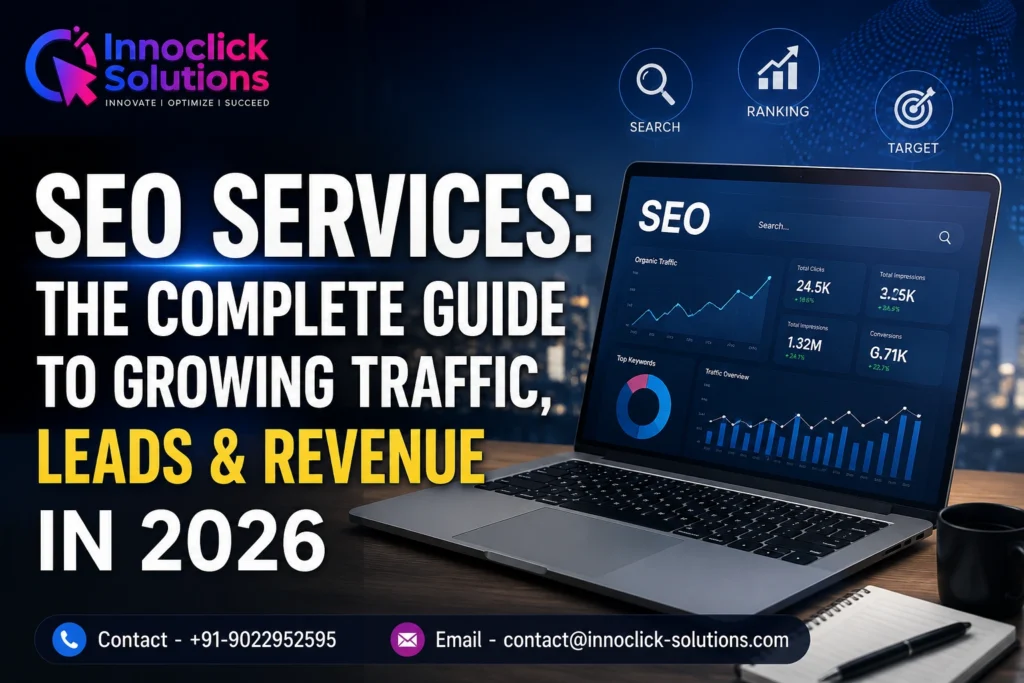
SEO services are a suite of ongoing optimization activities — spanning technical, content, link building, and AI search — that grow your website’s organic visibility, leads, and revenue. Businesses investing in professional SEO services see a median ROI of 748%, with meaningful results typically appearing between months 6 and 12. Choosing the right agency requires evaluating deliverables, transparency, and AI-search readiness.
Organic search drives 53% of all website traffic globally — and SEO services are what put businesses in front of that audience. SEO-generated leads close at 14.6%, compared to just 1.7% for outbound methods. Yet most businesses either don’t invest in SEO, or invest without understanding exactly what they’re paying for.
This guide covers everything you need to know: what SEO services include, how much they cost, what ROI to realistically expect, and how to choose an agency that delivers measurable results — not just ranking reports. By the end, you’ll know exactly what to buy, at what price, and how to hold your agency accountable.
Quick Summary
- SEO services encompass 7 disciplines: technical SEO, on-page, off-page/link building, local SEO, content SEO, e-commerce SEO, and AI search optimization (GEO).
- Median SEO ROI is 748% — but results compound over 12–18 months, not overnight.
- Monthly retainers typically range from $500 for local businesses to $50,000+ for enterprise.
- The most effective SEO programs combine content + link building as a compounding flywheel.
- Fewer than 10% of agencies currently offer GEO/AI overview optimization — a major differentiator in 2026.
What Are SEO Services?
SEO services are ongoing or one-time optimization activities that improve a website’s visibility in search engines — driving organic traffic, leads, and revenue without paid advertising. They cover everything from the technical health of your site to the quality of your content and the authority of your backlink profile.
SEO is not pay-per-click advertising, social media marketing, or a one-time fix. It is a sustained discipline that compounds over time. A well-executed SEO program builds an asset — your organic search presence — that continues generating returns long after the initial investment.
To understand what you’re buying, it helps to think in three layers. The first is technical SEO: making sure search engines can properly crawl, index, and understand your site. The second is content and on-page SEO: ensuring your pages address the right topics with the right language. The third is authority building: earning trust signals (primarily backlinks) from other credible websites.
Every reputable SEO agency delivers work across all three layers. The mix shifts depending on your site’s maturity and competitive landscape.
What Are the 7 Core Types of SEO Services?
The seven core types of SEO services are: technical SEO, on-page SEO, off-page SEO/link building, local SEO, content SEO, e-commerce SEO, and GEO (AI search optimization). Each addresses a distinct component of organic visibility — and effective programs typically combine several in parallel.
| SEO Service Type | What It Does | Best For |
|---|---|---|
| Technical SEO | Fixes crawlability, speed, indexing | All sites |
| On-Page SEO | Optimizes content, titles, meta tags | Content-heavy sites |
| Off-Page / Link Building | Earns authority through backlinks | Competitive niches |
| Local SEO | Optimizes for map pack & local queries | Brick & mortar, service areas |
| Content SEO | Creates keyword-targeted content | B2B, SaaS, e-commerce |
| E-Commerce SEO | Product pages, category structure, schema | Online stores |
| GEO / AI Search Optimization | Optimizes for AI Overviews, ChatGPT, Perplexity | All businesses — emerging must-have |
Technical SEO
Technical SEO addresses the infrastructure of your website. Core deliverables include crawlability audits, indexation management, Core Web Vitals (LCP, CLS, INP), mobile-first optimization, HTTPS compliance, and structured data (schema markup).
Without a technically sound foundation, even the best content may never get indexed or ranked. Google’s crawl budget is finite — every broken link, redirect chain, or duplicate page wastes it.
On-Page SEO
On-page SEO optimizes the content and HTML elements on individual pages. This includes title tags, meta descriptions, H1–H3 heading structure, keyword placement, internal linking, and content depth. These are the signals search engines read to understand what a page is about and how relevant it is to a given query.
Off-Page SEO and Link Building
Off-page SEO is primarily about earning backlinks — editorial citations from other websites that signal authority to Google. Methods include digital PR, editorial outreach, guest posting on relevant sites, and unlinked brand mention reclamation. Domain authority built through quality backlinks is one of the most durable ranking factors in competitive markets.
Local SEO
Local SEO optimizes your presence for geographically specific searches and the Google Maps “local pack.” Key deliverables include Google Business Profile optimization, consistent NAP (Name, Address, Phone) citations across directories, review acquisition strategies, and local schema markup. This is essential for any business that serves customers in a defined geographic area.
Content SEO
Content SEO is the discipline of creating and optimizing content that targets high-value keywords your audience is actively searching for. It includes keyword research, topic cluster development, long-form content creation, and content refreshing. Content SEO is particularly high-ROI for B2B, SaaS, and e-commerce brands with complex buyer journeys.
E-Commerce SEO
E-commerce SEO addresses the unique challenges of product-heavy sites: product schema markup, category page optimization, faceted navigation, thin content issues from duplicate product descriptions, and site architecture that funnels link equity to high-priority pages.
GEO — AI Search Optimization
GEO (Generative Engine Optimization) is the practice of optimizing content for AI-generated answers on platforms like Google AI Overviews, ChatGPT, Perplexity, and Claude. Deliverables include llms.txt compliance, passage-level citability, structured content formatting, and brand mention signals. Fewer than 10% of agencies currently offer this as a defined service in 2026 — making it a significant differentiator for buyers who want visibility beyond traditional search.
What’s Included in a Monthly SEO Retainer?
A monthly SEO retainer typically includes technical audit monitoring, keyword rank tracking, content production, link building activity, Google Business Profile management (for local clients), and a monthly performance report. The exact deliverables should be listed in writing before you sign.
Standard Monthly Deliverables Checklist
- Technical health monitoring (crawl errors, Core Web Vitals alerts)
- Keyword ranking report (positions, movement, visibility score)
- Content production (agreed monthly cadence — e.g., 4 blog posts)
- Link building (outreach sent, placements secured, domains earned)
- Google Business Profile updates (for local clients)
- Monthly performance report with organic traffic, conversions, and lead attribution
What Every Monthly Report Should Show
- Rankings movement (week-over-week and month-over-month)
- Organic traffic from GA4, filtered to organic search channel
- Leads or conversions attributed to organic traffic
- Domain Authority or Domain Rating trend
- Backlink profile health (new links earned, toxic links flagged)
Red Flags in Bad SEO Retainers
Watch out for retainers with vague deliverables like “ongoing optimization activities” — with no content calendar, no link building report, and no connection between organic traffic and actual business outcomes. If your monthly report only shows rankings without tying them to leads or revenue, ask for more. A good agency reports on business impact, not just search engine positions.
How Much Do SEO Services Cost in 2026?
SEO services pricing in 2026 typically ranges from $500/month for small local businesses to $50,000+/month for enterprise programs. The right investment depends on your market’s competitiveness, your site’s current health, and your revenue goals. One-time audits run $1,500–$5,000; ongoing retainers are required for sustained results.
| Business Type | Typical Monthly Investment | What You Get |
|---|---|---|
| Small / Local Business | $500–$2,000/mo | Local SEO, GBP, basic content |
| SMB / Regional | $2,500–$5,000/mo | Full-service SEO, content + links |
| National / Competitive | $5,000–$10,000+/mo | Deep content, aggressive link building, GEO |
| Enterprise | $10,000–$50,000+/mo | Multi-team, technical depth, international |
One-Time vs. Ongoing SEO
A one-time technical audit ($1,500–$5,000) is a valuable starting point but not a substitute for an ongoing retainer. SEO results decay without fresh content production and continued link acquisition. Think of it like physical fitness — a one-time session helps, but the results only last if you keep showing up.
What Does $1,500/Month Actually Buy?
At $1,500/month, you’re funding roughly 10–15 hours of professional work. In a competitive market, that typically covers: a technical health check, 1–2 content pieces per month, and basic rank tracking. It’s the floor for meaningful progress — not a complete program. For national or B2B markets with competitive keywords, $3,000–$5,000/month is the realistic minimum for measurable returns within 12 months.
Red Flags in SEO Pricing
Be skeptical of retainers under $500/month promising Page 1 rankings, guaranteed ranking timelines, or mystery “link packages.” Ask every prospective agency: how many hours are included, which team members will work on the account, and what specific deliverables are scoped per month?
What ROI Can You Realistically Expect From SEO Services?
The median SEO ROI is 748%, meaning businesses return approximately $22 for every $1 invested in professional SEO services. That said, ROI is not linear — it compounds over time, with the majority of returns accruing after month 12 as domain authority and content volume build.
SEO ROI Statistics for 2026
- Median SEO ROI: 748% ($22 per $1 invested)
- SEO leads close at 14.6% vs. 1.7% for outbound methods
- 49% of marketers rank organic search as their highest-ROI channel
- Organic leads show 20–30% higher lifetime value than paid leads
ROI by Industry — Benchmark Table
| Industry | Average SEO ROI | Notes |
|---|---|---|
| Real Estate | 1,389% | Highest measured ROI of any sector |
| Legal / Law Firms | 526% | High intent + high-value conversions |
| SaaS / B2B | 702% | Organic drives ~44.6% of B2B revenue |
| E-Commerce | 317% | Strong after 12+ months; slow ramp |
| Healthcare | 401% | YMYL sensitivity; E-E-A-T critical |
| Home Services / Local | 481% | Strong local pack + map signals |
The SEO ROI Timeline: Month by Month
- Months 1–3 (Foundation): Technical audit, fixes, keyword strategy, content architecture. Minimal traffic impact — this is groundwork, not results.
- Months 4–6 (Early Traction): Long-tail keyword rankings appear, indexing gains accelerate, initial organic traffic growth begins.
- Months 6–12 (Measurable Returns): Significant traffic growth, lead increases, movement on competitive keywords.
- Month 12+ (Compounding Returns): Full ROI realization. Returns compound year over year as domain authority builds and content clusters mature.
How Does the SEO Content and Link Building Flywheel Work?
The SEO flywheel works as a self-reinforcing cycle: quality content earns backlinks → backlinks boost rankings → higher rankings drive organic traffic → traffic generates leads and revenue → revenue funds more content and link building. The flywheel only works when both content and links are consistently invested in.
Content without links plateaus. Google may index well-written pages, but without authority signals, competitive keywords remain out of reach. Links without quality content decay — thin pages that attract links through outreach alone rarely hold rankings after algorithm updates.
The implication for buyers: be cautious of agencies that sell only content or only link building. The most durable SEO programs invest in both simultaneously, at a cadence matched to the site’s competitive environment.
What happens when you stop? Rankings decay within 6–18 months without fresh content and ongoing link acquisition. Unlike PPC — where results vanish the moment you pause spend — SEO decay is gradual. But it is real, and reversing lost rankings costs more than maintaining them.
DIY, Freelancer, or SEO Agency — Which Is Right for You?
The right choice between DIY, freelancer, and SEO agency depends on your budget, market competitiveness, and internal bandwidth. DIY is viable for early-stage businesses under $500/month. A freelance specialist suits local businesses with focused needs. A full-service agency is the right fit for SMBs to enterprise brands targeting competitive regional or national keywords.
| Situation | Best Fit | Why |
|---|---|---|
| Budget under $500/month, early-stage startup | DIY + tools (Ahrefs, SEMrush) | Agencies can’t operate effectively at this budget |
| Local service business, 1–3 locations | Freelance specialist or local agency | Focused scope, cost-efficient |
| SMB targeting regional/national keywords | Full-service SEO agency | Needs coordinated content + links + technical work |
| Enterprise with complex site (10k+ pages) | Agency with technical SEO specialists | Requires crawl budget management, log file analysis |
| SaaS, content-led growth model | Content SEO agency or in-house + agency hybrid | High content velocity + strategic link acquisition |
Before choosing, ask yourself three questions: How competitive is your market? Do you have internal bandwidth to manage a freelancer or review agency deliverables? Is your site technically sound, or does it need a full audit before content investment makes sense?
How Do You Choose the Right SEO Agency in 2026?
Choosing the right SEO agency requires evaluating five things: their goal alignment with yours, their own search visibility, the specificity of their deliverables, their link building process transparency, and their AI search readiness. Vague deliverables, guaranteed rankings, and absence of GEO services are the clearest red flags.
Step 1: Define Your Goal First
Traffic, leads, revenue, local visibility, and AI search presence are different goals that different agency types are built to deliver. Be specific. Share your revenue targets, not just keyword lists.
Step 2: Audit Their Own Site
Does the agency rank for competitive SEO keywords? If they can’t demonstrate organic visibility for their own site, that’s a meaningful data point. Use Ahrefs or SEMrush to check their domain’s organic traffic before the first call.
Step 3: Review Their Deliverables List
Ask for a sample deliverables schedule. If you see phrases like “ongoing optimization activities” without specifics, it’s a red flag. Green flags: a defined content calendar, link placement reporting with live URLs, and a monthly KPI dashboard tied to business outcomes.
Step 4: Ask About Their Link Acquisition Process
Black-hat signals include Private Blog Networks (PBNs), bulk directory submissions, and guaranteed link placements for fixed fees. Green flags: editorial outreach to real-traffic sites, digital PR campaigns, and transparent reporting on domain metrics of placed links.
Step 5: Check Their AI Search Readiness
Ask directly: “Do you offer GEO or AI overview optimization as a service?” Can they explain how they’d optimize your content for Perplexity, ChatGPT, and Google AI Overviews? This capability separates forward-thinking agencies from those still operating on 2022 playbooks.
10 Questions to Ask on Your First Agency Call
- What does your link building process look like, specifically?
- How do you measure success beyond keyword rankings?
- Can you share a sample monthly performance report?
- How do you respond to algorithm updates?
- What does the first 90 days look like in terms of deliverables?
- Who will be our primary point of contact, and what’s their SEO background?
- Do you offer AI search / GEO optimization?
- What industries have you worked in, and can you share results data?
- How do you involve subject matter experts in content creation?
- If we leave, do we retain ownership of all content and links built?
How Do You Measure SEO’s Impact on Revenue?
Measuring SEO’s revenue impact requires three steps: setting up organic conversion tracking in GA4, calculating media value equivalence, and attributing lifetime customer value to organic acquisition. The core formula is: (Revenue from Organic Traffic – SEO Cost) / SEO Cost × 100 = SEO ROI%.
Setting Up Organic Conversion Tracking in GA4
Create conversion events for your primary business actions: lead form submissions, phone calls, demo requests, and purchases. In GA4’s Acquisition report, filter to “Organic Search” as the channel. Every conversion in that view is attributable to your SEO investment.
The Media Value Equivalence Method
Calculate what your current organic traffic would cost if you purchased those same clicks through Google Ads. Formula: Monthly organic clicks × average CPC for those keywords = monthly media value. Example: 5,000 clicks/month × $10 average CPC = $50,000/month in media value for an SEO program that might cost $3,000–$5,000/month.
The SEO ROI Formula
(Revenue from Organic – SEO Cost) / SEO Cost × 100 = SEO ROI%
Example: $40,000 in organic-attributed revenue, $4,000 SEO cost = ($40,000 – $4,000) / $4,000 × 100 = 900% ROI.
Tag organic leads in your CRM and track churn rates and repeat purchase behavior separately from paid acquisition cohorts. Organic leads consistently show 20–30% higher lifetime value — a metric that dramatically improves the business case for SEO investment when presented to finance teams.
SEO Services FAQs
Q1. How long does SEO take to show results?
Initial ranking movement typically appears in months 3–6. Meaningful lead volume begins months 6–12. Full ROI realization takes 12–18 months for most businesses in competitive markets.
Q2. What is the difference between on-page and off-page SEO?
On-page SEO covers optimizations made directly on your site — content quality, title tags, internal links, and page structure. Off-page SEO refers to actions taken outside your site, primarily earning backlinks from other authoritative websites.
Q3. Can I do SEO myself?
Yes, especially at early stages with a limited budget. DIY SEO is viable for local businesses and early-stage sites. For competitive national or B2B markets, a professional agency typically delivers far better ROI because the workload and technical complexity exceed what most in-house teams can sustain.
Q4. How do I know if my SEO agency is doing a good job?
A good agency reports on organic traffic growth, keyword ranking improvements, leads attributed to organic, and backlinks earned. If your monthly report shows only rankings with no connection to business outcomes, ask for a revised reporting framework.
Q5. Is SEO still worth it in 2026 with AI search?
Yes. AI search surfaces content from well-optimized sites — the same signals that help you rank on Google also improve your visibility in AI Overviews, ChatGPT, and Perplexity. GEO is an extension of SEO, not a replacement for it.
Conclusion
SEO services span seven disciplines — from technical infrastructure to AI search optimization — and when executed with the right strategy, they deliver a median ROI of 748% over 12–18 months. The critical variable is choosing an agency whose deliverables are specific, whose reporting connects organic traffic to actual business outcomes, and whose team is positioned for the AI search era — not just traditional Google rankings.
Don’t settle for ranking reports. Demand revenue attribution.
Ready to see what’s holding your site back? Get a free SEO audit from InnoClick Solutions → or explore our full SEO services → to see how we build compounding organic growth for businesses like yours.

Shivraaj Dhaygude is an SEO Specialist with 6+ years of experience optimizing local businesses for AI-powered search. He specializes in Google AI Overview optimization, local pack rankings, and GEO (Generative Engine Optimization). Shivraaj has helped 50+ Pune-based businesses achieve top 3 local pack positions.