
What is Keywords?
Keywords are the search terms or phrases that users put in Google’s search bar to find what they need. Users put the search terms in the google search box and find their answers on google. In SEO that search terms also called a “Search Query”. As keyword helps user it also helps google also to understand the what the page is about.
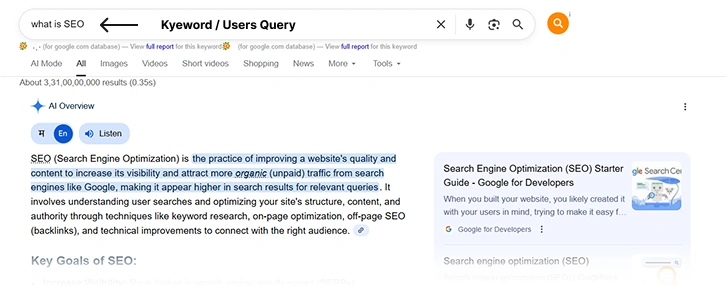
As per the Semrush research “Google sees more than 5 trillion search queries annually, which averages out to 9.5 million searches per minute.” In this guide you learn what is keyword? Why they are important? What are their different types? What are the keyword metrics? And many more..
Why Keywords are Important in SEO?
Keywords play a critical role in how search engines and users interact with your content. Keyword help you to connect with your audience and boost your ranking and drive more organic traffic by improving the visibility in search engine result pages.
Here’s why they matter:
- Help search engines understand your content
Keyword helps search engine and users to understand what your page is about and how it should be indexed. - Drive relevant traffic
Targeting the right keywords for a page brings users who are genuinely interested in your content or services. - Improve rankings and visibility
Well-optimized keywords on the page or content helps to increase your chances of appearing on the first page. - Support content strategy
Keywords guide what topics to write about and how to structure your content. - Increase conversions
Intent-based keywords attract genuine users who are interested into take action.
Types of Keywords?
There are major 6 types of keywords. Every keyword will target different users at different stages of user buying journey.
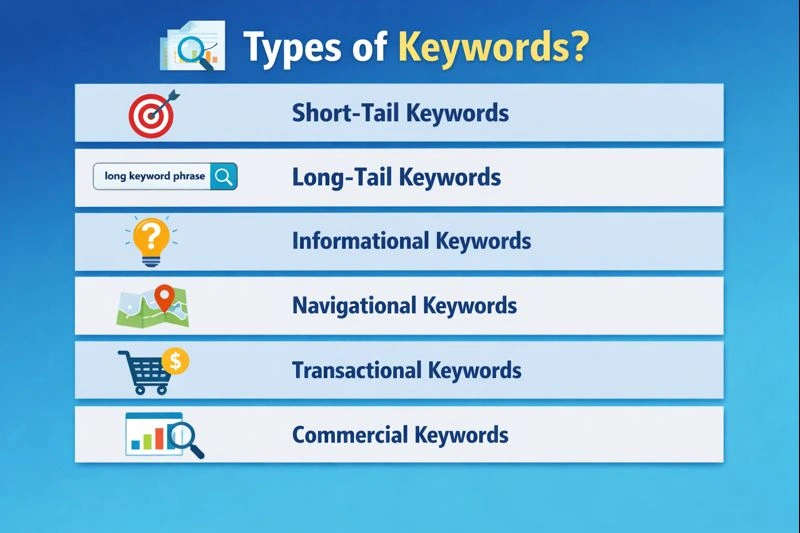
Here’s a clear, simple explanation of each keyword type with examples.
Short-Tail Keywords
These are the broad keywords basically one or two words. These keywords have high search volume and high competition but the intent is unclear.
Example: SEO, digital marketing
Long-Tail Keywords
These are longer and more specific phrases. These keywords have high intent but low search volume but high potential of conversion.
Example: Best SEO agency in Pune
Informational Keywords
Used when users want to learn or find answers. These work well for blogs and guides.
Example: what is SEO, how does SEO work
Navigational Keywords
Used when users want to reach a specific website or brand.
Example: Google Search Console login, Ahrefs blog
Transactional Keywords
Show clear intent to take action, usually to buy or sign up.
Example: Hire best SEO services in Pune , SEO services pricing
Commercial Keywords
These keyword shows the buying intent. These keywords are crucial for service pages, product pages or landing pages.
Example: best SEO tools, SEO vs SEM
If you want, I can also turn this into a table or SEO-friendly content for your blog.
What is Keyword Research?
Keyword research is the crucial process of finding and analyzing words or phrases people type into search engines to understand their needs, identify popular terms, and then create or optimize content that matches those searches to attract relevant users and rank higher in results.
The process of keyword research –
- Understanding your target audience
- Identifying search intent
- Checking search volume and competition
- Finding related and semantic keywords
Tools like Google Search Console, Google Keyword Planner, Ahrefs, and SEMrush help uncover keyword data. However, good keyword research is not just about tools. It’s about understanding why someone is searching and what type of content will best satisfy that query.
How to Use Keywords in SEO Properly?
To use keywords in SEO properly first analyse the terms and understand their intent. Then we can use this keyword in the primary places of the content. But make sure, your keyword should be naturally fit into the content to avoid keyword stuffing and their penalties.
Where to place keywords:
- Title tag: Include the primary keyword naturally, if possible title should start with primary keyword
- Meta description: Encourage clicks with intent-focused language
- URL: Keep it short up-to 3-4 words and keyword-relevant
- H1 and subheadings: Use keywords and variations
- Body content: Write naturally, conversational language and write for users not for robots
- Image alt text: Describe images using relevant keywords
- Internal links: Use descriptive anchor text
Best practices to follow:
- Avoid keyword stuffing
- Use synonyms and related terms
- Focus on topic depth, not repetition
- Write for users first, search engines second
Search engines now reward content that answers questions clearly and comprehensively.
Common Keyword Mistakes to Avoid
Many sites fail at SEO because of basic keyword mistakes.
Common issues include:
- Targeting only high-volume keywords
- Ignoring search intent
- Using the same keyword on multiple pages
- Stuffing keywords unnaturally
- Never updating old keyword-focused content
Avoiding these mistakes helps maintain long-term rankings and content quality.
Keywords vs Search Intent
A keyword shows what a user typed or what should be the query user have but search intent shows why they typed it.
For example:
- Keyword: SEO
Intent could be learning, hiring, or comparing
Modern SEO focuses more on intent than exact-match keywords. Matching the content type, depth, and format to user intent is what improves rankings today. Keywords guide you, but intent decides success.
Conclusion:
Keywords are still a core part of SEO, but they work best when used strategically. They help connect your content with real user searches, guide content creation, and support better rankings. This approach aligns with how modern search engines evaluate relevance, intent, and content quality, not just keyword frequency.
Instead of chasing traffic alone, focus on relevant keywords, clear intent, and genuinely helpful content. This is the same framework followed by experienced SEO professionals and recommended across major search engine guidelines for sustainable results.
When keywords are used naturally and backed by strong SEO fundamentals like quality content, proper on-page optimization, and user-focused structure, they become a reliable driver of long-term organic growth. If you want SEO to work consistently, start with the right keywords and build everything else around them.
FAQ’s:
What is keyword research in SEO?
Keyword research is the process of finding and analyzing search terms people use in search engines to identify keywords that can drive relevant traffic to your website.
What is keyword ranking in SEO?
Keyword ranking refers to the position a webpage holds on search engine results pages for a specific keyword.
What is a keyword in SEO?
A keyword in SEO is a word or phrase that users type into search engines and that webpages target to appear in relevant search results.
What is keyword density in SEO?
Keyword density is the percentage of times a keyword appears in a webpage compared to the total word count.
What is an LSI keyword in SEO?
LSI keywords are related terms and phrases that help search engines understand the context and meaning of your content.
What is keyword stuffing in SEO?
Keyword stuffing is the overuse of keywords in content in an unnatural way to manipulate search rankings, which can harm SEO.
What is keyword prominence in SEO?
Keyword prominence refers to how early and visibly a keyword appears on a page, such as in the title, headings, or opening content.
What is keyword proximity in SEO?
Keyword proximity measures how close related keywords appear to each other within content, helping search engines interpret relevance and context.Top of Form
What is keyword difficulty in SEO?
Keyword difficulty is the measure of difficulty level of keyword to rank in search engine result page.

Shivraaj is an experienced SEO Specialist with 6+ years of experience and passionate about helping businesses grow through strategic organic visibility. With strong expertise in AI Overview optimization, GEO targeting, and data-driven SEO strategies, he focuses on building results-oriented campaigns that enhance search performance and brand authority.
As a consultant and writer, Shivraaj is passionate about helping brands get more traffic, better engagement, and long-term success in today’s competitive digital world.