More than 90% of all online experiences now start with a search engine. Whether you’re looking for a local restaurant, a SaaS product, or a digital marketing agency, they typically all have one thing in common. It all starts with Google. That’s where SEO, or search engine optimization, comes into play.
But what is SEO? SEO isn’t just about being ranked higher in search engines, it’s about being in front of the right people, in front of the right people, with the right message. For the businesses of 2025, SEO is far more complex than keywords and backlinks. It is driven by artificial intelligence (AI), user intent, quality of content and experience signals.
This complete guide to SEO takes you through everything you need to know about what SEO is, how it works, why it’s important for your business, and the strategies that lead to long-term results.
Definition of SEO?
Search Engine Optimization (SEO) is the process of increasing a website’s visibility and ranking within search engines such as Google, Bing, Yahoo, etc. for relevant keywords and search queries. In simpler terms, SEO boosts your website to a higher position in the organic (non-paid) search results so that more people can locate, visit and interact with your website.
SEO vs. Paid Search
Paid search (like Google Ads) gives instant visibility, but only as long as you keep paying. SEO, on the other hand, builds long-term organic traffic that continues even if you stop spending.
In marketing, SEO plays a crucial role in the awareness and consideration stages of the funnel. It attracts visitors actively searching for information — people who are more likely to convert because their intent is high.
Why SEO Is Important for Businesses
SEO is important for businesses because it increases online visibility, drives targeted organic traffic, and builds credibility with potential customers. By ranking higher on search engines, businesses attract qualified leads, shorten the buying cycle, and achieve lasting growth with a cost-effective marketing approach.
Here’s why SEO matters more than ever in 2025:
- Long-Term ROI:
SEO delivers results that last. A single optimized page can generate consistent traffic for years. - Credibility & Trust:
Websites that rank high are seen as more trustworthy and authoritative. - Improved User Experience:
Google’s algorithm rewards sites that load fast, are mobile-friendly, and easy to navigate. - Higher Conversion Potential:
Organic visitors often have higher intent and better engagement rates. - Local Visibility:
For local businesses, SEO ensures your brand appears in Google Maps and local search packs.
Did you know?
- 93% of online experiences start with a search engine.
- SEO drives over 1000% more traffic than organic social media.
How Search Engines Work?
Search engines work by crawling the web to find pages, indexing their content, and ranking them based on relevance and quality. When you search, the engine quickly serves the most relevant results from its index to answer your query efficiently and accurately. Search engines follow a three-step process to deliver results:
1. Crawling
Search engine bots (also called spiders) scan the internet to find new or updated pages.
2. Indexing
Once discovered, those pages are stored in Google’s index — a massive database of web content.
3. Ranking
When a user searches, Google’s algorithm evaluates indexed pages and displays the most relevant and authoritative results.
Key Ranking Factors
- Content relevance
- Backlink authority
- Mobile usability
- Core Web Vitals (page experience metrics)
- User engagement (CTR, dwell time, bounce rate)
AI and machine learning models like RankBrain and BERT now help Google interpret intent more intelligently — meaning SEO today is about answering questions, not just matching keywords.
The 4 Core Types of SEO
To create a comprehensive SEO strategy, you must optimize across these four core pillars:
1. On-Page SEO
On-page SEO focuses on optimizing elements within your website to improve rankings.
Key factors include:
- Title tags, meta descriptions, and header tags
- Keyword placement and prominence
- Internal linking and anchor text optimization
- Image optimization (alt text, compression)
- Content depth and readability
Example:
Optimizing a blog’s meta title and description can improve click-through rates (CTR) from search results by 10–20%.
2. Off-Page SEO
Off-page SEO builds your site’s authority and reputation through external signals — mainly backlinks.
- Guest posting and content outreach
- Digital PR campaigns
- Social sharing and influencer mentions
- Brand citations and directory listings
High-quality backlinks are still one of Google’s strongest ranking factors.
3. Technical SEO
This focuses on how easily search engines can crawl and index your website.
Key elements:
- Site speed optimization
- Mobile-friendliness
- Secure HTTPS
- XML sitemap and robots.txt optimization
- Canonical tags and structured data
- Core Web Vitals performance
Technical SEO ensures your content is discoverable and accessible, not buried by crawl errors.
4. Local SEO
Local SEO helps businesses appear in “near me” and Google Maps results.
Optimization tactics:
- Google Business Profile setup and optimization
- NAP (Name, Address, Phone) consistency
- Local citations
- Customer reviews and star ratings
- Location-based keywords
For brick-and-mortar businesses, Local SEO drives both foot traffic and calls directly from search results.
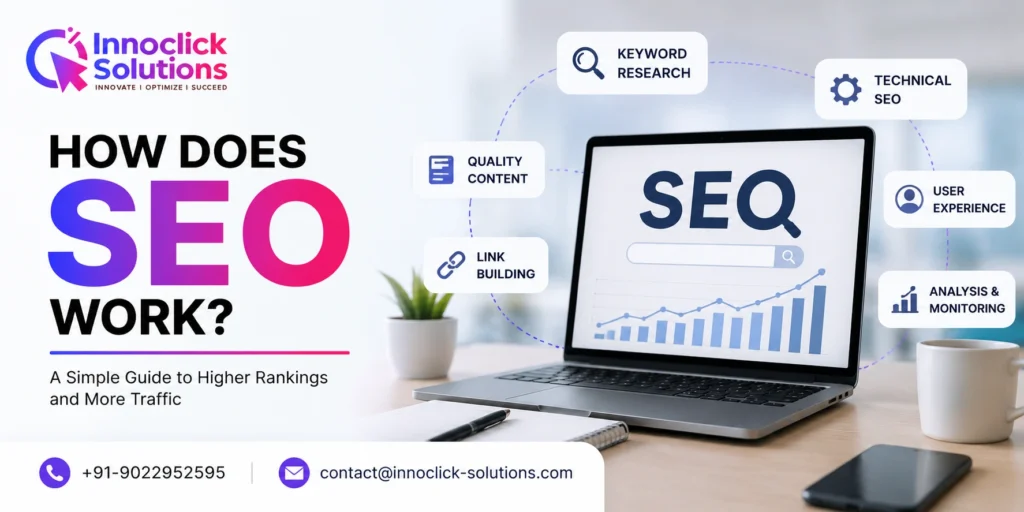
How SEO Works Step-by-Step?
A solid SEO strategy follows a systematic process:
- SEO Audit:
Evaluate site performance, structure, and content. Identify issues that block rankings. - Keyword Research:
Find search terms your target audience uses. Group them by intent (informational, navigational, transactional). - Competitor Analysis:
Understand what’s working for top-ranking competitors and spot content gaps. - On-Page Optimization:
Update titles, headings, URLs, and internal links to align with your keyword strategy. - Content Creation:
Publish high-quality, search-intent-driven blogs, landing pages, and guides. - Link Building:
Earn backlinks from authoritative sources to improve domain authority. - Tracking & Reporting:
Monitor organic traffic, conversions, and rankings via GA4, Search Console, and Looker Studio dashboards.
Building a Modern Strategy: Step by Step
Here’s how to put things together—SEO + AEO + GEO + AIO—into a strategy you can actually follow.
Step 1: Do an SEO Audit
-
Find broken links, slow pages, mobile issues.
-
Check existing content: which pages are already doing well, which are underperforming.
-
Evaluate UX: navigation, readability, core metrics.
Step 2: Keyword & Intent Research
-
Not just “what people type,” but why they type it.
-
Look for conversation-style queries (“how to…”, “why does”, “best way to…”).
-
Identify “answer-seeking” queries and “generative AI content” opportunities.
Step 3: Competitor Analysis
-
Who’s ranking for those questions?
-
What format are they using (listicles, how-tos, FAQs, voice-friendly)?
-
Where are they appearing in AI summaries, featured snippets, etc.?
Step 4: Optimize On-Page & Content Creation
-
Write content structured for clarity: short paragraphs, subheadings, bullet points.
-
Use schema markup: FAQ, Q&A, article, product, etc.
-
Include clear answer sections: put likely questions + concise, accurate answers.
-
Use internal links to relevant content.
Step 5: Technical + UX Optimization
-
Speed: compress images, reduce render-blocking scripts, use fast hosting.
-
Mobile-first design.
-
HTTPS, clean URLs.
-
Ensure crawlability: sitemap, robots.txt, avoid duplicate content, canonical tags.
Step 6: Build Authority & Backlinks
-
Guest posts, digital PR, collaborations.
-
Have your content cited by credible sources or publications.
-
Encourage reviews, testimonials (for local businesses especially).
Step 7: Create Content with AEO & GEO in Mind
-
For answer engines: write brief answer boxes early in content.
-
For generative AI: ensure content is well structured, factual, includes references or data, and is easy to digest.
-
Maintain clarity. Avoid fluff.
Step 8: Monitor & Adjust
-
Use tools like Google Search Console, analytics platforms, and AI tools that can measure how you might be showing up in AI summaries.
-
Track not only rankings but featured snippets, voice search queries, AI Overviews appearances.
-
Refresh content, remove or improve low-performing pieces.
SEO Ranking Meaning:
SEO ranking refers to the position of a web page in the search engine results pages for a particular keyword or search query.
In simple words – When someone searches for something in Google (say “best SEO agency in Pune“), the order in which the websites come up is their SEO ranking.
For example – If your website is at #1 in Google, you have the best SEO ranking for that keyword. If it is on page 2 or later, your ranking is not good enough and fewer people are likely to visit your site.
In short – SEO ranking = Your website’s position on Google (or other search engines) for a certain keyword.
Key SEO Ranking Factors
Google uses over 200 ranking factors, but the most impactful include:
| Area | Key Factors / Things to Focus On |
|---|---|
| Content Relevance & Quality | Understand what people really want when they search. Answer their questions fully. Dive deeper than surface-level content. Use examples, data, visuals. |
| User Intent | Is the user trying to learn, buy, compare, find local info? Match that. Informational, navigational, transactional queries each require a different approach. |
| Page Experience | Speed, mobile-friendliness, secure connection (HTTPS), good UX. Google’s Core Web Vitals still matter. |
| Structured Data & Schema Markup | Helps search engines, AI, voice assistants identify what your content is about. FAQ schema, Q&A, product schema, etc. |
| Internal Linking + Site Structure | Helps distribute “link equity,” keeps content organized, improves crawlability. Important for AI tools that derive context. |
| Backlinks & Authority | High-quality external links, mentions, good brand reputation. Not just quantity. Credible sources linking to (or citing) your content helps. |
| Freshness & Updates | Especially for topics that change fast. Updated content is more likely to be picked up by AI tools or considered trustworthy. |
Benefits of SEO for Businesses
When implemented properly, SEO delivers measurable and lasting business benefits:
- Higher Online Visibility – Appear for relevant keywords consistently.
- Steady Organic Traffic – Unlike ads, SEO traffic compounds over time.
- Improved Brand Awareness – Ranking for industry keywords builds authority.
- Better ROI Than Paid Ads – SEO costs less and converts better long-term.
- Lead Generation – Organic leads often have higher purchase intent.
- Long-Term Growth – Once optimized, your website continues to perform.
Example:
A local service business that invested in consistent SEO saw a 240% increase in organic leads in 6 months — without increasing ad spend.
SEO vs SEM: What’s the Difference?
| Feature | SEO | SEM |
|---|---|---|
| Type | Organic | Paid (PPC) |
| Cost | Free (time & effort) | Pay-per-click |
| Results | Long-term | Immediate but temporary |
| Goal | Build trust & visibility | Drive instant traffic |
| Best For | Sustainable growth | Short-term promotions |
While SEO focuses on organic visibility, SEM (Search Engine Marketing) combines both SEO and paid ads for a hybrid approach — ideal for accelerating early growth.
Common SEO Mistakes to Avoid
Even as the environment changes, many folks keep repeating the same missteps. Watch out for:
-
Keyword stuffing or over-optimization: stuffing keywords without understanding user intent feels spammy to both users & AI.
-
Neglecting mobile or page speed: slow sites lose. Users abandon, and search engines penalize.
-
Thin or duplicated content: content that doesn’t add value or is too shallow.
-
Ignoring structured data & schema: means missing chances to appear in featured snippets, knowledge panels, voice answers, or AI summaries.
-
Obsolete content: content not updated, outdated examples, broken links.
-
Chasing every trend without priorities: trying to optimize for every little thing and spreading too thin.
How to Measure SEO Success?
What gets measured gets improved. Here are metrics and KPIs that tell you whether your strategy is working.
| Metric | Why It Matters |
|---|---|
| Organic Traffic | Are people finding you via search? Growth here is foundational. |
| Keywords & Rankings | Not just position but whether you’re ranking in featured snippets / answer boxes. |
| Click-Through Rate (CTR) from SERPs | If people see your result but don’t click, maybe meta titles/descriptions need work. |
| Engagement Metrics | Bounce rate, dwell time, pages per session. Are people sticking around? |
| Conversion Metrics | Leads, sales, signups—depending on your goal. Organic traffic is good, but conversions are what pay the bills. |
| Backlink Profile | Number and quality (authority) of referring domains. |
| Appearance in Special SERP Features | Featured snippets, maps/local pack, voice search, AI Overviews, etc. |
| Speed & Core Web Vitals | Measured via tools (PageSpeed Insights, etc.) |
Emerging SEO Trends in 2025
SEO is evolving rapidly with AI and new search behaviors. Here’s what’s reshaping the future:
- AEO (Answer Engine Optimization): Optimizing for AI chatbots, voice assistants, and SGE (Search Generative Experience).
- AIO (AI Optimization): Using AI tools for keyword clustering, content briefs, and predictive analysis.
- GEO (Generative Engine Optimization): Adapting content for AI-generated summaries in search results.
- E-E-A-T (Experience, Expertise, Authoritativeness, Trust): Core to Google’s content evaluation.
- Voice and Visual Search: Optimizing for conversational and image-based queries.
- Zero-Click SERPs: Targeting featured snippets, FAQs, and People Also Ask.
These trends emphasize one principle: SEO is no longer about search engines — it’s about users and intent.
How to Build an SEO Strategy for Your Business?
Follow this 6-step roadmap to create an effective SEO plan:
- Set Clear Goals: Define what you want — traffic, leads, or brand awareness.
- Know Your Audience: Understand their pain points and search behavior.
- Perform an SEO Audit: Identify issues and opportunities.
- Create an Action Plan: Combine on-page, technical, and content strategies.
- Execute Consistently: Publish and optimize regularly.
- Measure & Adjust: Track performance, refine tactics, and scale what works.
Need help?
Our experts at Innoclick Solutions specialize in data-driven SEO services & strategies that drive measurable business growth.
Conclusion
SEO is the foundation of digital visibility. It connects your business with the right audience and builds sustainable, long-term growth. In 2025, SEO isn’t just about ranking — it’s about experience, authority, and adaptability in an AI-powered search landscape.
Whether you’re a startup, local business, or enterprise, SEO remains your most powerful growth engine.
Ready to grow your business through SEO?
Contact Us today for a free SEO audit and start building your online authority.
FAQ
1. What does SEO stand for?
SEO stands for Search Engine Optimization. It is the process of improving a website’s visibility and ranking on search engines like Google by optimizing content, keywords, and technical elements. The goal is to attract more organic traffic and connect users with relevant information effectively.
2. How long does SEO take to show results?
SEO typically takes about 3 to 6 months to show initial results, though it can take up to a year depending on factors like industry competition, website quality, and the consistency of SEO efforts. Early gains come from technical fixes and content updates; long-term success requires ongoing optimization.
3. What are the main types of SEO?
The main types of SEO are On-Page SEO (optimizing website content and HTML), Off-Page SEO (building backlinks and external authority), and Technical SEO (improving site speed, mobile-friendliness, and crawlability). These collectively enhance your website’s visibility and ranking on search engines. Additional types include Local, E-commerce, and Voice SEO.
4. Is SEO still worth it in 2025?
Yes, SEO is still worth it in 2025. It remains the most effective digital marketing channel for many businesses, generating higher sales and long-term ROI than paid ads. Around 91% of marketers report SEO positively impacts website performance, driving significant organic traffic and sustainable growth over time.
5. Can small businesses afford SEO?
Small businesses can afford SEO, with typical costs ranging from $500 to $3,500 per month depending on needs and goals. SEO is a cost-effective, long-term strategy that boosts visibility and drives organic traffic, offering a high ROI. Starting with local SEO and affordable packages can make it accessible and valuable for small budgets.

Shivraaj Dhaygude is a Pune-based SEO Specialist with over 6+ years of hands-on experience helping local businesses dominate Google Search and AI-powered results. He specializes in Local Pack optimization, Google AI Overview visibility, and Generative Engine Optimization (GEO) — an emerging discipline focused on appearing inside AI-generated search answers.
Shivraaj has personally led SEO campaigns for 50+ SMBs across Pune and Maharashtra, consistently delivering top-3 local pack rankings and measurable increases in organic leads. His approach combines technical SEO foundations with AI search readiness strategies, giving clients a competitive edge as search evolves.
He writes about local SEO, GEO, and AI search trends based on real client data and ongoing experimentation — not theory.