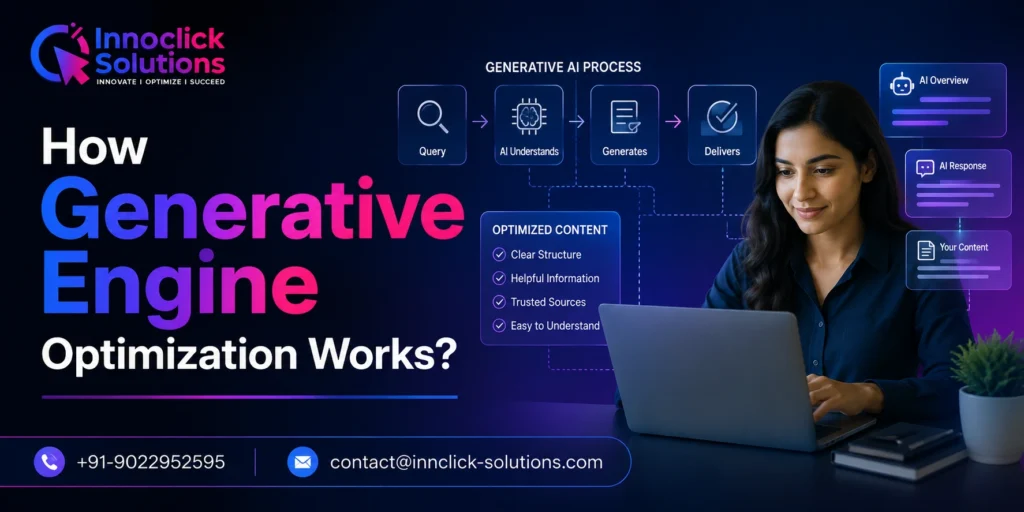

Generative Engine Optimization (GEO) is no longer a forward-looking strategy — it’s a present-tense competitive advantage. AI Overviews now reach 1.5 billion users monthly, and ChatGPT fields nearly 900 million weekly queries. If your SaaS brand isn’t appearing in those answers, your competitor is.
The problem isn’t that AI ignores SaaS brands. It’s that most SaaS content isn’t structured for AI retrieval. This post walks you through 8 battle-tested GEO tactics — from content architecture and brand entity signals to technical foundations — so your product gets named, cited, and trusted by the AI tools your buyers use every day.
Whether you’re working with a generative engine optimization company in Pune or building in-house GEO capability, these tactics apply.
GEO (Generative Engine Optimization) is the discipline of making your SaaS content citable by AI engines like ChatGPT, Perplexity, and Google AI Overviews. Most SaaS brands are invisible in AI-generated answers because their content architecture, entity signals, and technical foundations are misaligned with how LLMs select and retrieve information. These 8 tactics fix that.
Quick Summary
- GEO ≠ SEO: Traditional SEO earns rankings; GEO earns citations in AI-generated answers — two very different retrieval mechanisms.
- Brand mentions beat backlinks: AI engines weight unlinked brand mentions 3x more than traditional link signals.
- Your docs are underutilized: Product documentation pages are among the highest-cited content types in AI answers — yet most SaaS teams ignore them for GEO.
- Technical access matters: If AI crawlers can’t render your site, they won’t cite it. Server-side rendering is non-negotiable.
- Measurement is hard but possible: Standard analytics won’t surface AI citation traffic — you need a dedicated GEO KPI stack.
What Is GEO and Why Should Every SaaS Team Care Right Now?
GEO (Generative Engine Optimization) is the practice of structuring content so AI language models — including ChatGPT, Google Gemini, Perplexity, and Claude — select, extract, and cite it when answering user queries. Unlike traditional SEO, which targets ranking position, GEO targets citation inclusion in AI-generated responses.
GEO vs. Traditional SEO: What’s Actually Different
| Signal | Traditional SEO | GEO |
|---|---|---|
| Primary goal | Rank in SERPs | Be cited in AI responses |
| Key ranking factor | Backlinks + on-page signals | Brand mentions + content structure |
| Content unit | Full page | Citable passage (134–167 words) |
| Crawler behavior | Googlebot renders JS | GPTBot/ClaudeBot do NOT render JS |
| Author signals | E-E-A-T for Google | Entity schema + sameAs for LLMs |
How AI Engines Decide What to Cite
AI platforms pull from distinctly different source hierarchies. ChatGPT draws heavily from Wikipedia (47.9% of citations) and Reddit (11.3%). Perplexity cites Reddit in nearly half of all responses (46.7%). Google AI Overviews favor pages already in the top 10 organic results.
The implication: brand mentions across platforms correlate 3x more strongly with AI citations than backlinks. A mention in a Reddit thread or YouTube video tutorial may do more for your AI visibility than a dozen domain links.
Tactic #1: How Do You Build Content AI Engines Actually Want to Cite?
Build “citability blocks” — self-contained passages of 134–167 words that open with a direct answer, contain a verifiable claim, and require no surrounding context to be understood. This passage length matches the typical AI extraction window used by major LLMs when pulling inline citations.
What Is a Citability Block?
Here’s the before/after for a SaaS CRM feature explanation:
Before (not citable): “Our pipeline management feature is really powerful and helps you do a lot of things in your sales process that would otherwise take too much time.”
After (citable block): “Pipeline management in [CRM Product] automates deal stage progression by tracking buyer signal triggers — email opens, demo completions, and contract views. Sales teams using automated pipeline management report a 28% reduction in manual data entry and a 19% improvement in forecast accuracy (Internal Benchmark, 2025). The feature supports up to 50 custom deal stages and integrates natively with Salesforce, HubSpot, and Pipedrive.”
The second version is factual, self-contained, and cite-worthy. Apply this framework to every blog post, landing page, and pricing page explanation.
How to Retrofit Your Existing Content
- Identify your 10 highest-traffic pages.
- Locate the section that answers the page’s primary query.
- Rewrite that section as a 134–167 word direct-answer block.
- Add one verifiable statistic with a source attribution.
- Remove all cross-reference dependencies (“as we mentioned above…”).
Tactic #2: Why Are Product Docs Your Most Underused GEO Asset?
Product documentation pages are cited by AI engines at a higher rate than blog content because they contain precise, structured, factual answers to specific technical queries — exactly what LLMs are trained to retrieve. A “how to connect [Tool A] with [Tool B]” query almost always surfaces a docs page over a blog post.
Documentation SEO & GEO Best Practices
AI engines favor docs pages that follow a predictable structure: question-based headings, short answer paragraphs, code snippet context, and explicit version dates.
Key implementation steps for your docs:
- Use question-based H2s. “How do I set up SSO in [Product]?” outperforms “SSO Configuration.”
- Add a direct-answer paragraph in the first 60 words of every doc page.
- Date-stamp every article. LLMs deprioritize undated technical content.
- Allow AI crawlers in robots.txt. GPTBot, ClaudeBot, and PerplexityBot must not be blocked.
This section is where most SaaS brands leave citations on the table. If you’re evaluating LLM optimization services, documentation optimization should be among the first deliverables you request.
Tactic #3: How Do Brand Mentions Across Platforms Drive AI Citations?
Brand mentions on high-authority platforms — particularly YouTube, Reddit, LinkedIn, and Wikipedia — are the strongest off-site GEO signal. YouTube brand mentions carry the highest citation correlation score (~0.737) among all off-site signals studied.
The Platform Hierarchy for SaaS Brands (Effort vs. Impact)
| Platform | Citation Correlation | Effort Level |
|---|---|---|
| YouTube tutorials | 0.737 | Medium |
| Reddit organic mentions | High | Low-medium |
| LinkedIn thought leadership | Medium | Low |
| Wikipedia presence | Very high | High |
A Practical Reddit Strategy That Won’t Get You Banned
Reddit is Perplexity’s #1 citation source, yet most SaaS marketing guides say “get Reddit mentions” without explaining how. Here’s how to do it without violating community rules:
- Participate genuinely in subreddits like r/SaaS, r/entrepreneur, and vertical-specific communities (r/sales, r/devops, etc.) before mentioning your product.
- Answer questions thoroughly. A 400-word technical answer with no product mention builds more trust — and earns organic mentions from other users — than any promotional post.
- Create content that others reference. Benchmark reports, templates, and how-to guides shared on Reddit get organically cited in threads for months.
YouTube: The Most Overlooked GEO Channel for SaaS
Short-form feature walkthroughs, side-by-side tool comparisons, and integration tutorials all generate the highest-correlation AI citation signal. A 4-minute Loom-style tutorial on “How to automate [workflow] with [Your Product]” can generate brand mentions across Reddit, LinkedIn, and AI-generated comparison answers simultaneously.
Tactic #4: What Is llms.txt and How Should SaaS Companies Implement It?
llms.txt is a plain-text file placed at your domain root (yoursite.com/llms.txt) that tells AI crawlers which pages to prioritize for indexing and citation. Backed by Reddit, Medium, Cloudflare, Akamai, and Creative Commons, it is an emerging standard that functions as an AI-specific sitemap.
# llms.txt for [Your SaaS Product]
# Version: 1.0 | Last updated: 2026-08
## Core Product Pages
– /features: Full feature overview for [Product]
– /pricing: Current pricing tiers and plan comparison
– /integrations: All native integrations and API partners
## Key Blog Content
– /blog/geo-tactics-saas-cited-ai-answers
– /blog/[your-top-performing-post]
## Documentation
– /docs/getting-started
– /docs/api-reference
– /docs/integrations/[tool]
## Brand & Entity
– Author: [Name], [Title] — [LinkedIn URL]
– Publisher: [Company Name] — [Crunchbase or Wikipedia URL]
– Primary use case: [One sentence product description]
Which AI Crawlers to Allow in robots.txt
User-agent: GPTBot
Allow: /
User-agent: ClaudeBot
Allow: /
User-agent: PerplexityBot
Allow: /
User-agent: CCBot
Disallow: /
Tactic #5: How Does Original Research Improve AI Citation Rates?
AI engines strongly prefer primary sources — content containing unique statistics, original survey data, or proprietary benchmarks that cannot be paraphrased from another source. When your SaaS brand publishes a number no one else has, AI tools must cite you to reference it.
Low-Effort Original Research Ideas for SaaS Teams
- Anonymized aggregate usage data — “We analyzed 10,000 user sessions and found…”
- Quarterly customer survey — 5 questions, 200+ respondents, published as a “State of [Industry]” PDF.
- Product benchmark report — Compare performance metrics across your user base by plan tier or industry.
- Integration usage trends — Which integrations your customers activate first (frequently high-search-volume data).
- Churn reason analysis — Aggregated exit survey insights (highly cited in SaaS editorial content).
You don’t need a research team. A Google Form, 200 customers, and a well-formatted results page is enough to generate a citable primary source.
Tactic #6: How Do Author and Brand Entity Signals Affect AI Visibility?
E-E-A-T is now a GEO signal, not just an SEO one. AI engines use entity co-occurrence — how often your brand, authors, and product are mentioned alongside credible entities — to assess authority before including you in generated answers.
Entity Linking via same As Schema
The most underused GEO tactic in SaaS: implementing sameAs schema to link your Organization and Person entities across the web.
{
“@context”: “https://schema.org”,
“@type”: “Organization”,
“name”: “InnoClick Solutions”,
“url”: “https://innoclick-solutions.com”,
“sameAs”: [
“https://www.linkedin.com/company/innoclick-solutions”,
“https://www.crunchbase.com/organization/innoclick-solutions”,
“https://github.com/innoclick-solutions”,
“https://www.g2.com/products/innoclick-solutions”
]
}
This tells every AI crawler exactly who you are across platforms — eliminating entity ambiguity that causes AI engines to skip your content in favor of more clearly identified brands.
If you’re looking to hire a GEO agency that executes entity schema at this level, verify they include sameAs implementation as a standard deliverable — most don’t.
Tactic #7: How Should SaaS Brands Use Question-Based Headings for GEO?
AI models are query-matching engines — they return content whose headings most closely mirror how users phrase their questions. A heading like “Pipeline Management Features” will lose to “How does pipeline management work in [Product]?” for any conversational AI query.
10 Question Templates Every SaaS Blog Should Use
- What is [feature/concept]?
- How does [Product] compare to [Competitor]?
- How to [achieve outcome] with [Product]?
- Is [Product] right for [persona]?
- What are the best [tools/integrations] for [use case]?
- Why does [problem] happen in [workflow]?
- How much does [feature] cost in [Product]?
- Can [Product] integrate with [Tool]?
- What is the difference between [Feature A] and [Feature B]?
- How do I set up [workflow] in [Product]?
Apply these as H2 and H3 headings across your blog, documentation, and landing pages. An AI SEO agency in Pune or elsewhere should be mapping these templates to your keyword universe before producing a single piece of content.
Tactic #8: What Technical Foundation Does GEO Require for SaaS Sites?
AI crawlers cannot execute JavaScript — meaning client-side rendered SaaS sites (Next.js CSR, React SPAs) present AI bots with a blank page. If your marketing site relies on client-side rendering, AI engines will not crawl, index, or cite your content, regardless of how well-optimized it is.
Server-Side Rendering: The Non-Negotiable GEO Foundation
SSR (Server-Side Rendering) or SSG (Static Site Generation) ensures AI crawlers receive fully rendered HTML on first load. Most modern SaaS marketing sites built on Next.js support SSR — confirm with your engineering team that your public-facing pages are not client-side rendered.
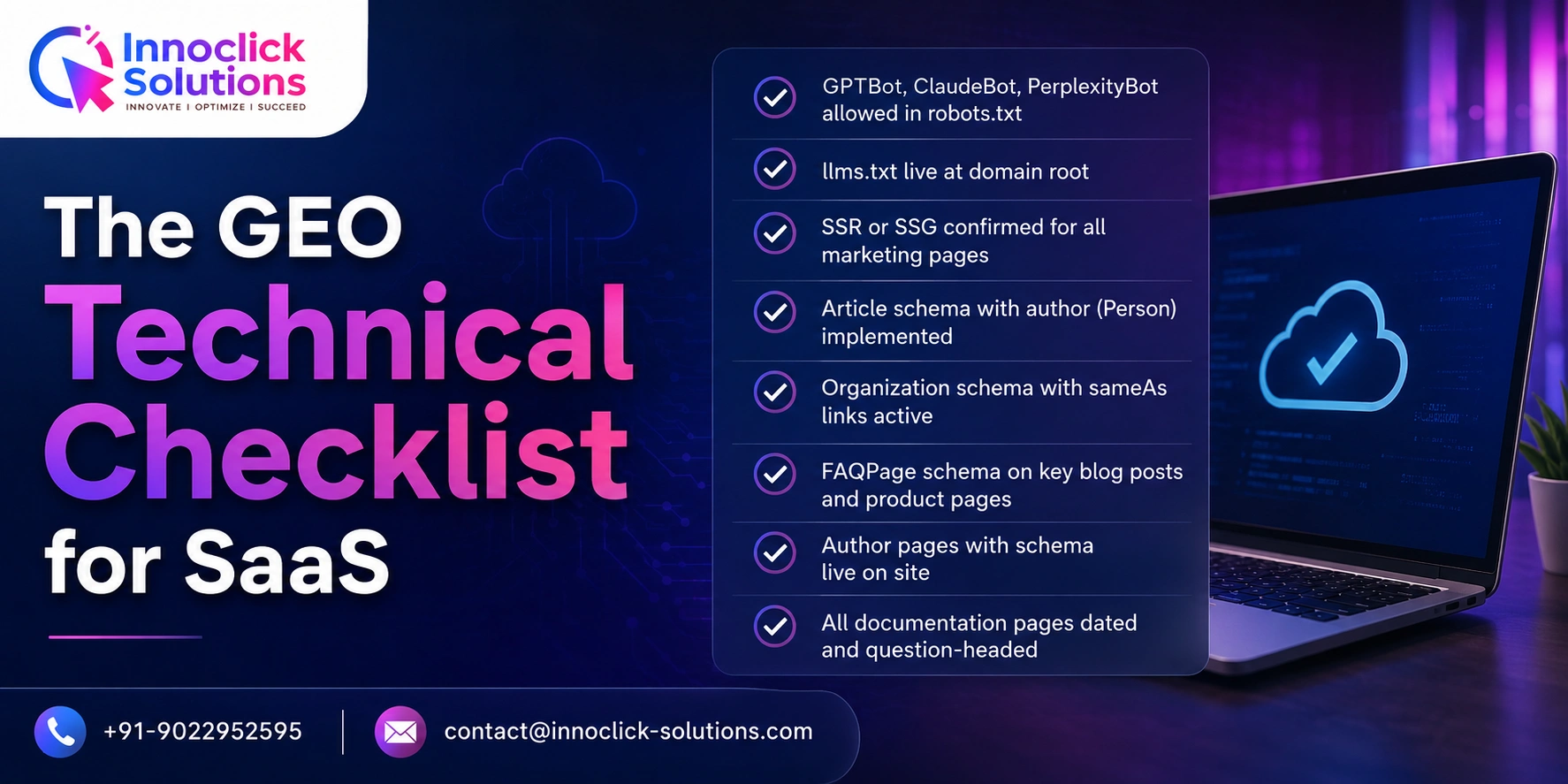
The GEO Technical Checklist for SaaS
How Do You Actually Measure GEO Performance for SaaS?
Standard web analytics will not show you AI citation traffic. Google Search Console does not cleanly segment AI Overview clicks. GA4 increasingly buckets AI-referred traffic as direct or dark traffic. You need a dedicated GEO measurement stack.
GEO KPIs and Recommended Tools
| KPI | Tool |
|---|---|
| Branded query trend | Google Search Console |
| Direct/dark traffic growth (MoM) | Google Analytics 4 |
| Brand mention volume | Mention.com or BrandMentions |
| AI citation spot-checks | Manual prompts in ChatGPT + Perplexity |
| AI search visibility | DataForSEO AI SERP scraper |
A Simple GEO Dashboard (4 Metrics)
- Branded query impressions in GSC — monthly trend, target +5% MoM
- Direct/dark traffic in GA4 — MoM delta; rising direct often signals AI referral
- Weekly manual AI citation checks — prompt your 10 core target queries in ChatGPT and Perplexity; log whether you’re cited
- Brand mention volume — weekly from Mention.com; track spikes against content publish dates
This dashboard takes under an hour per week to maintain and gives you the only reliable signal currently available for SaaS GEO performance. A qualified generative engine optimization company in Pune should be reporting on at least three of these four metrics monthly.
Conclusion
GEO tactics for SaaS aren’t replacing traditional SEO — they’re adding a new layer that increasingly determines whether buyers find your product through AI-generated answers or not at all. The 8 tactics covered here — citability block architecture, documentation optimization, brand mention signals, llms.txt implementation, original research, entity schema, question-based headings, and technical foundations — form a complete GEO framework any SaaS team can execute.
Start with what you can implement this week: allow AI crawlers in robots.txt, add sameAs schema to your Organization markup, and rewrite the first 150 words of your five highest-traffic pages as direct-answer citability blocks.
Ready to get your SaaS brand cited in AI answers? Explore InnoClick Solutions’ LLM optimization services or contact us to audit your current AI citation visibility.
Call to Action
If you’re serious about getting your SaaS cited in ChatGPT, Perplexity, and Google AI Overviews, InnoClick Solutions can help. As a leading AI SEO agency in Pune, we offer end-to-end GEO strategy, technical implementation, and performance measurement — purpose-built for SaaS growth teams. Book a free GEO audit →
FAQ’s:
Q1: What is Generative Engine Optimization (GEO) for SaaS?
GEO is the practice of structuring SaaS content so AI engines like ChatGPT, Perplexity, and Google AI Overviews select and cite it in generated answers. It differs from SEO in that it targets citation inclusion rather than keyword ranking position.
Q2: How do AI engines like ChatGPT decide what SaaS content to cite?
AI engines prioritize content that is factually dense, self-contained, properly attributed to a credible entity, and structured with question-based headings. Brand mentions on platforms like YouTube, Reddit, and Wikipedia significantly increase citation likelihood.
Q3: What is llms.txt and does my SaaS site need it?
llms.txt is a plain-text file placed at your domain root that tells AI crawlers which pages to prioritize for indexing. Backed by Cloudflare, Reddit, and Akamai, it functions as an AI-specific sitemap and is recommended for all SaaS brands pursuing GEO.
Q4: Why does server-side rendering matter for GEO?
AI crawlers such as GPTBot and ClaudeBot cannot execute JavaScript, so client-side rendered sites appear as blank pages to LLMs. Server-side rendering (SSR) or static site generation (SSG) ensures AI bots receive fully rendered HTML, making your content accessible for citation.
Q5: How do I measure if my SaaS brand is being cited in AI answers?
Track branded query impressions in Google Search Console, monitor direct/dark traffic trends in GA4, run weekly manual citation checks in ChatGPT and Perplexity for your 10 core target queries, and use brand mention monitoring tools like Mention.com or BrandMentions.

Shivraaj Dhaygude is a Pune-based SEO Specialist with over 6+ years of hands-on experience helping local businesses dominate Google Search and AI-powered results. He specializes in Local Pack optimization, Google AI Overview visibility, and Generative Engine Optimization (GEO) — an emerging discipline focused on appearing inside AI-generated search answers.
Shivraaj has personally led SEO campaigns for 50+ SMBs across Pune and Maharashtra, consistently delivering top-3 local pack rankings and measurable increases in organic leads. His approach combines technical SEO foundations with AI search readiness strategies, giving clients a competitive edge as search evolves.
He writes about local SEO, GEO, and AI search trends based on real client data and ongoing experimentation — not theory.