
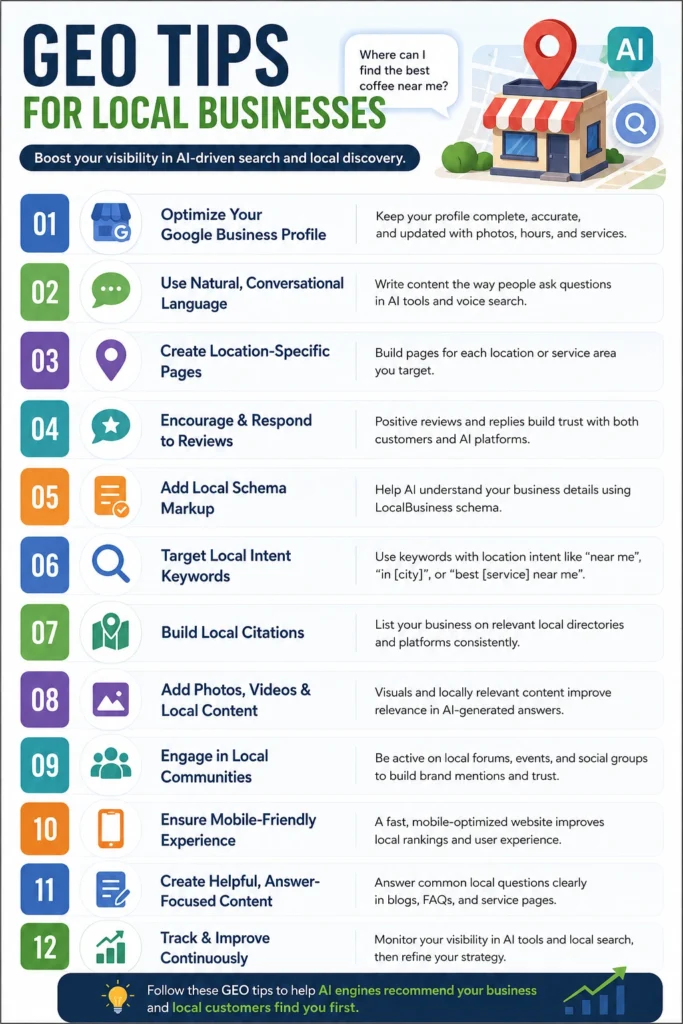
GEO for local businesses — Generative Engine Optimization — is no longer optional. Over 60% of Google searches now end without a single click, with AI Overviews delivering the answer directly on the results page. If your local business isn’t cited in those AI-generated answers, a competitor already is. This guide gives you 10 specific, budget-friendly GEO strategies to make your local business visible in ChatGPT, Perplexity, and Google AI Overviews — starting today.
Key Takeaways:
- GEO gets you cited, not just ranked: Traditional local SEO puts you on the map; GEO puts you in the AI answer.
- AI citation drives higher-quality leads: AI-referred visitors convert at 4.4× the rate of organic search traffic.
- Structure is everything: Self-contained answer blocks, FAQ schema, and LocalBusiness schema are the three fastest wins.
- Consistency builds AI trust: Uniform NAP data across directories signals reliability to AI systems.
- Monitoring is non-negotiable: Only 16% of brands track their AI search performance — those that do have a 9× visibility advantage.
What Is GEO and Why Does It Matter for Local Businesses?
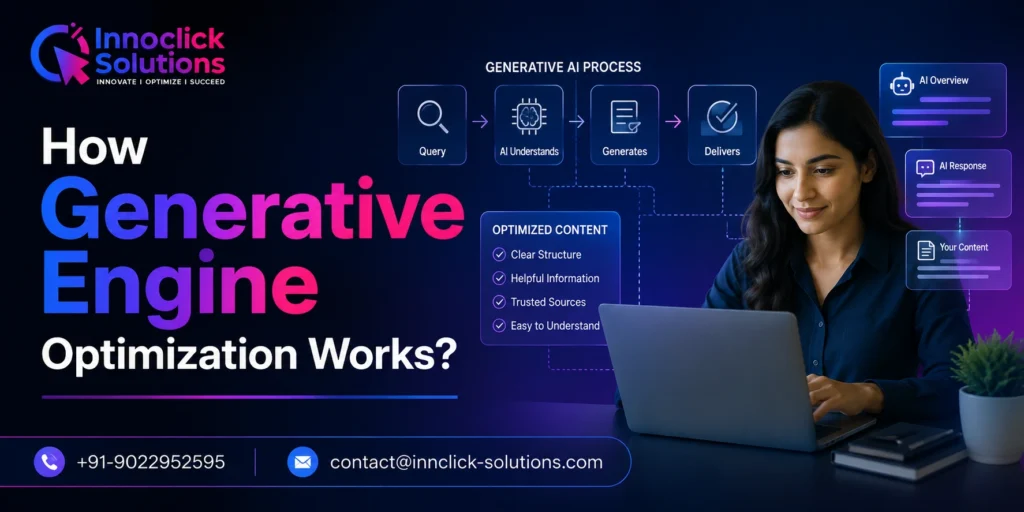
GEO (Generative Engine Optimization) is the practice of structuring your website, listings, and content so that AI platforms — including ChatGPT, Perplexity, Google Gemini, and Google AI Overviews — select and cite your local business when generating answers. Unlike traditional SEO, which earns blue-link clicks, GEO earns AI citations that appear directly inside the generated answer.
The shift is already here. Gartner predicted a 25% decline in traditional search volume by 2026 — and that prediction is now reality. Meanwhile, AI-referred traffic to websites surged 600% between January 2025 and early 2026. For a local business, this means your next customer may never scroll through a list of Google results — they’ll simply ask ChatGPT “best plumber near me” and act on whatever name appears in the answer.
GEO vs. Traditional Local SEO — What’s the Difference?
Traditional SEO gets you ranked. GEO gets you cited. Here’s how the two disciplines compare:
| Dimension | Local SEO | GEO |
| Goal | Rank in Google Map Pack & SERPs | Get cited in AI-generated answers |
| How it works | Keywords, backlinks, GBP optimization | Structure, authority signals, fact density |
| Key signals | NAP, reviews, domain authority | Schema, FAQs, citations, statistics |
| Tools | Google Search Console, BrightLocal | Otterly AI, Peec AI, ZipTie |
| Metric | Click-through rate (CTR) | Citation rate & AI share of voice |
How AI Platforms Choose Local Business Sources
Each AI platform selects local answers differently. Google AI Overviews pulls from your Google Business Profile, indexed web pages, and schema markup in real time. ChatGPT synthesizes from its training data plus live web search results. Perplexity retrieves from current web sources, weighting recency and authority heavily. The common thread: all three favor content that is structured, factual, consistent, and citable.
Tip #1 — How Should You Optimize Your Google Business Profile for AI Visibility?
Your Google Business Profile (GBP) is a primary AI signal. Google pulls GBP data — categories, attributes, Q&A, reviews, and service descriptions — directly into AI Overviews for local queries. A fully completed, keyword-rich GBP profile dramatically increases your chances of appearing in AI-generated local answers.
Why GBP Is an AI Signal, Not Just a Map Signal
Most business owners think of their GBP as a tool for Google Maps ranking. It’s also a structured data source that AI Overviews directly reads. When a user asks Google’s AI “best dentist in Baner,” the AI Overviews engine pulls business name, category, hours, services, and review snippets straight from GBP. If your profile is incomplete or inconsistent, the AI may skip your business entirely.
GBP Optimization Checklist for GEO
- Complete every field: primary and secondary categories, services list, business description (with local keywords), hours, website URL, and phone number.
- Seed the Q&A section with 5–10 common customer questions and self-answer them in 40–60 words each — AI extracts these directly.
- Add photos with descriptive file names (e.g., “emergency-plumber-pune.jpg”) and caption-style descriptions.
- Use Google Posts weekly to signal activity — AI systems favor businesses with consistent, recent updates.
- Enable messaging and keep response times low — engagement signals reinforce GBP authority.
Tip #2 — Why Does NAP Consistency Affect AI Citation Eligibility?
NAP stands for Name, Address, and Phone Number. AI systems like ChatGPT and Perplexity cross-reference your business information across multiple directories. When your NAP is inconsistent — different spellings, old phone numbers, or mismatched addresses — AI platforms flag your business as an unreliable source and deprioritize it in generated answers.
This is one of the most overlooked GEO factors for local businesses. A single digit wrong in your phone number on Yelp, or a name variation between Justdial and Google, is enough to reduce your AI citation eligibility. AI engines are trained to value consistency as a proxy for authority.
Top Directories to Audit for NAP Consistency
| Directory | Why It Matters for AI | Check Frequency |
| Google Business Profile | Primary AI Overview source | Monthly |
| Yelp | ChatGPT & Perplexity pull review data | Monthly |
| Bing Places | Powers Microsoft Copilot | Quarterly |
| Apple Maps | Siri & iOS AI search | Quarterly |
| Justdial / Sulekha | India-specific AI training data | Quarterly |
| Industry directories | Niche authority signal | Bi-annually |
Tip #3 — How Should You Structure Website Content for AI Extraction?
Structure your website so that every section answers one clear question in 40–60 self-contained words. AI systems extract content by section, not by full page. Content that is organized with question-format headings (H2/H3) and standalone answer blocks is 28–40% more likely to be cited by LLMs than unstructured narrative prose.
Use Headings That Match How People Ask Questions
Think about what a customer types into ChatGPT to find your business: “What time does the best electrician in Kalewadi open?” or “How much does a kitchen renovation cost in Pune?” Your H2 and H3 headings should mirror those queries exactly. This alignment between user intent and heading structure is the single most powerful on-page GEO tactic.
Write Self-Contained Answer Blocks (40–60 Words)
Before (poor AI extractability): “We offer a wide range of plumbing services and have been in business for many years, serving customers across various parts of the city with commitment and professionalism.”
After (AI-ready): “Innoclick Plumbing provides emergency pipe repair, bathroom fitting, and water tank installation across Pimpri-Chinchwad and Pune. We have completed 500+ projects since 2015. Call +91-XXXXXXXXXX for same-day service.”
The after version is specific, measurable, location-tagged, and self-contained — exactly what an AI system needs to cite your business confidently.
Tip #4 — How Do You Implement LocalBusiness Schema for GEO?
LocalBusiness schema is structured JSON-LD code added to your website that tells AI systems exactly who you are, what you do, where you are, and when you’re open. FAQPage schema can boost AI citation rates by 3.7× compared to unstructured content. Implementing both is one of the highest-ROI GEO actions a local business can take.
What LocalBusiness Schema Tells AI Systems About You
Schema markup gives AI engines precise, machine-readable data: your business name, address, geo-coordinates, phone, hours, price range, service area, payment methods, and aggregate review rating. Rather than forcing the AI to infer this from unstructured text, schema hands it over cleanly — dramatically improving citation accuracy and frequency.
How to Implement LocalBusiness Schema (Step-by-Step)
- Step 1: Use Google’s Structured Data Markup Helper to generate the JSON-LD code.
- Step 2: Paste the script block into the <head> of your homepage and key service pages.
- Step 3: Validate using Google’s Rich Results Test (search.google.com/test/rich-results).
- Step 4: Add FAQPage schema to your FAQ section — each Q&A pair becomes directly extractable by AI.
- Step 5: Update schema whenever hours, services, or locations change.
Tip #5 — How Do Reviews Influence AI-Generated Local Answers?
AI systems treat review volume, recency, and sentiment as trust signals. Perplexity and ChatGPT actively pull review snippets from Google, Yelp, and TripAdvisor when generating local answers. A business with 200 reviews averaging 4.2 stars will typically outperform one with 15 reviews at 4.8 stars in AI-generated results — because volume and recency signal active, trustworthy operations.
How to Generate More Reviews Strategically
- Send a post-service review request via SMS within 2 hours of job completion — response rates are 3–5× higher than email alone.
- Place a QR code at your counter, on your invoice, and on your vehicle that links directly to your Google review page.
- Respond to every review — positive and negative. AI systems read owner responses as engagement signals and use them to assess business legitimacy.
- Ask satisfied customers to mention specific services and your city/neighborhood in their review — this gives AI systems geo-anchored text to extract.
Tip #6 — How Should You Create an FAQ Section That Gets Cited by AI?
Create a dedicated FAQ section on your website and key service pages, targeting the exact questions your customers type into ChatGPT or Google. Each answer should be 40–60 words, standalone, and jargon-free. Add FAQPage schema to every FAQ section so AI engines can extract the Q&A pairs directly — this can increase citation rates by 3.7×.
How to Research the Right FAQ Questions
- “People Also Ask” boxes in Google for your main service + city keyword
- com — type your service and location for question clusters
- ChatGPT auto-suggestions — start typing “Best [your service] in [city]” and note what the AI auto-completes
- Your own customer emails, WhatsApp messages, and front-desk questions — real customer language is the most AI-friendly language
Example: Well-Structured FAQ vs. Poor FAQ
Poor: “What are your hours? We are open most days and try to accommodate flexible timing.”
Good: “What are your business hours? Innoclick Electricians operates Monday–Saturday, 8 AM to 7 PM, and Sunday 10 AM to 4 PM. Emergency services are available 24/7. Call +91-XXXXXXXXXX for after-hours support in Pune and Pimpri-Chinchwad.”
Tip #7 — Why Does Getting Cited on Third-Party Sites Matter for GEO?
Third-party citations are more powerful than your own website for GEO. Research shows that brands are 6.5× more likely to be cited by AI engines via third-party authority sources than from their own domain. AI systems treat external mentions as independent validation — the more authoritative third-party sites reference your business, the more trustworthy your brand appears to the AI.
Which Third-Party Sites AI Systems Trust Most (Local Edition)
- Yelp, Google Maps, TripAdvisor — review platforms AI actively scrapes
- Justdial, Sulekha, IndiaMart — India-specific directories with strong AI indexing
- Healthgrades, Angi, Houzz — vertical authority directories for specific industries
- Local news sites and Chamber of Commerce directories — editorial mentions AI treats as earned media
- Industry association websites (e.g., CREDAI for real estate, IMA for doctors) — niche authority signals
How to Build Third-Party Presence Without Paid Placements
- Issue a press release to local news outlets (Pune Mirror, Lokmat Times) — easily indexed and cited by AI within days
- Guest post on local industry blogs with a bio link back to your business page
- Submit your business to the local Chamber of Commerce, BNI, and startup directories
- Answer questions on Quora, Reddit r/pune, or local Facebook groups with your business expertise — community mentions build AI training data over time
Tip #8 — How Can Adding Statistics Increase Your AI Visibility by Up to 40%?
The Princeton GEO research paper (Aggarwal et al., KDD 2024) tested nine GEO optimization methods and found that adding statistics to content boosts AI visibility by up to 41%, while adding authoritative citations boosts it by up to 41%. Replacing vague claims with specific, verifiable numbers is the single most effective content change a local business can make for GEO.
Practical Before/After Rewrite for Local Businesses
Before: “We’re experienced roofers who have done lots of projects across Pune.”
After: “Our Pune roofing team has completed 320+ residential and commercial projects since 2018, with an average project rating of 4.9 stars across 180 Google reviews. We serve Kothrud, Baner, Wakad, and Pimpri-Chinchwad.”
Where Local Businesses Can Find Citable Statistics
- Government data: Maharashtra Municipal Corporation, National Sample Survey, MoSPI reports
- Industry associations: CREDAI Maharashtra, FICCI, CII local chapter reports
- Your own data: projects completed, years in operation, customer count, average rating, response time SLA
- Google Business Profile Insights: monthly views, direction requests, call volume — cite these as proof of local demand
Tip #9 — Are You Blocking AI Bots from Crawling Your Website?
Many local business websites unknowingly block AI crawlers through overly broad robots.txt rules, making it impossible for ChatGPT, Perplexity, and Google Gemini to index their content. If AI bots cannot crawl your website, your business cannot be cited in AI-generated answers — regardless of how well-optimized your content is.
Which AI Bots You Must Allow in robots.txt
- GPTBot & ChatGPT-User (OpenAI — powers ChatGPT and ChatGPT Search)
- PerplexityBot (Perplexity AI — direct web retrieval for answers)
- ClaudeBot & anthropic-ai (Anthropic — Claude’s web indexing)
- Google-Extended (Google — Gemini AI Overviews training and retrieval)
- Bingbot (Microsoft — powers Copilot AI answers)
How to Check and Fix Your robots.txt Right Now
- Step 1: Go to yourdomain.com/robots.txt in your browser.
- Step 2: Look for “Disallow: /” rules or any Disallow lines targeting the bots listed above.
- Step 3: Delete disallow rules for bots you want to cite your content.
- Step 4: Paste and save this safe snippet as your robots.txt base:
User-agent: GPTBot Allow: / User-agent: PerplexityBot Allow: / User-agent: ClaudeBot Allow: / User-agent: Google-Extended Allow: / User-agent: Bingbot Allow: /
Tip #10 — How Do You Monitor Whether Your GEO Strategy Is Working?
Only 16% of brands currently track their AI search performance — those that do have a 9× visibility advantage over those that don’t. Monitoring GEO results means manually testing your business’s citation presence in ChatGPT, Perplexity, and Google AI Overviews each month, then iterating based on what you find. Without monitoring, GEO is guesswork.
Free DIY AI Visibility Monitoring (No Tools Required)
- Pick 10 queries a customer would use to find your business (e.g., “best electrician in Wakad”, “emergency plumber Pimpri-Chinchwad”)
- Run each query in ChatGPT, Perplexity, and Google AI Overviews separately
- Log whether your business name, website, or GBP appears in the generated answer
- Repeat monthly and track trends in a simple spreadsheet
Paid AI Monitoring Tools Worth Considering
| Tool | Best For | Price Range |
| Otterly AI | Brand citation tracking across LLMs | ~$49–$299/mo |
| Peec AI | AI share of voice monitoring | ~$99–$399/mo |
| ZipTie | SMB-friendly citation alerts | ~$29–$149/mo |
| LLMrefs | Citation source tracking | Free tier available |
Which GEO Tips Apply to Different Local Business Types?
GEO strategy is not one-size-fits-all. The platforms AI systems trust, the questions customers ask, and the schema types that work best all vary by industry. Applying the tips above in a sector-specific way significantly multiplies their impact.
Restaurants & Cafés
- Optimize your GBP menu section with dish names, prices, and dietary tags — AI extracts these for “best biryani near me” queries
- Add cuisine type, ambiance, and price range to your business description using natural conversational language
- Get listed and reviewed on Zomato, Swiggy, and TripAdvisor — these platforms are heavily cited by AI for food queries
Healthcare Providers & Clinics
- Build a complete Healthgrades and Practo profile with specializations, qualifications, and patient reviews
- Add Physician and MedicalBusiness schema to your website with board certification details
- Create FAQs around treatments, appointment booking, and insurance — answer in plain language AI can cite
Home Services (Plumbers, Electricians, Contractors)
- Add ServiceArea schema specifying every neighborhood you serve — AI uses this for “near me” queries
- Build a before/after project portfolio with structured captions: service type, location, timeline, and outcome
- Get listed on Angi, UrbanClap (Urban Company), and Housing.com for home services AI citation authority
Retail & Boutiques
- Implement Product schema with SKUs, pricing, and availability — AI surfaces this for shopping queries
- Mention local inventory and exclusive products in your GBP description — AI cites unique local offerings more than generic store descriptions
Conclusion
GEO for local businesses compounds over time. The earlier you start, the more AI trust you accumulate. These 10 tips — from completing your Google Business Profile and maintaining NAP consistency, to adding LocalBusiness schema, building third-party citations, and monitoring AI visibility — give you a complete, actionable roadmap to appear in AI-generated answers without a large agency budget.
The shift is already underway. AI search traffic is growing 600% year-over-year, converts at 4.4× the rate of organic traffic, and the businesses being cited right now are building a compounding first-mover advantage that will be very difficult to close later.
If you’re looking for the best GEO agency in India to implement these strategies for your local business, Innoclick Solutions specializes in Generative Engine Optimization for Indian SMBs — combining local SEO expertise with AI-native content structuring to get your business cited across ChatGPT, Perplexity, and Google AI Overviews.
FAQ’S:
Q1: What is GEO and how is it different from local SEO?
GEO (Generative Engine Optimization) is the practice of structuring your online presence so AI platforms like ChatGPT, Perplexity, and Google AI Overviews cite your business in generated answers. Traditional local SEO earns Google Map Pack rankings; GEO earns AI citations. Both are necessary — SEO gets you ranked, GEO gets you quoted.
Q2: How long does it take to see GEO results for a local business?
Basic GEO improvements — such as completing your GBP, fixing NAP consistency, and adding FAQ schema — can produce measurable AI citation results within 30–60 days. More competitive improvements, like building third-party authority citations and content restructuring, typically show compounding results in 90–180 days.
Q3: Does GEO replace local SEO for local businesses?
No. GEO complements local SEO — it does not replace it. Traditional local SEO remains essential for Google Maps rankings and organic blue-link clicks. GEO adds a layer of optimization specifically for AI-generated answers. The most effective local businesses in 2026 optimize for both simultaneously.
Q4: What schema markup is most important for local business GEO?
LocalBusiness schema and FAQPage schema are the two highest-priority schema types for local business GEO. LocalBusiness schema tells AI engines exactly who you are, where you are, and what you do. FAQPage schema makes your Q&A content directly extractable by AI systems, increasing citation rates by up to 3.7×.
Q5: How do I know if ChatGPT or Perplexity is citing my local business?
Run a monthly manual audit: type 10 customer queries into ChatGPT, Perplexity, and Google AI Overviews separately (e.g., “best [your service] in [your city]”). Check whether your business name, GBP, or website appears in the generated answer. Log results in a spreadsheet and track trends over time. Paid tools like Otterly AI automate this process.

Shivraaj Dhaygude is a Pune-based SEO Specialist with over 6+ years of hands-on experience helping local businesses dominate Google Search and AI-powered results. He specializes in Local Pack optimization, Google AI Overview visibility, and Generative Engine Optimization (GEO) — an emerging discipline focused on appearing inside AI-generated search answers.
Shivraaj has personally led SEO campaigns for 50+ SMBs across Pune and Maharashtra, consistently delivering top-3 local pack rankings and measurable increases in organic leads. His approach combines technical SEO foundations with AI search readiness strategies, giving clients a competitive edge as search evolves.
He writes about local SEO, GEO, and AI search trends based on real client data and ongoing experimentation — not theory.