



On-page SEO for healthcare websites requires more than keyword placement — it demands HIPAA compliance, E-E-A-T signals, and structured content that Google’s quality raters and AI models can trust. Healthcare pages fall under Google’s YMYL (Your Money or Your Life) category, meaning they are held to significantly higher quality standards than standard web content.
On-page SEO for the healthcare industry is one of the most nuanced disciplines in digital marketing. Healthcare websites don’t just compete for rankings — they compete for patient trust, regulatory compliance, and medical credibility simultaneously.
Over 80% of patients research their symptoms or provider online before ever picking up the phone [1]. If your medical website isn’t optimized at the page level, those patients are going to your competitor’s site instead.
This guide covers every critical on-page SEO element healthcare organizations need to rank higher and build patient trust — from HIPAA-compliant metadata to E-E-A-T content signals, schema markup, and the newest frontier: optimizing for Google AI Overviews and LLM citations.
Whether you manage SEO for a hospital system, a solo practice, or a telehealth platform, this is the practical framework you’ve been looking for.
Why Is On-Page SEO Different for Healthcare Websites?
On-page SEO for healthcare websites is fundamentally different because medical content falls under Google’s YMYL (Your Money or Your Life) classification — a category of pages that can directly impact a reader’s health, financial stability, or safety. YMYL pages face stricter quality evaluation and require demonstrable expertise, authority, and trustworthiness.
The YMYL Factor
Google’s Search Quality Rater Guidelines define YMYL content as anything that could have a significant impact on a reader’s health, finances, or legal situation. Medical websites are one of the clearest examples.
This classification means Google holds your condition pages, treatment descriptions, and provider bios to a much higher content quality bar than a blog about recipes or travel. Thin, generic, or unattributed medical content will not rank — regardless of how well your technical SEO is set up.
E-E-A-T: The Framework Every Medical Website Must Demonstrate
E-E-A-T stands for Experience, Expertise, Authoritativeness, and Trustworthiness — the four signals Google’s quality raters use to evaluate YMYL pages. For healthcare websites, E-E-A-T must be demonstrated through on-page elements, not just backlinks.
- Experience: First-hand patient or clinical experience reflected in content
- Expertise: Credentials, specializations, and medical education of content authors
- Authoritativeness: Recognition by other credible medical organizations and publications
- Trustworthiness: Accuracy, source citations, privacy policies, and HIPAA compliance signals
Every page on your healthcare website should visibly address at least three of these four signals.
Why Patients Search Differently Than Other Consumers
Patients search with emotional urgency. A query like “child has high fever won’t stop crying” carries a very different intent — and emotional weight — than someone searching for a new restaurant. Healthcare keyword strategy must account for this.
Urgent or crisis searches (symptom-first queries) should land on condition pages with immediate, reassuring information. Research-phase searches (comparison or “best treatment for” queries) belong on service and treatment pages. Trust-validation searches (“Dr. Smith reviews”) should land on credentialed provider profile pages.
Matching the right page type to the right emotional intent is one of the highest-leverage moves in healthcare website SEO.
How Should Healthcare Websites Approach Keyword Research?
Healthcare keyword research requires bridging the gap between clinical terminology and everyday patient language. Physicians say “myocardial infarction” — patients search “heart attack symptoms.” Effective healthcare SEO targets the words patients actually type, mapped to the emotional urgency behind each query.
Clinical Language vs. Patient Language
The most common on-page SEO mistake in healthcare is writing content in the language providers use rather than the language patients search for.
| Clinical Term | Patient Search Term |
|---|---|
| Myocardial Infarction | Heart attack symptoms |
| Hypertension | High blood pressure treatment |
| Cerebrovascular Accident | Stroke signs in adults |
| Cholecystitis | Gallbladder pain what to do |
| Epistaxis | Nosebleed won’t stop |
Use tools like Google Search Console, Google’s “People Also Ask” results, and keyword research platforms to identify how your target patients phrase their health concerns. Then use that language naturally throughout your page content, headers, and metadata.
Mapping Keywords to Patient Emotional State
This is the keyword strategy step that most healthcare SEO guides skip entirely — yet it directly determines which page should rank for which query.
- Urgent / crisis searches → Condition and symptom pages (e.g., “signs of appendicitis”)
- Research / comparison searches → Service and treatment pages (e.g., “knee replacement vs. physical therapy”)
- Trust / validation searches → Provider bio and reviews pages (e.g., “Dr. [Name] orthopedic surgeon reviews”)
When you align page type with search intent and emotional state, you reduce bounce rates, improve dwell time, and signal relevance to Google’s ranking algorithms.
Long-Tail and Question-Based Keywords
Question-based keywords are particularly powerful in healthcare because they align with how patients naturally phrase their concerns — and they earn featured snippet and People Also Ask placements. Target questions like:
- “What are the early signs of Type 2 diabetes?”
- “How long does ACL surgery recovery take?”
- “Is telehealth covered by Medicare?”
Answer these questions directly — in the first sentence under your H2 or H3 — to maximize your chances of earning a featured snippet.
How Do You Write Title Tags and Meta Descriptions for Healthcare Pages?
Healthcare title tags should follow this formula: [Primary Keyword] | [Location] | [Practice Name] — kept under 60 characters. Meta descriptions should be 150–160 characters and combine the primary keyword with an emotional reassurance and a clear call to action, while never including any protected health information.
Title Tag Examples: Before vs. After
| Page Type | Before (Weak) | After (Optimized) |
|---|---|---|
| Homepage | Welcome to City Medical Center | City Medical Center — Compassionate Care in Chicago |
| Condition Page | Information About Knee Pain | Knee Pain Treatment in Austin | City Orthopedics |
| Provider Bio | Dr. Jane Smith, MD | Dr. Jane Smith, Cardiologist | Chicago Heart Clinic |
Meta Descriptions: Writing for Patients AND Google
A strong healthcare meta description includes three elements: the primary keyword, an emotional reassurance that addresses patient anxiety, and a direct CTA.
Example — Cardiology Service Page: “Struggling with chest pain or irregular heartbeat? Our board-certified cardiologists in Chicago offer same-week appointments. Learn about your treatment options today.” (158 characters)
HIPAA Compliance in Metadata
Never include any protected health information (PHI) in metadata. This means no patient names, conditions, appointment details, or any combination of identifiers (age + location + condition) in title tags, meta descriptions, or Open Graph tags.
Dynamic page titles generated from URL parameters or user session data can be a particularly dangerous HIPAA exposure point — one that most website owners don’t even realize exists.
What Schema Markup Does a Healthcare Website Need?
Healthcare websites should implement at least four schema types: MedicalOrganization (for the practice itself), Physician or Person (for provider profiles), FAQPage (for FAQ sections), and MedicalCondition (for condition and symptom pages). Together, these unlock rich results that significantly increase SERP visibility.
Key Schema Types for Healthcare
| Schema Type | Best Used On | Rich Result It Enables |
|---|---|---|
MedicalOrganization |
Homepage / About page | Knowledge panel, business details |
Physician / Person |
Provider bio pages | Knowledge panel, authorship attribution |
MedicalCondition |
Condition / symptom pages | Enhanced SERP display |
FAQPage |
FAQ sections | People Also Ask appearances |
HowTo |
Treatment prep or procedure guides | Step-by-step rich results |
Review |
Reviews / testimonials pages | Star ratings in SERPs |
How Schema Drives AI Citations
Google AI Overviews and LLM-powered search tools like Perplexity actively favor content with clean schema markup. When your physician profile includes proper Person schema with medicalSpecialty, affiliation, and alumniOf attributes, it becomes significantly more citable by AI search systems.
What NOT to Include in Schema
Never include identifiable patient data in Review schema. Even with consent, a review that contains a patient’s name, condition, and treatment creates HIPAA exposure when marked up in structured data that search engines index and display publicly.
How Does HIPAA Compliance Affect On-Page SEO?
HIPAA compliance directly affects on-page SEO by restricting what information can appear in metadata, URLs, testimonials, schema markup, and tracking implementations. Healthcare websites must audit every on-page element — not just content — for potential protected health information (PHI) exposure.
On-Page Elements That Carry HIPAA Risk
Most healthcare marketers think of HIPAA as a content concern. In reality, these specific on-page elements carry significant compliance risk:
- Contact and intake forms that collect health details — these can create PHI if data is passed through URL parameters
- Patient testimonials and case studies — any combination of name, condition, age, or location can constitute PHI
- Tracking pixels on appointment pages — Meta Pixel and Google Ads tags on scheduling pages were specifically flagged by HHS OCR in 2022 as potential HIPAA violations [5]
- Dynamic URL parameters — session-based URLs that carry health-related query strings
- Personalized content modules — sections that display content based on a user’s previously submitted health information
The Tracking Pixel Problem
The 2022 HHS Office for Civil Rights guidance made one thing clear: placing a Meta Pixel or Google Ads conversion tag on a patient appointment scheduling page — even without intentional data collection — can constitute an unauthorized disclosure of PHI.
The safest approach: restrict all third-party tracking pixels to non-patient-facing pages only (your homepage, blog, general service pages). Use server-side tagging or HIPAA-compliant analytics tools (like Freshpaint or TrustArc) for any patient-facing conversion tracking.
How Should Medical Content Be Optimized for Quality and Freshness?
Medical content should be structured for comprehensiveness, accuracy, and regular updates. The single most impactful — and most overlooked — on-page signal in healthcare SEO is the “Last Medically Reviewed” date, which tells both Google and patients that your content is current and clinically vetted.
The “Last Medically Reviewed” Markup
Most healthcare SEO guides mention content freshness in passing. None explain how to actually implement it on-page and in schema.
Visible on-page implementation: Display the review date prominently near the top of the article — directly under the title or author byline. Format: “Last Medically Reviewed: [Month Year] by [Physician Name, Credentials]”
Schema implementation: Use dateModified and — where supported — dateReviewed attributes in your Article schema. This signals freshness directly to Google’s indexing systems.
Recommended review cadence:
- Condition and symptom pages: Review every 12 months
- Treatment and procedure pages: Review every 6–12 months
- Drug information pages: Review every 6 months or when FDA guidance changes
- Blog posts / news articles: Review annually unless the topic changes sooner
Physician and Author Bio Optimization
A credentialed author bio is one of the most powerful on-page E-E-A-T signals available to healthcare websites — and one of the most poorly executed.
An optimized physician bio should include: medical degree and board certifications, clinical specialty, years of experience, hospital or health system affiliations, peer-reviewed publications or media appearances (where applicable), and a professional headshot with descriptive alt text.
Every piece of medical content on your site should link to the bio of the physician who authored or reviewed it. This creates a verifiable chain of expertise that Google’s quality raters and AI systems can evaluate.
How Is On-Page SEO Different Across Healthcare Sub-Verticals?
On-page SEO strategy differs meaningfully between hospital systems, solo practices, and telehealth platforms. Hospital systems need scalable site architecture. Solo practices need locally optimized provider bios. Telehealth platforms need nationally targeted condition hub pages — each without geographic modifiers.
| SEO Tactic | Hospital System | Solo Practice / Clinic | Telehealth Platform |
|---|---|---|---|
| Primary keyword focus | Service line + location | Provider name + specialty + city | Condition-first + “online” modifier |
| Most important page type | Service line landing pages | Provider bio + appointment booking | Condition hub pages |
| Internal linking priority | Location pages → Service pages | Blog → Appointment page | Condition pages → Sign-up flow |
| Schema priority | MedicalOrganization + Physician | Physician + LocalBusiness | MedicalCondition + FAQPage |
| Compliance focus | Multi-location PHI exposure | Testimonials + intake forms | Cross-state licensing disclosures |
How Can Healthcare Websites Optimize for AI Overviews and LLM Citations?
Healthcare websites optimize for Google AI Overviews by structuring content with direct definition paragraphs, numbered steps, and FAQ-style question-answer pairs. AI models favor content that is clearly scoped, authoritatively attributed, and formatted for fast extraction — not long, wandering prose.
Healthcare is one of the top verticals where Google AI Overviews surface direct answers — meaning poorly structured content gets bypassed entirely, even if it ranks organically [6].
On-Page Formatting That AI Models Prefer
- Lead with a direct definition or answer in the first 40–60 words of each section
- Use numbered steps for treatment, procedure, or preparation content
- Write H3s as full questions and answer them in the first sentence of the subsection
- Include FAQ sections with concise, self-contained question-answer pairs at the bottom of service and condition pages
- Attribute content to named, credentialed physicians — AI systems favor citable authorship
The difference between “AI-unfriendly” and “AI-optimized” content often comes down to one thing: whether a reader (or a model) can extract a complete, usable answer from a section without reading the rest of the page. Structure every section with that test in mind.
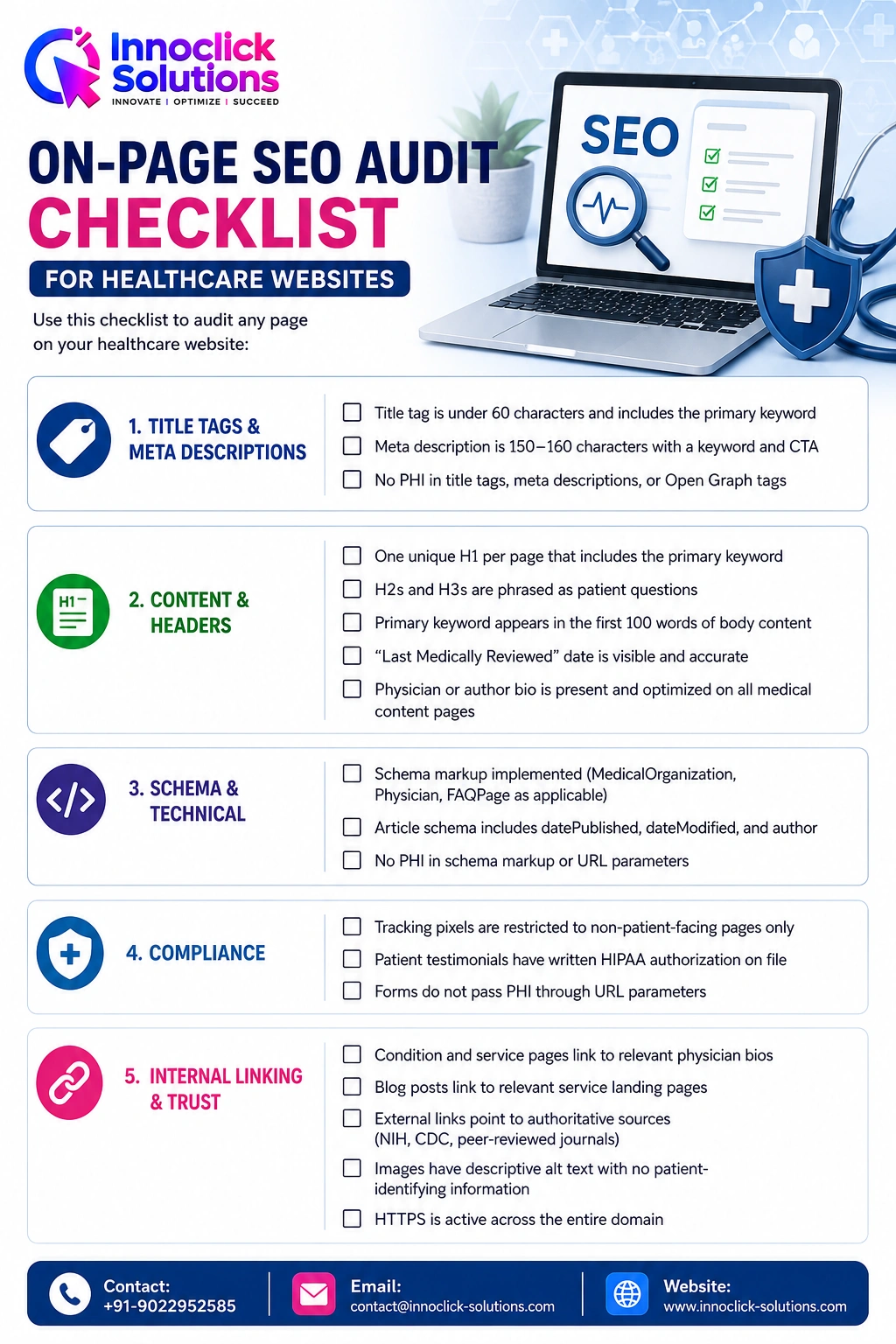
On-Page SEO Audit Checklist for Healthcare Websites

Conclusion
On-page SEO for the healthcare industry is not a one-time technical task — it’s an ongoing commitment to patient trust, clinical accuracy, and regulatory compliance. The websites that earn top rankings in medical search are the ones that demonstrate real expertise through credentialed authors, maintain content freshness with “Last Medically Reviewed” dates, implement the right schema markup, and keep every on-page element HIPAA-safe.
Start with your most important patient-facing pages — your top condition pages, service lines, and provider bios. Apply the E-E-A-T and HIPAA frameworks covered in this guide, run the checklist, and optimize systematically.
Ready to audit your healthcare website’s on-page SEO? Contact the team at innoclick-solutions.com for a free healthcare SEO audit, or explore our related guides below to go deeper on any of these strategies.


Shivraaj Dhaygude is a Pune-based SEO Specialist with over 6+ years of hands-on experience helping local businesses dominate Google Search and AI-powered results. He specializes in Local Pack optimization, Google AI Overview visibility, and Generative Engine Optimization (GEO) — an emerging discipline focused on appearing inside AI-generated search answers.
Shivraaj has personally led SEO campaigns for 50+ SMBs across Pune and Maharashtra, consistently delivering top-3 local pack rankings and measurable increases in organic leads. His approach combines technical SEO foundations with AI search readiness strategies, giving clients a competitive edge as search evolves.
He writes about local SEO, GEO, and AI search trends based on real client data and ongoing experimentation — not theory.