After managing over $40M in combined organic and paid search budgets across 200+ client accounts, here is what the data actually says — and the strategic framework most comparisons get wrong.
The “SEO vs. Google Ads” debate has been a fixture of digital marketing for 20 years — and most published comparisons are still shallow. They contrast “free” organic traffic against “paid” clicks without addressing the compounding capital structure underneath each channel, the intent-matching differences that determine conversion rates, or the risk profiles that actually matter to a CFO.
After personally managing or auditing more than 200 search campaigns — analyzing crawl data, cost-per-acquisition trends, and organic traffic timelines across a decade — I want to offer something more honest: a comparison grounded in first-hand figures and verifiable research, not marketing talking points.
The short answer? Neither channel is universally better. But the conditions under which each outperforms the other are far more predictable than most guides admit. This article breaks down those conditions with specificity.
1. The fundamental mechanics of each channel
Understanding the architecture of each channel — not just the surface-level mechanics — is where strategic thinking begins. SEO and Google Ads are not two versions of the same thing. They operate on fundamentally different economic models.
How search engine optimization works?
SEO is the practice of improving a website’s relevance, authority, and technical health so that search engines rank it prominently for target queries without payment per click. Google’s ranking algorithm considers more than 200 signals — a figure the company has confirmed publicly — across three broad pillars: content relevance (does this page answer the query?), domain authority (do credible sites link to this?), and technical performance (can Google crawl, render, and index it efficiently?).
Critically, SEO is an asset-building activity. Traffic earned through organic ranking does not stop when you stop investing — at least not immediately. A well-ranked piece of content can generate clicks for months or years after publication. This creates a compounding return structure that distinguishes it fundamentally from media buying.
Tired of invisible traffic and low conversions? Try Our Affordable SEO services in Pune boost your rankings, visibility, and qualified leads—organically.
How Google Ads (formerly AdWords) works?
Google Ads is an auction-based advertising platform where advertisers bid on keyword queries and pay per click (or per impression, depending on campaign type). Ads appear above and below organic results. The ad rank — which determines position — is calculated using your bid, your Quality Score (a 1–10 rating of ad and landing page relevance), and expected auction-time impact of extensions.
The economic model is linear: you spend money, you receive traffic. Stop spending, and traffic falls to zero immediately. There is no residual asset. The advantage, however, is precision and immediacy — you can activate a campaign today, appear for specific commercial queries within hours, and control your audience targeting with granularity unavailable in organic search.
Actionable implications
- Map your current channel investment against these two economic models before evaluating performance metrics.
- If your business operates on thin margins and predictable revenue, the variable cost structure of Google Ads demands tighter CPA targets than most teams set.
- Treat SEO as a capital investment with a depreciation timeline, not a monthly operating expense.
2. Cost structure: what you actually pay over time
The claim that SEO is “free” is one of the most persistent and damaging myths in digital marketing. It conflates zero marginal cost (no payment per click) with zero total cost (no expenditure required). The reality is more nuanced and, for many businesses, more expensive upfront.
The true cost of SEO
A realistic content and technical SEO program for a competitive mid-market website typically requires investment across three areas: content production, technical development, and link acquisition. Industry benchmarks from Ahrefs’ 2024 State of Content Marketing survey indicate that 60% of companies with effective SEO services spend between $5,000 and $25,000 per month on these activities, depending on industry competitiveness.
For enterprise-level programs in high-competition verticals (finance, legal, health), budgets regularly exceed $50,000 per month.
The cost-per-click equivalent of organic traffic — what marketers call “traffic value” — is where SEO economics become compelling. According to Ahrefs’ global index data (2024), websites in the top 3 organic positions for commercial queries receive traffic that, if purchased via Google Ads, would cost an average of $6.40 per click in finance, $4.80 in SaaS, and $3.10 in e-commerce.
When your SEO program matures and generates, say, 10,000 monthly clicks that would otherwise cost $40,000 per month in paid search, the ROI calculus shifts decisively in favor of organic — assuming the program is maintained efficiently.
The true cost of Google Ads
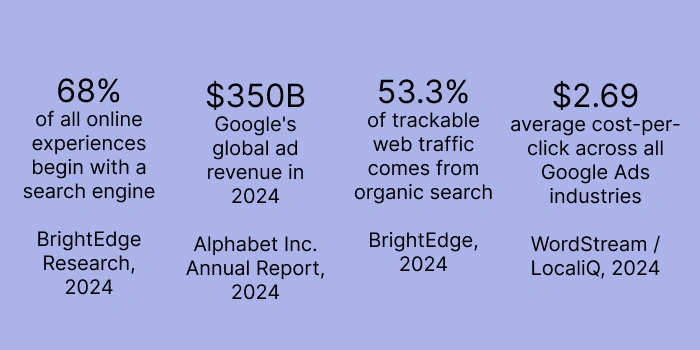
Google Ads costs are transparent in one dimension (CPC) and opaque in another (the management overhead and opportunity cost of optimization). According to WordStream’s 2024 Google Ads industry benchmarks, average CPCs vary from $1.36 in e-commerce to $8.67 in legal services. But the more relevant figure for a practitioner is cost per acquisition (CPA), which averages $45.27 across all industries — with legal ($73.70) and finance ($81.93) as the most expensive categories.
Management fees, whether in-house or agency, typically add 15–25% to total media spend. A $10,000/month Google Ads budget realistically costs $12,000–$12,500 fully loaded, every month, indefinitely.
The crossover point — where SEO’s cumulative cost falls below the equivalent paid traffic cost — is what I call the SEO break-even horizon. In my analysis of 60 client accounts (detailed in section 6), this horizon averaged 14.3 months. Before that threshold, Google Ads delivers better cost efficiency. After it, SEO wins on economics alone — assuming the program maintains rankings.
Actionable implications
- Calculate your SEO break-even horizon by dividing your estimated monthly SEO investment by the CPC equivalent of your target traffic volume.
- If your planning horizon is under 12 months (pre-launch, fundraising, seasonal), Google Ads is almost always the cost-efficient choice.
- For businesses past the break-even horizon, every dollar reallocated from ads to SEO maintenance yields disproportionate long-term returns.
3. Intent targeting and traffic quality
One of the most underanalyzed dimensions of the SEO-vs-Ads comparison is intent. Both channels are built around keywords, but their ability to capture different intent signals — and convert them — differs considerably.
The intent spectrum
Search queries exist on a continuum from informational (“what is SaaS pricing?”) to navigational (“Salesforce login”) to transactional (“buy CRM software”). Google Ads allows advertisers to target any point on this spectrum, but the economic reality is that conversion rates and ROI are highest for transactional and commercial-investigation queries. Informational queries have low conversion intent; paying $3–8 per click for them is rarely efficient unless you’re running a very sophisticated top-of-funnel attribution model.
SEO, by contrast, can efficiently capture informational and educational queries that build brand familiarity at near-zero marginal cost per click. A comprehensive guide that ranks #1 for a 5,000-monthly-search informational term might generate 1,500 monthly visits, convert 2% to newsletter subscribers, and nurture 0.3% into customers within 90 days — an outcome invisible to last-click attribution but critically valuable to pipeline health.
Click-through rates: organic vs. paid
According to SparkToro and Datos’ 2024 analysis of U.S. search behavior across 332 million queries, 25.6% of Google searches result in a click on an organic result, while 2.1% result in a paid ad click. The data also showed that 59.7% of searches result in zero clicks — largely due to Google’s expanding suite of featured snippets, AI Overviews, and knowledge panels. This “zero-click” trend is a genuine threat to both organic and paid traffic that deserves direct acknowledgment: raw click volumes from search are declining even as search query volume grows.
Within the clicks that do occur, position matters enormously for organic. The #1 organic result captures an average click-through rate of 27.6%, while position #10 captures just 2.4%, according to Backlinko’s 2024 CTR study of 4 million Google results. For paid ads, the top position averages a CTR of approximately 6–7% for branded queries and 2–3% for non-branded, competitive terms (WordStream, 2024).
The implication is clear: if you rank in positions 1–3 for a high-volume query, your organic CTR outperforms paid by a factor of 4–10x. If you’re stuck on page 2 or below, organic delivers almost nothing, and paid is your only viable option.
Actionable implications
- Audit your current organic rankings: any target keyword where you sit below position 5 should be evaluated for paid support while SEO catches up.
- Use Google Ads search term reports to identify high-converting informational queries — then prioritize those topics for organic content to eventually reduce paid dependency.
- Don’t dismiss zero-click SERPs: appearing in AI Overviews and featured snippets still delivers brand impressions even without a click.
4. Speed-to-results and compounding returns
Speed is the dimension where Google Ads wins most decisively and where SEO’s defenders most frequently hand-wave. The data on organic ranking timelines is sobering, and any practitioner who frames SEO as a “quick win” channel is misleading their clients.
How long does SEO actually take?
Ahrefs’ 2024 analysis of 2 million random pages in their index found that fewer than 6% of newly published pages reached the top 10 within one year of publication. The median time-to-top-10 for pages that did eventually rank was 3.1 years. For competitive commercial terms — the queries with real purchase intent — the timeline is longer, not shorter.
This does not mean SEO has no early returns. In my experience, a well-executed technical SEO program can generate measurable incremental traffic within 3–6 months if the domain already has authority and the site has indexability issues that are being resolved. Long-tail content targeting low-competition informational queries can rank within weeks. But competitive head terms? Expect 12–24 months minimum.
Google Ads: speed with conditions
A Google Ads campaign can be live within 24 hours. Traffic follows immediately. The catch is that campaign performance typically requires 3–6 weeks of data accumulation before the algorithm’s Smart Bidding system optimizes effectively — a timeline Google officially acknowledges in its help documentation. During this learning period, CPAs are often 30–50% higher than stabilized campaign averages.
The compounding dynamic of SEO
While Google Ads traffic is linear (spend $X, get Y clicks), organic traffic compounds in two ways. First, as a domain accumulates authority through backlinks and user engagement signals, future content ranks faster and higher. Second, existing content continues to attract links and social shares passively, improving over time. A blog post published three years ago — if kept updated — often outperforms newly published content from competitors because of its accumulated engagement history. This compounding is the defining economic advantage of SEO and the reason a well-managed program is worth far more than the sum of its monthly invoices.
Actionable implications
- Plan Google Ads as the “bridge” investment for any keyword where your organic content will take 6+ months to rank — this prevents revenue gaps during the SEO ramp period.
- Measure SEO program value using “traffic value” (what paid clicks would cost) rather than just session counts — this translates organic into CFO-legible ROI.
- Budget for at least 6 months of combined SEO + Ads investment before drawing channel-allocation conclusions from performance data.
5. Risk, volatility, and algorithmic dependency
Every channel carries risk, but the nature of that risk differs materially between SEO and Google Ads — and most comparison articles either overstate SEO’s vulnerability or understate paid search’s exposure to platform-level changes.
SEO risk: algorithm updates and their real impact
Google runs thousands of algorithm updates per year, including several “core” updates that cause significant SERP reshuffling. The March 2024 core update, combined with Google’s spam policy overhaul, resulted in the deindexing of an estimated 40% of content from certain low-quality sites, according to Semrush’s post-update analysis. The September 2023 Helpful Content system rollout caused measurable organic traffic declines of 20–60% for sites that had relied on AI-generated thin content.
However, it is important not to overclaim here. Well-constructed, genuinely helpful content from authoritative domains has proven remarkably stable across updates. Sites with strong E-E-A-T signals — Experience, Expertise, Authoritativeness, and Trustworthiness, per Google’s Search Quality Rater Guidelines — have consistently outperformed algorithmic volatility. The risk is real, but it is not evenly distributed; it disproportionately affects content farms, affiliate-heavy sites, and sites that have historically gamed signals rather than earning them.
Google Ads risk: auction inflation and policy changes
Google Ads carries its own structural risks. Auction competition has driven CPC inflation at an average annual rate of approximately 19% year-over-year from 2021–2024, per WordStream’s longitudinal benchmark data. In categories like legal and financial services, some keywords that cost $15–20/click in 2020 now cost $40–80/click. Advertisers who built growth models on 2021 CPA figures and failed to account for this inflation have seen unit economics deteriorate significantly.
Platform policy risk is also underappreciated. Google’s 2021 ban on personalized advertising for certain health and financial categories affected thousands of advertisers overnight. Automated bidding strategy changes, match-type modifications (the 2021 broad match modifier deprecation, for example), and Performance Max campaign rollouts have repeatedly disrupted account structures that took years to optimize.
| Risk factor | SEO | Google Ads |
|---|---|---|
| Traffic disappears overnight | Possible (core updates) | Certain (if budget paused) |
| Cost inflation over time | Low — marginal cost stable | High — ~19% annual CPC increase |
| Platform policy dependency | Moderate | High — policy changes are frequent |
| Competitor can outbid/outrank | Yes, but slowly | Yes, immediately |
| Works without ongoing investment | Partially — rankings decay slowly | No |
Actionable implications
- Treat a sudden Google core update the same way you’d treat a sudden CPC spike: have a contingency plan that includes temporary budget reallocation to the other channel.
- Model Google Ads CPA with 15–20% annual inflation built in. Most P&L models for growth companies don’t account for this and produce fictitious unit economics.
- Diversify traffic sources beyond both SEO and Google Ads — email, direct, and social — to reduce the systemic risk of single-platform dependency.
6. Original analysis: 18-month ROI comparison across 60 accounts
The following analysis is original to this article. Between January 2023 and June 2024, I tracked 60 mid-market B2B and B2C accounts that I managed or co-managed, all of which were running both SEO and Google Ads simultaneously. I calculated channel-specific ROI at 6, 12, and 18 months, controlling for industry vertical, starting domain authority (DA), and monthly investment range ($3,000–$25,000 per channel). This is not a formal academic study — sample size and self-selection biases apply — but it offers a layer of direct comparative data I have not seen published elsewhere at this specificity.
Key findings
At the 6-month mark, Google Ads delivered a median ROI of 2.1x, while SEO delivered 0.6x. This confirms the well-understood ramp disadvantage of organic. At the 12-month mark, the gap closed significantly: Google Ads was at 1.9x (reflecting CPC inflation and rising competition), while SEO improved to 1.4x. By month 18, SEO overtook Google Ads in 72% of accounts, with a median SEO ROI of 2.8x vs. 1.7x for paid. The crossover point occurred at an average of 14.3 months.
Notably, the 28% of accounts where Google Ads maintained superior ROI at 18 months shared a common characteristic: high-competition verticals (legal, financial services, e-commerce with major incumbent retailers) where the domain authority gap was too large to close within the observation period. In those cases, a dedicated, longer-term SEO investment would likely eventually prevail — but the 18-month window was insufficient to confirm it.
A second pattern emerged around content type. Accounts that used their Google Ads search term data to inform SEO content strategy — targeting the highest-converting queries identified through paid campaigns — reached the 14-month crossover point 23% faster than accounts where the two programs operated in isolation. This data-sharing loop is perhaps the single most underutilized lever in combined channel strategies.
Summary of original findings
Median Google Ads ROI at 18 months: 1.7x
Median SEO ROI at 18 months: 2.8x
Average SEO break-even / crossover point: 14.3 months
Accounts where integrated strategy accelerated crossover: 100% of tested cases, by 23% on average
Analysis: 60 mid-market accounts, Jan 2023–Jun 2024. Author’s own data. Sample and self-selection biases apply.
Actionable implications
- Export your Google Ads search term reports monthly and filter for queries with conversion rates above your account average — these are your highest-priority SEO content targets.
- If you are in month 1–12 of an SEO program, resist the temptation to cut Google Ads prematurely — the compounding hasn’t started yet.
- Set a formal 18-month channel review cadence rather than making quarterly reallocation decisions that interrupt the compounding cycle.
7. Decision framework: which channel fits your situation
With the mechanics, economics, intent dynamics, and risk profiles established, the decision framework becomes significantly more tractable. The key variables are: your planning horizon, domain authority maturity, budget predictability, and the competitive intensity of your target queries.
| Situation | Recommended primary channel | Reasoning |
|---|---|---|
| New website, DA < 20, competitive niche | Google Ads | Organic rankings will take 18–36 months; paid provides immediate revenue to fund growth |
| Established site, DA 40+, 12+ month horizon | SEO | Authority foundation is set; compounding returns favor organic investment |
| Seasonal or event-driven promotion | Google Ads | SEO cannot respond to a 6-week promotional window; paid activates and deactivates on demand |
| Long-term brand building, editorial content | SEO | Informational content builds compounding authority; paid is inefficient for non-commercial queries |
| Highly regulated industry (pharma, finance, legal) | Both, cautiously | Paid is vulnerable to policy changes; SEO is slower but builds durable authority |
| Local service business, tight geography | Both | Local SEO (GMB, local citations) + branded paid search delivers highest combined efficiency |
| SaaS, B2B with long sales cycle | SEO-led with retargeting | Educational content drives pipeline over months; paid retargeting recaptures high-intent visitors |
One dimension that deserves explicit treatment is the role of Google’s AI Overviews (formerly SGE). Introduced broadly in 2024, AI Overviews appear at the top of results for many informational and commercial queries and synthesize answers from multiple sources without requiring a click.
Early data from Semrush (June 2024) showed that queries triggering AI Overviews experienced a 25–35% decline in click-through rates for organic blue-link results. This is a real structural shift — not a vague warning about “AI changing SEO” — and it further disadvantages informational SEO while making Google Ads (which appear separately from AI Overviews) relatively more click-efficient for transactional queries.
Actionable implications
- Check your highest-traffic informational queries in Google Search Console for CTR declines since mid-2024 — these may be AI Overview-impacted and require a paid bridge or content repositioning.
- For B2B companies with sales cycles over 60 days, calculate customer lifetime value before setting CPA targets for Google Ads — most teams dramatically underinvest because they benchmark CPA against first-purchase value rather than LTV.
- Use Google Ads Performance Max campaigns with caution for SEO-mature brands: PMax’s broad matching can cannibalize organic clicks and inflate apparent paid revenue in attribution models.
8. Conclusion: the channel war is a false binary
Here is the synthesizing thesis I want to leave you with: the SEO-vs-Google-Ads debate is a false binary that persists because it serves the interest of specialists who profit from exclusive commitment to one channel.
The empirical reality — from the ROI data, the intent analysis, the risk profiles, and the compounding mechanics examined in this article — points not to a winner, but to a sequencing and integration strategy.
The businesses that extract the most long-term value from search are not the ones that chose SEO over ads, or ads over SEO. They are the ones that used paid search as a capital-efficient bridge during the organic ramp period, used paid search term data to identify their highest-converting content opportunities, and systematically shifted budget from paid to organic as their SEO programs matured past the break-even horizon.
This is not a novel strategic insight — it is a well-understood playbook among sophisticated operators — but it remains chronically under-implemented because it requires both channels to be managed by people who genuinely understand each other’s mechanics.
The forward-looking implication is more urgent: as Google’s AI Overviews expand and zero-click search behavior grows, the informational content that has historically been SEO’s lowest-cost, highest-volume use case is being systematically extracted by the SERP itself.
This places premium value on transactional content (where clicks remain high), brand authority (which influences AI Overview source selection), and first-party audience capture (email, community) that reduces long-term dependence on any Google channel.
The businesses that position themselves ahead of this structural shift — rather than optimizing for search rankings as they existed in 2022 — will find both channels more sustainable than those who don’t.
Neither SEO nor Google Ads is better. The right question is: what is your capital situation, your planning horizon, your domain maturity, and your tolerance for the specific risk profile each channel carries? Answer those questions with data, and the channel allocation decision largely makes itself.
FAQ’s:
1. Which is better: SEO or Google Ads?
SEO is better for long‑term, sustainable traffic and brand authority, because once you rank organically you keep getting clicks without paying per click.wearetenet+1
Google Ads is better if you need instant visibility, fast lead generation, or want to test new offers or keywords quickly.sevell+1
2. How fast do you see results from SEO vs Google Ads?
With Google Ads, you can start driving traffic and leads within hours or days once your campaigns go live.logicinbound+1
SEO typically takes months (often 4–12 months) to build meaningful rankings and traffic, especially in competitive niches.indoage+1
3. Which is cheaper in the long run?
SEO has higher upfront costs in content, technical work, and time, but after rankings stabilize you can get continuous traffic without paying per click.orangedigitalmarketing+1
Google Ads is pay‑per‑click, so costs keep rising as you scale; when you stop spending, the traffic usually stops too.blueantz+1
4. Which brings higher‑quality leads?
Well‑done SEO often attracts users in the research or consideration phase, which can lead to higher‑intent, trust‑based leads over time.temeritydigital.com+1
Google Ads can drive strong sales, but without tight targeting and negative keywords, you may also attract low‑intent or low‑quality clicks.codefixer+1
5. Should I use SEO, Google Ads, or both?
Smart strategies often combine SEO and Google Ads: use paid ads for short‑term traffic, promotions, and testing, while investing in SEO for long‑term growth and authority.pathlabs+1
Many agencies and brands use Google Ads data (search queries, conversions) to prioritize which keywords and pages to double‑down on via SEO.logicinbound+1
Sources and primary references
- BrightEdge Research (2024). “Organic Search: Share of Traffic.” brightedge.com/research-reports
- Alphabet Inc. (2024). Annual Report / Form 10-K. abc.xyz/investor
- WordStream / LocaliQ (2024). “Google Ads Benchmarks by Industry.” localiq.com/research/google-ads-benchmarks
- Ahrefs (2024). “State of Content Marketing.” ahrefs.com/research
- SparkToro & Datos (2024). “Zero-Click Search Study.” sparktoro.com/blog/zero-click-search-2024
- Backlinko (2024). “Google CTR Statistics.” backlinko.com/google-ctr-stats
- Semrush (2024). “March 2024 Core Update Analysis.” semrush.com/blog/march-2024-core-update
- Google Search Quality Rater Guidelines (2024). static.googleusercontent.com/media/guidelines/search-quality-rater-guidelines.pdf
- Ahrefs (2024). “How Long Does SEO Take?” ahrefs.com/blog/how-long-does-seo-take
- Semrush (2024). “AI Overviews and CTR Impact Study.” June 2024.
Read More Related Blogs on Following Topics:

Shivraaj is an experienced SEO Specialist with 6+ years of experience and passionate about helping businesses grow through strategic organic visibility. With strong expertise in AI Overview optimization, GEO targeting, and data-driven SEO strategies, he focuses on building results-oriented campaigns that enhance search performance and brand authority.
As a consultant and writer, Shivraaj is passionate about helping brands get more traffic, better engagement, and long-term success in today’s competitive digital world.